

Imagine your vessel's electrical system fails fifty miles offshore. Your primary water maker is now a multi-thousand dollar paperweight. In this moment, the only thing between you and life-threatening dehydration is the mechanical reliability of your personal desalination unit. You understand that at sea, complexity is a liability. Relying on batteries or fuel during a crisis creates a single point of failure. You can't afford that risk. It's the difference between a controlled situation and a true emergency.
This 2026 guide will help you master the technology and selection criteria for portable seawater survival. You'll learn how to secure a life-saving freshwater supply that operates entirely independently of your boat's power grid. We'll break down the engineering of manual reverse osmosis. We'll explore how to achieve 60 bar pressure with human power alone. Finally, we'll explain why the QuenchSea 3.0 is the essential redundancy for any yacht or life raft. We're moving past expensive, fragile electronics. We're focusing on what actually works when the power goes out.
Key Takeaways
- Understand why a personal desalination unit is the critical redundancy for the maritime 'Rule of 3' survival hierarchy.
- Discover the engineering behind manual reverse osmosis and how to maintain the 60 bar pressure required to reject 98% of dissolved salts.
- Compare manual, electric, and solar power sources to determine which system offers the highest reliability for life raft or yacht storage.
- Learn operational best practices for source water selection to protect your membrane from silt and sediment damage.
- Explore the technical specifications of the QuenchSea 3.0, which produces 5 to 8 liters of freshwater per hour without fuel or batteries.
What is a Personal Desalination Unit and Why is it Essential?
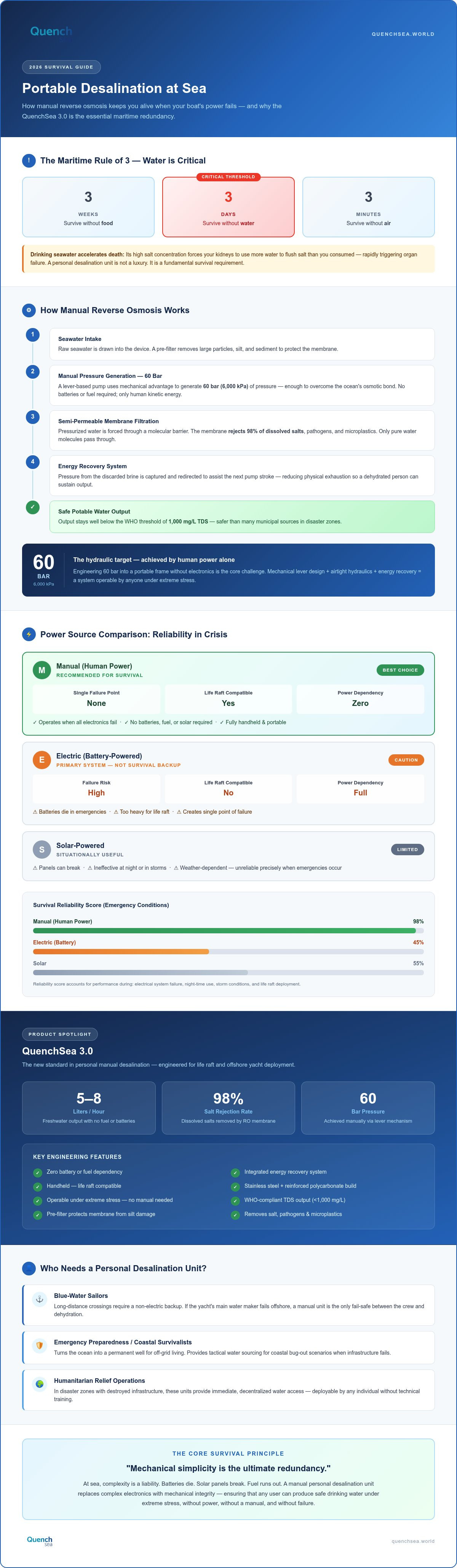
A personal desalination unit is a compact, man-portable device engineered to convert raw seawater into potable freshwater. Unlike industrial-scale systems, these units are designed for individual or small-group survival. They utilize How Manual Reverse Osmosis Works to strip dissolved salts and pathogens from the ocean. In the maritime 'Rule of 3' survival hierarchy, water is your most critical consumable asset. You can survive three weeks without food, but only three days without water. A personal desalination unit bridges that lethal gap when your primary supply fails.
Drinking seawater is a biological death sentence. The high salt concentration forces your kidneys to use more water to flush the salt out than you actually consumed. This accelerates dehydration and leads to rapid organ failure. A personal desalination unit stops this cycle. It transforms a limitless but toxic resource into a life-sustaining supply. For anyone operating more than a few miles from shore, this technology isn't a luxury. It's a fundamental requirement for self-reliance.
The Survival-Grade Mandate: Reliability Over Convenience
True survival gear must function when everything else fails. Batteries die. Solar panels break. Fuel runs out. A manual personal desalination unit relies on human kinetic energy. It replaces complex electronics with mechanical integrity. We distinguish between truly portable handheld units and "luggable" electric versions. If you can't carry it in a life raft or a bug-out bag, it isn't a survival tool. It's just equipment. High-quality manual units are engineered to achieve 60 bar pressure using only physical effort. This simplicity ensures that any user can produce water under extreme stress without a manual or a power source.
Key User Groups for Portable Desalination
These units serve distinct groups who prioritize readiness in harsh environments:
- Blue-water sailors: Long-distance crossings require a non-electric backup. If the yacht’s main water maker fails, a manual unit is the only fail-safe.
- Emergency Preparedness: Coastal survivalists use these for tactical water sourcing. It turns the ocean into a permanent well for off-grid living.
- Humanitarian Relief: In disaster zones with destroyed infrastructure, these units provide immediate, decentralized water access.
Whether you're packing a life raft or securing a coastal bug-out bag, the goal remains the same. You need a tool that works every time. Mechanical simplicity is the ultimate redundancy.
How Manual Reverse Osmosis Works: The Engineering of Survival
Reverse osmosis (RO) is the benchmark for seawater purification. It forces saltwater through a semi-permeable membrane to overcome natural osmotic pressure. In a personal desalination unit, you generate this force manually. The membrane acts as a molecular barrier. It rejects 98% of dissolved salts and allows only pure water molecules to pass. This process ensures the output stays well below the World Health Organization (WHO) threshold of 1,000 mg/L for Total Dissolved Solids (TDS). High-quality units produce water that's safer than many municipal sources in disaster zones.
Desalinating ocean water requires intense force. You must achieve 60 bar (6,000 kPa) of pressure to overcome the salt's osmotic bond. Engineering this into a portable frame is a significant feat. Manual levers in a personal desalination unit use mechanical advantage to amplify human effort. Some devices integrate energy recovery systems. These systems capture the pressure from the discarded brine and redirect it to help the next pump stroke. This reduces physical exhaustion. Survival hardware must use rugged materials like stainless steel and reinforced polycarbonates. The precision involved in creating these high-performance materials is comparable to the standards met by a semiconductor grade acids supplier for industrial applications. Flimsy components can't withstand the 6,000 kPa internal environment.
Achieving 60 bar pressure manually isn't just about strength. It's about efficiency. The hydraulic system must be airtight and friction-resistant. High-performance units use a unique piston design to maintain consistent flow. Without energy recovery, pumping would be too exhausting for a dehydrated person. By recycling internal pressure, the workload becomes manageable for sustained periods. This mechanical sophistication ensures that the device remains a tool for survival rather than a source of physical collapse. Understanding the QuenchSea 3.0 technical design reveals how this hydraulic efficiency is achieved in a compact form.
Filtration Beyond Salt: Pathogens and Microplastics
Ocean water contains more than just salt. Survival-grade systems utilize a triple filtration architecture. Before the water reaches the RO membrane, it passes through micro-filtration and ultra-filtration stages. These pre-filters remove microplastics, silt, and sediment. They also eliminate biological threats like bacteria, cysts, and viruses. This sequence is vital for the device's lifespan. If raw sediment reaches the delicate RO membrane, it causes immediate fouling. Effective pre-filtration protects your primary asset and ensures long-term reliability in murky coastal waters.
Manual vs. Electric vs. Solar: Choosing for Reliability
Selecting a water maker for a survival scenario requires a cold assessment of failure points. In a maritime environment, complexity is your enemy. Electric units offer convenience but rely on 12V/24V systems. These systems are highly susceptible to salt-air corrosion and circuit failure. Solar units introduce fragile photovoltaic panels and require clear skies to function. A manual personal desalination unit eliminates these external dependencies. It relies on the only resource guaranteed to be present: you. This "user as engine" philosophy ensures that as long as you can move, you can drink.
Maintenance is another critical differentiator. Batteries have a finite shelf life and discharge over time. Membranes in electric systems often require complex chemical pickling for long-term storage. Manual units are simpler. Their mechanical nature allows for rapid deployment without checking charge levels or hunting for cables. While the initial investment in an electric system is high, the life-saving potential of a manual backup provides a superior return on investment for emergency preparedness. You're buying certainty, not just a gadget.
The Failure Point Analysis
Electronic units face a high risk of failure in abandon-ship scenarios. Submersion or heavy spray can short-circuit a 12V pump instantly. Solar-powered systems are tethered to the weather; cloud cover or panel damage renders them useless. In contrast, manual units prioritize mechanical integrity. There are no circuit boards to fry and no cells to crack. The reliability of a manual personal desalination unit depends entirely on physical presence. This makes it the only truly fail-safe option for a grab bag or life raft. It's a tool built for the worst-case scenario, not the best one.
Output vs. Portability Trade-offs
Fixed water makers produce high volumes but offer zero utility once you leave the vessel. In an abandon-ship situation, portability is non-negotiable. A compact unit producing 5 to 8 liters per hour provides sufficient hydration for a 4-person crew. This output exceeds the minimum survival requirements and allows for a buffer in extreme heat. Understanding your Life Raft Water Supply needs is essential for choosing the right gear. Weight and footprint matter. A device that fits in a standard dry bag is far more valuable than a high-output machine left bolted to a sinking hull. Efficiency must be measured by what you can carry.
Operational Best Practices: Maximizing Your Water Output
Operating a personal desalination unit in a high-stress environment requires more than muscle. It requires a tactical approach to energy management. To maintain the necessary 60 bar pressure, you must adopt a steady, rhythmic cadence. Rapid, frantic pumping leads to early muscle failure and irregular pressure spikes. Instead, focus on full, controlled strokes. This maximizes the hydraulic efficiency of the device while minimizing your caloric expenditure. You're balancing the energy spent against the hydration gained. In a survival situation, every calorie counts.
Source water selection is your first line of defense. While the unit is designed for raw seawater, intake quality directly impacts membrane longevity. Avoid water with visible oil slicks, heavy silt, or thick algae. These contaminants cause rapid fouling of the pre-filters. If you're near a coast, draw water from deeper, clearer areas whenever possible. This simple step ensures you maintain the 5 to 8 liters per hour output without needing frequent filter changes. Protecting the membrane is protecting your life.
Maintenance and Membrane Care
Salt is the primary enemy of stored survival gear. After every use, you must flush the system with freshwater to prevent salt crystallization. For long-term readiness in a bug-out bag, use a pickling solution to inhibit biological growth. If you experience a sudden pressure drop, check for air locks in the intake line. Reliable water production depends on these disciplined maintenance habits. Consistent care ensures the personal desalination unit is ready the moment you need it. Neglecting post-use flushing will lead to permanent membrane damage.
Tactical Deployment in Emergency Situations
In a survival scenario, your "Hydration ROI" is the most important calculation. You must produce water before you reach the point of severe dehydration. Waiting to pump until you are physically weak is a critical error. Implement a crew rotation strategy to share the physical workload. This keeps the unit running consistently while allowing individuals to recover. Learn more about balancing Emergency Drinking Water at Sea to optimize your survival strategy. For those building a fail-safe kit, you can secure a QuenchSea 3.0 to ensure your team remains hydrated and operational.
QuenchSea 3.0: The New Standard for Personal Desalination
The QuenchSea 3.0 represents the culmination of survival-grade engineering. It's the most accessible manual RO desalinator on the market. This personal desalination unit is built for the extreme. It delivers 5 to 8 liters of freshwater per hour. This output is achieved with a consistent 98% salt rejection rate. The design is ultra-compact and weighs significantly less than traditional electric water makers. It fits into standard emergency grab bags without compromising on hydraulic power. This isn't just a backup tool. It's a primary lifeline for those in the world's most challenging environments. Our mission is to provide clean water to 100 million people by 2035 through this low-cost innovation.
Durability is the core of the QuenchSea 3.0 philosophy. The device features a Red Dot Award-winning design that prioritizes mechanical integrity over aesthetic fluff. It's engineered to withstand the corrosive reality of the marine environment. Every component is tested to handle the intense 60 bar pressure required for reverse osmosis. This level of reliability is why defense organizations and humanitarian groups trust this hardware for rapid deployment. It functions without batteries. It operates without fuel. It simply works when you need it most.
Why QuenchSea 3.0 Leads the 2026 Market
Legacy manual units often required excessive physical force that exhausted dehydrated users. QuenchSea 3.0 solves this with an optimized hydraulic system. It reaches the necessary 60 bar pressure with significantly lower physical effort. The triple filtration advantage is another critical differentiator. By utilizing ultra and micro-filtration, the device ensures safe water even in murky coastal environments. During high-stress emergencies, clarity of operation is vital. The unit features simple pictorial instructions. This design allows anyone to produce water effectively without needing a technical manual or an external power source.
Integrating QuenchSea into Your Safety Protocol
Every vessel needs a redundant water source that doesn't rely on the boat's electrical grid. This device is the essential addition to any survival desalination device kit. It supports yachting backups, life raft readiness, and off-grid coastal survival. Its portability means you can take your water source with you if you're forced to abandon ship. This level of empowerment is what defines modern maritime safety. Don't leave your hydration to chance or aging batteries. Secure your QuenchSea 3.0 Desalination Device today.
Secure Your Independent Water Supply
Reliability in extreme environments is not a coincidence. It is the result of deliberate engineering and mechanical simplicity. You now understand that a manual personal desalination unit is the only fail-safe redundancy for blue-water sailing and emergency grab bags. By prioritizing human-powered hydraulics over fragile electronics, you eliminate the risk of battery failure or salt-air corrosion. Success at sea depends on your ability to produce freshwater regardless of the weather or your vessel's power state.
The QuenchSea 3.0 stands as a Red Dot Design Award winner for a reason. It is a field-tested tool used by marine professionals and NGOs worldwide to ensure survival in the most hostile conditions. With a 98% salt rejection rate guaranteed, it provides the technical confidence you need when the stakes are highest. Don't leave your hydration to chance or complex systems that require fuel to function. Equip your life raft with the QuenchSea 3.0 today and take command of your survival. You have the knowledge and the tools. Prepare now and sail with the confidence of total self-reliance.
Frequently Asked Questions
Can I drink the water produced by a personal desalination unit immediately?
Yes. Water produced by a high-quality personal desalination unit is safe for immediate consumption. The reverse osmosis process removes 98% of dissolved salts and particulates. If you stored the device using a chemical preservative or pickling solution, you must flush the system for several minutes before drinking. Always monitor the taste. If the output remains salty, the membrane is likely compromised. Consistent output ensures your survival in high-stakes maritime environments.
How much physical effort is required to operate a manual water maker?
Operating a manual water maker requires consistent physical exertion to maintain 60 bar pressure. It's not effortless. However, modern designs like the QuenchSea 3.0 utilize hydraulic efficiency to make the task manageable for a single person. You should aim for a rhythmic pumping cadence rather than short bursts of speed. This prevents early fatigue. In a life raft scenario, rotating crew members every 20 minutes ensures a continuous freshwater supply.
How long does the RO membrane last in a portable desalination device?
A standard RO membrane typically lasts between one and two years with proper maintenance. Its lifespan depends heavily on the quality of the source water and the frequency of freshwater flushing. Silt and oil are the primary causes of membrane fouling. Utilizing triple filtration stages protects the delicate membrane from premature failure. If the salt rejection rate drops below 95%, you must replace the membrane to ensure water safety.
Does a personal desalination unit remove bacteria and viruses?
Yes. A personal desalination unit equipped with a high-quality reverse osmosis membrane effectively removes 99.9% of bacteria, viruses, and cysts. The membrane pores are approximately 0.0001 microns in size. This is significantly smaller than the smallest known biological pathogens. Additionally, the integrated ultra-filtration and micro-filtration stages provide redundant layers of protection. This ensures your drinking water remains safe from biological contaminants even in compromised coastal areas or stagnant survival zones.
Is it possible to desalinate water using only solar power without filters?
No. Desalination requires a method to separate salt from water. While solar stills use evaporation and condensation without mechanical filters, their output is extremely low and insufficient for most survival needs. Reverse osmosis systems, whether manual or electric, require high-pressure membranes and pre-filtration to function. Solar-powered RO units exist but are complex and fragile. For a reliable backup, mechanical simplicity is superior. Avoid relying on filter-free solar methods in life-critical emergencies.
What happens if I use a personal desalination unit in very cold or very salty water?
Extreme conditions impact performance. Very cold water is more viscous. This makes it harder to force through the membrane and increases the physical effort required to pump. High salinity water, such as in the Red Sea, increases osmotic pressure. This may slightly reduce the freshwater output per hour. However, a survival-grade unit is engineered to handle these variables. It will still produce safe water provided you maintain the required 60 bar internal pressure.
Can I use a personal desalination unit for brackish water or lake water?
Yes. You can use these units for brackish or lake water. Reverse osmosis technology is highly effective at removing the lower salt concentrations found in brackish sources. When using lake water, the pre-filtration system becomes critical. It must remove organic matter and sediment to prevent the RO membrane from clogging. While designed for the ocean, the versatility of a manual unit makes it a valuable tool for inland disaster relief and off-grid survival.
How do I store my desalination unit when not in use for long periods?
Proper storage is essential for membrane integrity. Never allow the RO membrane to dry out. After use, flush the unit thoroughly with freshwater to remove all salt traces. For storage exceeding two weeks, you must use a pickling solution or a specific membrane preservative. This prevents the growth of bacteria and mold inside the housing. Seal the unit in a cool, dark place. This preparation ensures your gear is mission-ready for any future emergency.