

What if your freshwater plan still works after the batteries die and fuel runs out? At sea or off-grid, seawater is close at hand, but ordinary filters can’t remove its dissolved salt. A human powered seawater desalinator tackles that problem with pressure: a hand pump pushes seawater through a reverse-osmosis membrane that separates fresh water from salt.
The principle is straightforward, but practical details matter just as much. How much effort does pumping require? How quickly can a system produce water? What preparation and maintenance will help keep it ready when you need it?
This guide explains how manual desalination works, why it differs from basic filtration, and what to compare with electric systems and solar stills. You’ll also learn how QuenchSea 3.0 fits the manual reverse-osmosis category, and how to plan for production, effort, collection, and upkeep before relying on a desalination device as a marine or off-grid backup.
Key Takeaways
- Follow the process from seawater intake to freshwater collection to understand what each operating step involves.
- Compare a human powered seawater desalinator with solar stills and electric water makers by power source, portability, and the role each can play in a backup plan.
- Build readiness before you need water: learn your device, keep its components together, and follow the model-specific instructions for operation and storage.
- QuenchSea 3.0 is a portable, manually powered reverse-osmosis option for marine and off-grid preparedness.
What Is a Human-Powered Seawater Desalinator?
A human-powered seawater desalinator uses physical effort, typically a hand pump, to drive desalination without electricity, batteries, or fuel. In a portable reverse-osmosis system, the pump creates pressure that pushes seawater against a membrane. Some water passes through while much of the dissolved salt stays behind. This differs from solar-thermal systems, which use heat from sunlight, and from large desalination plants built to supply communities or municipalities.
Salt removal and general water purification are not the same thing: desalination reduces dissolved salts, while other treatment steps may be needed to address different contaminants. Don’t assume a desalinator removes every possible biological or chemical hazard. Use the device as directed and assess its output according to its instructions and relevant safety guidance.
A compact unit is best understood as a backup water-production tool, not an unlimited household supply. Manual operation takes effort, and practical output depends on the device and how it’s used. Plan around your group’s water needs, the time and energy available for pumping, and the amount of water you can collect and store safely. A human powered seawater desalinator can reduce dependence on onboard or off-grid power, but it still needs to be ready, accessible, and maintained.
How is desalination different from water filtration?
Seawater contains suspended particles, such as sediment, as well as dissolved salts. A basic particle filter can catch material larger than its openings, but dissolved salt passes through ordinary filters. Desalination targets dissolved salt through processes such as reverse osmosis. The Desalination overview explains the broader range of methods. Filtration and desalination describe different treatment functions, and neither label alone proves that water is safe from every contaminant.
Who may need a manual seawater desalinator?
Manual desalination can suit sailors and offshore travelers who want a water-production option that doesn’t depend on an electrical system or fuel supply. It can also support life-raft preparedness, yacht safety planning, emergency response, disaster relief, defence, and off-grid coastal use. In a life raft, a device needs to fit into a broader water plan that accounts for storage and other supplies. The guide to life raft water supply explores that context.
These are backup scenarios, not a promise of effortless or continuous supply. Before relying on a unit, consider who will operate it, how it will be carried, and whether the group can use it under stressful conditions. A portable manual system fills a specific gap when powered equipment is unavailable. It doesn’t replace sound trip planning, stored water, or a broader emergency-preparedness plan.
How Does a Human-Powered Reverse-Osmosis Desalinator Work?
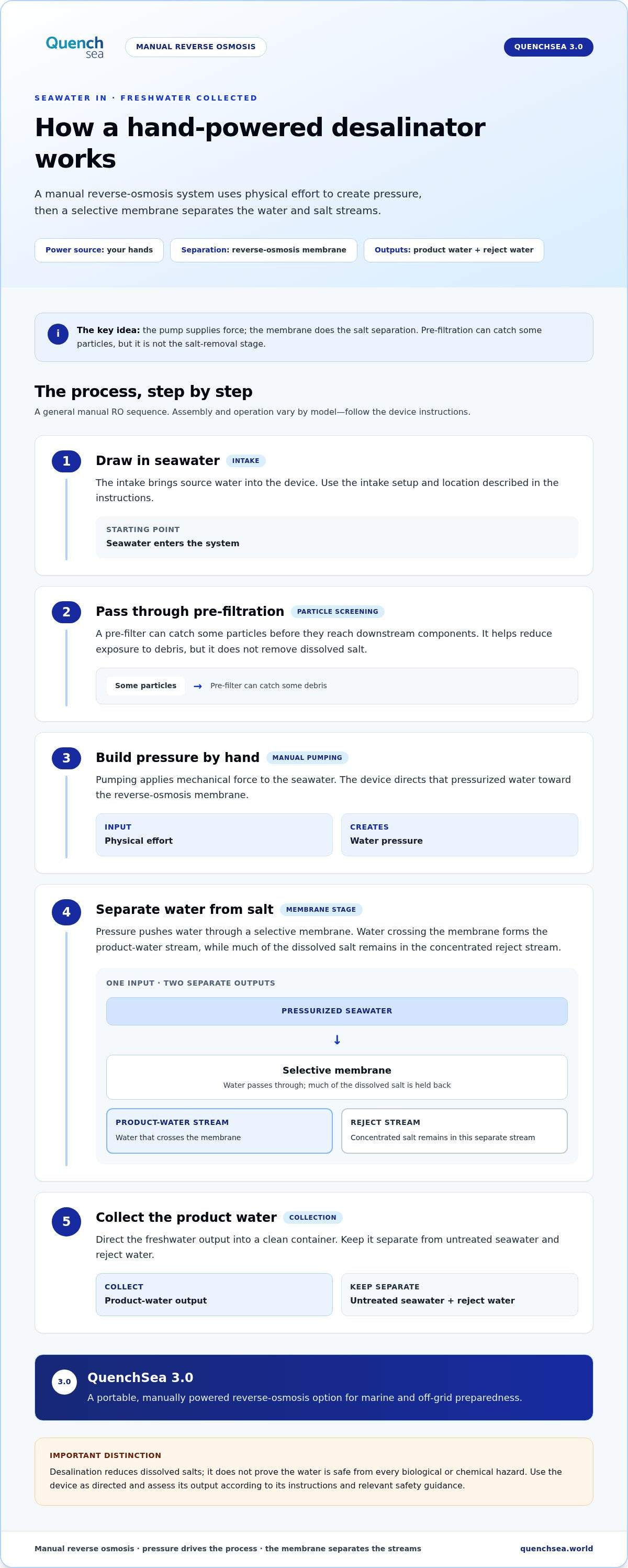
A manual reverse-osmosis system turns repeated physical effort into pressure. That pressure drives seawater through a selective membrane, producing a freshwater stream and a more concentrated reject stream. Assembly and operating steps vary by model, so follow the device’s instructions rather than treating every pump system as interchangeable.
In short, hand-generated pressure pushes water through a selective membrane, which lets water pass while holding back much of the dissolved salt.
- Draw in seawater. The intake brings source water into the device. Use the intake setup and location described in the instructions.
- Pass water through pre-filtration. A pre-filter can catch some particles before they reach downstream components. It helps reduce exposure to debris, but it isn’t the salt-removal stage.
- Build pressure by hand. Pumping applies mechanical force to the seawater. The device directs that pressurized water toward the reverse-osmosis membrane.
- Separate the streams. Water crossing the membrane forms the product-water stream. Much of the dissolved salt remains in the concentrated reject stream.
- Collect the product water. Direct the freshwater output into a clean container, keeping it separate from untreated seawater and reject water.
What role do pressure and the membrane play?
In reverse osmosis, pressure pushes water through a membrane that selectively allows water molecules to cross while retaining much of the dissolved salt. The pump supplies the force; the membrane performs the separation. The U.S. Geological Survey’s Reverse Osmosis Desalination overview explains the process in more detail. For a closer look at a hand-operated application, see this guide to manual reverse osmosis seawater.
Pressure alone doesn’t make freshwater. The membrane and the system’s flow paths determine how water and dissolved material separate. Pre-filtration helps reduce particle exposure for downstream components, but it doesn’t replace the membrane or establish that the collected water is free of every possible contaminant. Use the device as directed and follow model-specific guidance for assessing its output.
What happens to the separated salt?
The salt doesn’t vanish. It remains concentrated in the reject stream, which exits separately from the produced freshwater. A portable desalinator therefore creates two outputs that must not be confused. Follow the manufacturer’s instructions for managing reject water, and don’t assume a small device eliminates all waste or environmental impact.
This hand-pumped process differs from Rochester’s solar-thermal research approach, which uses heat from sunlight to evaporate water and separate it from salt. Both address saline water, but they rely on different mechanisms. To explore a portable manual system built around pressure and reverse osmosis, review the QuenchSea 3.0 desalination device.
Manual Desalinators Compared With Solar and Electric Water Makers
No single desalination method fits every situation. The right choice depends on what power you can rely on, how much space you have, and whether you need emergency backup or a larger ongoing supply. Compare operating demands as carefully as the technology.
| Approach | Power dependency | Portability | Operating effort | Likely role |
|---|---|---|---|---|
| Manual reverse osmosis | Human effort, no electrical supply or fuel needed | Designed for portable use, though size and weight vary by model | Requires hands-on pumping and attention | Backup for marine, emergency, or off-grid use |
| Solar still | Sunlight and suitable conditions | Designs range from simple field setups to larger systems | Less pumping, but relies on exposure and time | Small-scale water production where sunlight is available |
| Electric water maker | Compatible electrical supply | Varies by system and installation | Less manual pumping, with power-system demands | Regular production where electrical power is available |
This is a category-level comparison, not a performance ranking. Product output depends on verified specifications and operating conditions, including how equipment is set up and used. Compare a model’s documented capacity with your actual need instead of assuming all devices in a category produce the same amount.
When does human power offer a practical advantage?
A human powered seawater desalinator can be useful when mains electricity, batteries, or fuel aren’t available or dependable. That independence has a trade-off: producing water takes sustained effort. In a marine backup plan, consider who can operate the unit, how pumping fits around other tasks, and how much water the group needs. It’s a contingency tool, not an effortless source for bulk daily supply.
Think through the full operating scenario. A portable device still needs access to seawater, time for someone to work the pump, and a clean way to collect the output. Planning these details in advance helps you decide whether a manual unit suits the crew and the intended trip.
How does a manual unit differ from solar or electric options?
Solar stills generally use sunlight to heat water, then collect condensed vapor. Their operation depends on suitable sun and differs from membrane-based reverse osmosis. A research-scale solar-thermal system also shouldn’t be treated as equivalent to compact field equipment just because both use solar energy.
Electric water makers depend on a compatible power source, which may suit a vessel or site with reliable electrical capacity. Manual systems shift the energy demand to the operator instead. Choose based on conditions: access to sunlight, available power, portability needs, and willingness to do the work all matter. No approach is universally superior.
How to Prepare and Operate a Manual Seawater Desalinator
A manual unit is most useful when everyone who may need it knows how it works before an emergency. Build readiness in stages: learn the device, keep its parts together, practise the process, and plan how to handle the freshwater. Always follow the exact model’s current instructions for assembly, operation, cleaning, and storage. Designs differ, so a generic routine can’t replace the manufacturer’s guidance.
- Learn the device. Read the instructions and identify the intake, operating controls, freshwater outlet, and maintenance steps. Make sure intended operators understand how to set it up and what normal operation should look like.
- Keep it accessible. Store the unit and its required components together in a location suited to the intended use, such as a vessel’s emergency equipment area. Keep the instructions accessible too.
- Practise under controlled conditions. Run through setup and operation before departure or deployment. Practice can reveal missing components and help operators understand the effort and time involved.
- Collect and store carefully. Use a clean, suitable container for produced water. Keep it separate from seawater and reject-water handling equipment, then follow container guidance and applicable safety advice.
Real-world production can vary. Source-water conditions, the unit’s maintenance state, and the pace an operator can sustain all affect what the system delivers. Treat published output as model-specific information, not a guaranteed amount for every situation. Plan with a margin and maintain other water arrangements rather than assuming the device alone will meet every need.
What should users plan before an offshore or emergency situation?
Start with the people and the scenario. Identify who may operate the device, how long the group may need its backup plan, and how much clean-water storage is available. Keep other water supplies in the plan. Store the unit where it can be reached quickly, and review the latest operating instructions before departure, not for the first time during an emergency. These decisions are part of wider survival desalination device preparedness.
How should users handle produced freshwater?
Prevent cross-contamination at the collection point. Set aside a clean container for freshwater, and don’t use it to scoop seawater or handle the reject stream. Keep openings and contact surfaces clean, close the container after collection, and follow the container maker’s directions for cleaning and storage. Don’t assume a fixed shelf life; storage conditions and container guidance matter.
Practise the procedure, collect water in clean containers, and store it as directed to make a manual desalinator a more dependable backup. For marine or off-grid preparedness, explore the QuenchSea 3.0 desalination device as a portable, manually powered reverse-osmosis option.
QuenchSea 3.0: A Human-Powered Seawater Desalinator for Preparedness
Once you’ve compared power sources, portability, and operating effort, assess a specific device against the conditions you expect to face. QuenchSea 3.0 is a portable, manually powered reverse-osmosis seawater desalination device. It uses hand-generated pressure to produce freshwater without electricity, batteries, or fuel. That places it in the human-powered category, rather than among solar-thermal systems or electric water makers.
The device is designed for marine safety, emergency preparedness, disaster relief, defence, and off-grid coastal use. In these settings, manual operation provides a water-production option when powered equipment isn’t practical. It still requires an operator, proper preparation, and a realistic plan for collection and storage. It’s a backup tool, not a substitute for assessing the group’s full water needs.
Which needs align with QuenchSea 3.0?
QuenchSea 3.0 suits plans where portability and independence from an electrical supply or fuel matter. A yacht crew can include it in a wider marine backup plan; an off-grid coastal user can use a manual option where powered systems aren’t available. Emergency and disaster-relief teams can also assess how its operating method fits their equipment and deployment needs.
Let your intended conditions guide the evaluation. Consider who will operate the unit, how it will be carried, and how produced water will be handled. For a closer look at the device’s documented details, consult this guide to the QuenchSea 3.0 desalination device. Use current product documentation for specifications, including output, and don’t assume results will be identical across operating conditions.
What is the next step for evaluating a manual desalinator?
Match the equipment to your actual plan before relying on it. Review the verified specifications and operating instructions for the exact model. Confirm that intended users can operate it, and consider whether your freshwater containers and storage plan suit the expected use. Keep stored water and other backup arrangements in view; a desalinator is only one part of preparedness.
Base decisions on documented information. Performance depends on the particular device and operating conditions, while water-quality statements and maintenance guidance should come from its current documentation. Don’t infer durability, output, or treatment capabilities from the general label “desalinator.”
A human powered seawater desalinator earns its place in a plan when its operating demands and documented capabilities align with the mission. Explore QuenchSea and assess whether QuenchSea 3.0 fits your marine or off-grid preparedness needs.
Turn Water Planning Into Readiness
A dependable backup starts before conditions become difficult. Decide who may need to produce water, where the equipment will be carried, and how you’ll keep collected water clean. Make sure the people responsible can follow the device’s instructions and understand the effort involved. That preparation turns a human powered seawater desalinator from stored gear into a considered part of your plan.
For marine, emergency, disaster-relief, defence, or off-grid coastal planning, QuenchSea 3.0 offers a portable, manually operated reverse-osmosis option. Compare its documented specifications and operating guidance with your intended use, then include it in a broader water-supply plan with clean storage and other backup arrangements.
Take the next step and assess whether this approach fits your needs. Explore QuenchSea 3.0 and build a clearer, more practical freshwater backup plan.
Frequently Asked Questions
Can a human-powered seawater desalinator make ocean water safe to drink?
A reverse-osmosis unit can produce water with much of its dissolved salt removed, but that alone doesn’t establish that every batch is safe to drink. Suitability depends on membrane condition, correct operation, and the product’s documented water-quality performance. Follow its current instructions and stated verification method. Don’t drink untreated seawater or rely on appearance; clear water can still contain dissolved contaminants the process wasn’t designed to address.
How much water can a manual seawater desalinator produce per hour?
Hourly production depends on the model and operating conditions, so use the manufacturer’s current rated output as a planning reference, not a guaranteed result. Estimate the group’s daily requirement, then consider how much time operators can realistically spend pumping and how much clean water can be stored. Check the rating’s assumptions and instructions before relying on it, and keep another water source in your contingency plan.
Does a hand-powered reverse-osmosis desalinator need electricity or fuel?
No. A human powered seawater desalinator designed for manual operation uses the operator’s effort to generate pressure, rather than relying on mains electricity or fuel. That can be useful aboard a vessel with a failed power system or at a remote coastal site. The trade-off is physical work: users still need to follow the model’s operating procedure, maintain it, and plan who will operate it.
Can a seawater desalinator also purify freshwater from a lake or river?
Don’t assume it can. A seawater unit is designed for saline feedwater, while lake or river water may contain particles, microorganisms, or other contaminants that require different treatment. Water that looks clear after passing through a desalinator isn’t automatically safe. Use the device only with source-water types specified in its instructions, and follow appropriate safety advice for freshwater treatment.
How physically demanding is a human-powered desalinator to operate?
The effort varies with the device, operating procedure, duration, and the user’s strength and condition. During a practice run, note how operators feel and whether taking turns or resting is practical for your group. Don’t assume a rated production pace will be sustainable for a long session. Familiarity with the pump and setup helps users plan their effort more realistically before an urgent situation.
What should I prepare alongside a portable seawater desalinator?
Set aside clean, suitable containers for produced water, protect the device from damage, and keep its current instructions accessible. During a drill, have each intended operator practise setup and collection so the handoff is clear. Also consider how many people may rely on the supply, how long production could take, and what stored water or alternate arrangements are available. The device should support, not replace, a broader preparedness plan.