

Imagine your primary electric water maker's circuit board fries three hundred miles from the nearest coast. You know that relying solely on complex electronics in a corrosive saltwater environment is a gamble you can't afford to lose. When the power fails, your survival depends on mechanical integrity. This guide will help you master hand crank desalination to ensure a fail-safe freshwater supply using nothing but human leverage. We'll move past the theory to look at the operational reality of manual reverse osmosis.
Modern engineering has finally tipped the scales in favor of the survivor. You'll learn the essential survival math required to balance physical exertion against hydration needs. We'll examine how the QuenchSea 3.0 utilizes a unique hydraulic system to achieve 98% salt rejection while producing 5 to 8 liters of water per hour. This deep dive covers everything from triple pre-filtration mechanics to ergonomic efficiency; providing you with a reliable roadmap for non-electric water security at sea. We've stripped away the fluff to focus on what truly works when the stakes are highest.
Key Takeaways
- Learn why manual backups are the only fail-safe solution when primary electric water makers fail in offshore environments.
- Understand the mechanical physics required to overcome 60 bar of osmotic pressure using human leverage alone.
- Master the survival math of hand crank desalination by balancing physical exertion against your body's specific hydration needs.
- Identify the optimal pumping rhythms and maintenance steps to ensure your RO membrane remains functional in high-stakes scenarios.
- Discover how the QuenchSea 3.0 delivers 5 to 8 liters per hour through its specialized ergonomic Z-shaped lever system.
The Role of Hand Crank Desalination in Emergency Preparedness
Survival is a calculated game of biological math. You know the Rule of 3: three minutes without air, three days without water, and three weeks without food. At sea, the irony is lethal. You're surrounded by an infinite supply of water that will kill you if ingested. Hand crank desalination serves as the mechanical bridge between that hostile environment and your survival. Manual Reverse Osmosis Desalination (MROD) uses physical force to push seawater through a membrane, stripping away salt and pathogens. To understand the science behind this process, you can explore the fundamentals of how manual reverse osmosis works via high-pressure filtration.
Success in a survival scenario requires a shift from a "rationing" mindset to a "production" mindset. Rationing is a defensive posture; it's a slow countdown to zero. Production is offensive. When you have the means to generate 5 to 8 liters of fresh water every hour, you're no longer just surviving. You're sustaining your physical and cognitive functions. This shift in perspective is what separates victims from survivors in high-stakes marine environments.
Beyond the Life Raft: Coastal and Tactical Use
Don't limit the utility of a manual desalinator to a life raft. Coastal bug-out scenarios often involve contaminated or brackish groundwater. In these tactical environments, hand crank desalination provides a fuel-free, battery-independent source of hydration. For humanitarian relief, these devices allow for rapid deployment in disaster zones where infrastructure has collapsed. The ability to produce potable water without a reliance on a fragile supply chain is a massive strategic advantage in long-term survival situations.
Why Manual Backups are Non-Negotiable
Electric water makers are marvels of engineering, but they're vulnerable. Saltwater is a relentless corrosive agent. Circuit boards fry. Pumps seize. Solar panels shatter. When your primary power source fails, a manual backup is your only fail-safe. Beyond reliability, consider the logistics of weight and space. Stored water is heavy and bulky. A single QuenchSea 3.0 unit replaces the need for dozens of heavy water jugs. It frees up critical space in your vessel or survival kit while providing an theoretically infinite supply.
There is also a profound psychological benefit to manual production. In a crisis, passivity leads to despair. Taking physical action, such as maintaining a steady pumping rhythm, provides a sense of agency. It keeps your mind occupied and your body moving. You aren't just waiting for rescue; you're actively securing your own future through mechanical effort. This sense of empowerment is essential for maintaining the will to survive in extreme conditions.
How Manual Reverse Osmosis Works Without Electricity
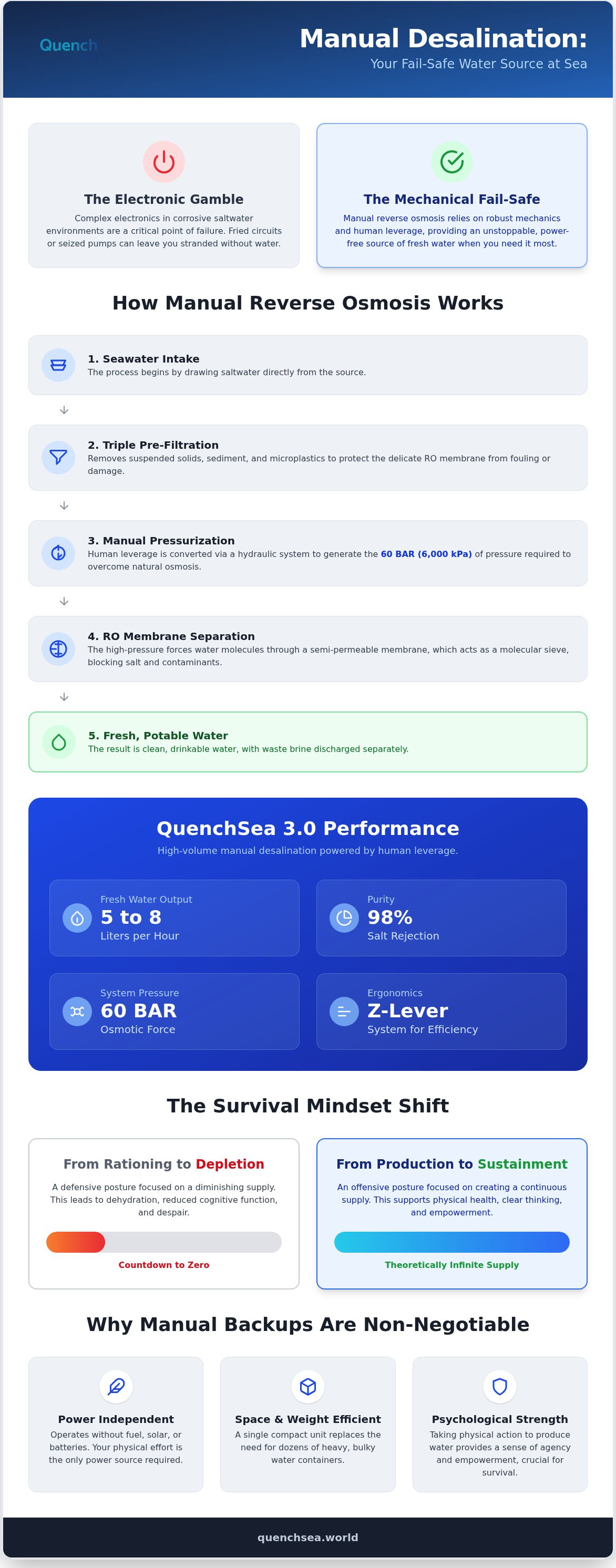
Seawater is a dense solution of dissolved salts and minerals. To extract pure water, you must reverse the natural process of osmosis. This requires significant physical force. Specifically, you must overcome an osmotic pressure of approximately 60 bar (6,000 kPa). Without electricity, this task falls entirely on mechanical leverage and hydraulic efficiency. Modern hand crank desalination systems are designed to bridge this gap between human capability and physical law.
The heart of the system is the semi-permeable membrane. This thin-film composite acts as a molecular sieve. It allows water molecules to pass through while rejecting 98% of dissolved salts. This process effectively lowers the Total Dissolved Solids (TDS) of the seawater to levels safe for human consumption. Engineering research into Evaluating Output: Survival Math confirms that maintaining this pressure manually is a matter of consistent, optimized effort. It's a calculated mechanical process where every stroke must count.
The Mechanical Advantage: Lever and Hydraulics
Converting human arm strength into 60 bar of pressure requires a sophisticated mechanical advantage. Modern units like the QuenchSea 3.0 utilize high-grade stainless steel and reinforced polymers to withstand these extreme internal forces. While these are portable solutions, the same principles of robust engineering and separation efficiency are applied by Australian supplier Sacor in industrial contexts to handle larger volumes of material. The lever design is critical; it must maximize the power stroke while minimizing fatigue. Many advanced systems now include energy recovery mechanisms. These recycle the high-pressure energy from the waste brine to assist the next intake stroke, which significantly reduces the work required by the operator.
The RO membrane is highly effective but also incredibly fragile. Suspended solids, sediment, and microplastics can foul the membrane surface, leading to permanent damage or total failure. A robust triple filtration system is essential for protection. This layered approach ensures that only pre-scrubbed water reaches the membrane, extending the life of the device and maintaining high output levels during prolonged survival scenarios.
- Micro-filtration: Captures larger debris and sediment that would clog the pump.
- Ultra-filtration: Blocks smaller particles and biological threats like parasites and pathogens.
- The RO Core: The final stage where the actual desalination occurs at the molecular level.
If you're looking for a system that integrates these technical standards, you should explore the QuenchSea 3.0 specifications to see how it handles these filtration demands. This hardware is built for durability and simplicity, ensuring it remains a dependable tool rather than a liability when you're off the grid.
Evaluating Output: Survival Math and Physical Effort
Survival at sea is a battle of thermodynamics. Every movement costs calories and, more importantly, moisture. If you burn more water through sweat while pumping than you produce through the device, you've encountered a "hydration deficit." This is the fatal flaw of many legacy hand crank desalination units. When a device only produces 0.5 liters per hour, the metabolic cost of the physical labor often outweighs the hydration gain. You aren't just pumping for water; you're pumping for your life. Efficiency isn't a luxury. It's a biological requirement.
In high-heat marine environments, a human at rest requires approximately 2 to 3 liters of water daily just to maintain basic organ function. If you're active or exposed to direct sun, that requirement can easily double. Using a low-output desalinator means you might spend six to eight hours a day pumping just to meet your own needs. For a multi-person crew, this math becomes impossible. One person would have to pump for 24 hours straight to keep a small group alive. This is why high-output engineering is the only viable path for modern maritime safety.
The Hydration-to-Exertion Ratio
Modern high-volume units like the QuenchSea 3.0 change the survival equation entirely. By delivering 5 to 8 liters per hour, the device allows a survivor to secure their daily water requirement in under 45 minutes of work. This massive increase in output drastically reduces the risk of physical exhaustion and heatstroke. Ergonomic design plays a critical role here. The QuenchSea 3.0 features a specialized Z-shaped lever that optimizes the power stroke. This allows you to utilize larger muscle groups like the lats and core rather than relying solely on arm strength. You produce more water with significantly less metabolic strain.
Water Quality Standards: WHO vs. Survival Grade
Potability is about more than just removing the "salty" taste. The World Health Organization (WHO) generally suggests that drinking water should stay below 600 to 1,000 parts per million (ppm) of Total Dissolved Solids (TDS) for long-term health. In a survival scenario, "survival grade" water can technically be higher, but there's a limit. If salt rejection is too low, the kidneys must work harder to process the remaining minerals, which actually accelerates dehydration.
A rejection rate of 98% is the benchmark for safety. This ensures the TDS remains well within a range that supports human health without stressing the renal system. Maintaining a high rejection rate is vital because salt poisoning (hypernatremia) can lead to confusion, seizures, and death. High-quality membranes ensure that the water you work so hard to produce is actually helping you stay alive rather than contributing to your decline.
Best Practices for Operating and Maintaining Manual Desalinators
Operational discipline is the difference between a functional tool and a useless weight. Deploying a hand crank desalination device requires more than just physical effort; it requires tactical positioning. First, secure the unit to your vessel or life raft using a high-tensile lanyard. Losing your only water source to a rogue swell is a terminal mistake. Once anchored, deploy the intake hose. Aim for the cleanest possible water by avoiding the surface film where oils, fuels, and concentrated microplastics accumulate. Submerging the intake at least 0.5 meters below the surface provides a significant advantage in water quality.
Managing the intake is critical to avoid air locks. Ensure the weighted strainer is submerged deeply enough to avoid sucking air during wave action. Establish a steady, rhythmic cadence. Modern hydraulics are designed for consistent pressure, not erratic bursts. For the QuenchSea 3.0, the Z-shaped lever allows for a full-body stroke that maximizes output while minimizing muscle fatigue. Watch the output flow. If the production rate drops significantly, it's a signal to inspect your pre-filters for organic debris or bio-fouling.
Operational Efficiency at Sea
Maintaining a consistent pumping rhythm is vital for membrane health. Rapid, jerky movements can cause pressure spikes that stress the internal seals. Aim for a smooth, continuous cycle that keeps the internal pressure at the required 60 bar. If you're operating in turbid coastal waters, you may need to change your pre-filters more frequently. A clogged pre-filter increases the force required to pump and can lead to cavitation, which damages the hydraulic assembly. Always carry at least two sets of spare filters in your emergency kit.
Long-Term Storage and Maintenance
Maintenance doesn't end when you reach land. Saltwater is a corrosive predator. After every use, you must flush the system with fresh water. This simple step prevents salt crystals from desiccating and tearing the delicate RO membrane. If the device will sit idle for more than two weeks, use a food-grade pickling solution. This preservative inhibits bacterial growth and keeps the membrane moist, preventing it from becoming brittle and failing during your next emergency.
- Freshwater Flush: Run 2 liters of fresh water through the system after each session to clear brine.
- Seal Inspection: Check O-rings and seals for cracks or perishing every 90 days.
- Membrane Care: Use a pickling solution if the unit is stored for more than 14 days.
- Moving Parts: Apply a light coat of marine-grade silicone lubricant to the lever joints to prevent seizing.
To ensure your emergency kit remains mission-ready, order replacement filters and membranes for your QuenchSea 3.0 today. Consistent maintenance is the only way to guarantee mechanical reliability when the stakes are life-critical.
QuenchSea 3.0: High-Volume Manual Desalination for 2026
The QuenchSea 3.0 represents a significant leap in hand crank desalination technology. It moves beyond the limitations of older portable units by utilizing a sophisticated hydraulic system. This system allows users to reach the required 60 bar pressure with minimal effort. Central to this efficiency is the unique Z-shaped lever. This design isn't just aesthetic; it provides a mechanical advantage that allows you to engage your core and back muscles. This prevents the rapid arm fatigue common with vertical or horizontal handle designs found in legacy models. By optimizing the power stroke, the device achieves a consistent output of 5 to 8 liters per hour.
For yacht owners and blue-water cruisers, every kilogram of weight matters. Storing hundreds of liters of water is a logistical burden that affects vessel performance and consumes critical storage capacity. The QuenchSea 3.0 offers a lightweight alternative without sacrificing power. It produces up to 8 liters per hour, which is a massive improvement over the 0.5 liters per hour standard of many competitors. This makes it a viable primary backup rather than just a last-resort emergency tool. It bridges the gap between portability and high-volume production.
The Modern Standard for Marine Safety
Long-distance sailing requires absolute redundancy. Even the most advanced electric water makers are vulnerable to electrical failure or salt corrosion. The QuenchSea 3.0 has become the preferred choice for sailors because it democratizes marine safety through low-cost, high-reliability engineering. When you compare the cost of maintaining large freshwater tanks against the reliability of mechanical production, the ROI is clear. It integrates seamlessly into broader life raft water supply strategies, ensuring you have a continuous source of hydration regardless of your vessel's power status.
Mission-Driven Innovation
Beyond marine safety, this technology addresses the global water crisis. Low-cost desalination is a transformative force for humanitarian relief. In disaster zones where infrastructure is non-existent, these devices provide immediate access to potable water without the need for fuel or batteries. The vision is ambitious: deploying 100 million devices by 2035 to empower communities in water-stressed regions. This isn't just about survival at sea; it's about global responsibility and innovative engineering. You can take part in this mission by prioritizing your own preparedness.
Don't leave your hydration to chance when you're off the grid. Secure your survival-grade water source today and ensure your vessel is equipped for the realities of offshore travel. Reliability is the only metric that matters in an emergency.
Secure Your Mechanical Redundancy
Survival at sea isn't about hope. It's about mechanical certainty. You've seen that relying on complex electronics in a saltwater environment is a high-stakes gamble. By mastering the survival math of hand crank desalination, you move from a mindset of rationing to one of active production. High-output engineering ensures that you generate more hydration than you burn through physical labor. This balance is critical for long-term health and cognitive function in extreme conditions.
The QuenchSea 3.0 provides the redundancy required for blue-water sailing and humanitarian relief. It utilizes a robust, human-powered hydraulic system to achieve 98% salt rejection; meeting WHO standards for potable water. With an output of 5 to 8 liters per hour, it delivers the volume necessary to sustain a crew when primary systems fail. Don't leave your safety to chance or a fragile power grid.
Equip your vessel with the QuenchSea 3.0 manual desalinator and take command of your freshwater security. You have the tools to overcome the environment. Preparedness is the ultimate empowerment.
Frequently Asked Questions
How much physical effort is required to operate a hand crank desalinator?
Operating a hand crank desalination unit requires consistent physical input to overcome 60 bar of osmotic pressure. The QuenchSea 3.0 utilizes a specialized hydraulic system and an ergonomic Z-shaped lever to minimize this strain. This allows a single survivor to utilize their core and back muscles rather than just arm strength. Most operators can secure their daily hydration requirements in approximately 45 minutes of work without reaching total exhaustion.
Can you drink seawater directly if you use a manual RO device?
Never ingest seawater directly; the high sodium concentration forces your kidneys to use more water than you've consumed, accelerating dehydration. You must process seawater through a manual reverse osmosis device before it's potable. These systems strip away 98% of dissolved salts and pathogens. Once the water passes through the RO membrane, the salt levels drop to within safe limits, transforming a toxic solution into a life-sustaining resource.
How long does the reverse osmosis membrane last in a manual unit?
The lifespan of a reverse osmosis membrane depends heavily on water quality and maintenance discipline. In typical survival conditions, a well-maintained membrane can process several thousand liters of water. However, organic fouling and salt crystallization are the primary threats to longevity. You must perform a freshwater flush after every use and utilize pickling solutions for long-term storage. These steps prevent the delicate film from becoming brittle or clogged by biological growth.
Is the water produced by a hand-powered desalinator safe for children?
Water produced by a high-quality hand crank desalination unit is safe for children. The reverse osmosis process removes 98% of salts and virtually all biological contaminants, including bacteria and parasites. Because children are more vulnerable to dehydration and waterborne illnesses, the high purity of RO water is a significant advantage. Always ensure the device is functioning correctly by monitoring the output quality and maintaining the triple pre-filtration system to guarantee safety.
Can I use a hand crank desalination device for brackish water or lake water?
You can use these devices for brackish water or lake water, but different considerations apply. Reverse osmosis is highly effective at removing the minerals in brackish sources. While it will also purify lake water, the high sediment levels in some freshwater sources can clog the RO membrane faster than seawater. Always use the triple pre-filtration system to remove suspended solids and protect the core membrane from premature fouling in non-marine environments.
What is the difference between a water filter and a desalinator?
The primary difference lies in the ability to remove dissolved solids. A standard water filter uses porous media to trap bacteria, protozoa, and sediment, but it cannot stop salt molecules. A desalinator uses reverse osmosis technology to force water through a semi-permeable membrane at high pressure. This process removes 98% of dissolved salts, which is the only way to make seawater safe for human consumption in a maritime survival scenario.
How do I store my manual desalinator when it's not in use?
Proper storage is essential to prevent mechanical failure. If you won't use the device for more than 14 days, you must flush it with fresh water and apply a food-grade pickling solution. This preservative keeps the membrane moist and prevents the growth of bacteria or mold inside the unit. Store the desalinator in a cool, dry place away from direct sunlight to protect the high-grade polymers and seals from UV degradation.
Does the QuenchSea 3.0 require any batteries or external power?
The QuenchSea 3.0 is a 100% manual device and does not require batteries, fuel, or any external power source. It relies entirely on human-powered hydraulics to generate the 60 bar of pressure needed for desalination. This makes it a fail-safe backup for offshore sailors who cannot risk a total power failure. Because it's battery-free, the unit remains shelf-stable for years and is always ready for immediate deployment in an emergency.