

Storing water is a tactical failure in a marine survival scenario. Every liter you carry is a kilogram of dead weight that compromises your mobility and drains your energy. You understand the high-stakes reality of dehydration in high-salinity zones. Staring at an infinite horizon of saltwater while your body fails is a scenario no professional wants to face. Effective coastal survival water purification requires a shift from a storage mindset to a production mindset.
We're here to help you build a high-performance kit that turns the ocean into your reservoir. You'll gain the strategic knowledge to deploy a lightweight, fail-safe system that functions in the most corrosive environments. This guide outlines the 2026 standard for ocean hydration, focusing on mechanical reliability and hardware that creates an infinite supply. We'll examine the integration of manual reverse osmosis technology, specifically the QuenchSea 3.0, to ensure you never run dry when the stakes are highest. It's time to replace heavy logistics with engineering certainty.
Key Takeaways
- Shift your survival strategy from finite storage to infinite production to eliminate heavy tactical loads.
- Optimize your coastal survival water purification setup by integrating manual reverse osmosis hardware designed for high-salinity environments.
- Build a modular kit that includes pre-filtration modules to protect your primary desalination engine from sediment and debris.
- Master strategic sourcing techniques to find the cleanest intake points and ensure a steady supply of freshwater from the ocean.
- Deploy the QuenchSea 3.0 for reliable, hand-powered desalination without the logistical burden of batteries or fuel.
The Anatomy of a Tactical Coastal Survival Water Kit
A coastal survival water kit is more than a collection of bottles. It's a modular, engineered system designed to source, prep, and produce potable water from the harshest marine environments. Survival experts often cite the Rule of 3. While you can survive three weeks without food, you'll rarely last three days without water. In a high-salinity coastal zone, heat and salt-laden air accelerate dehydration. This makes coastal survival water purification your primary tactical priority once you've secured immediate physical safety from the elements.
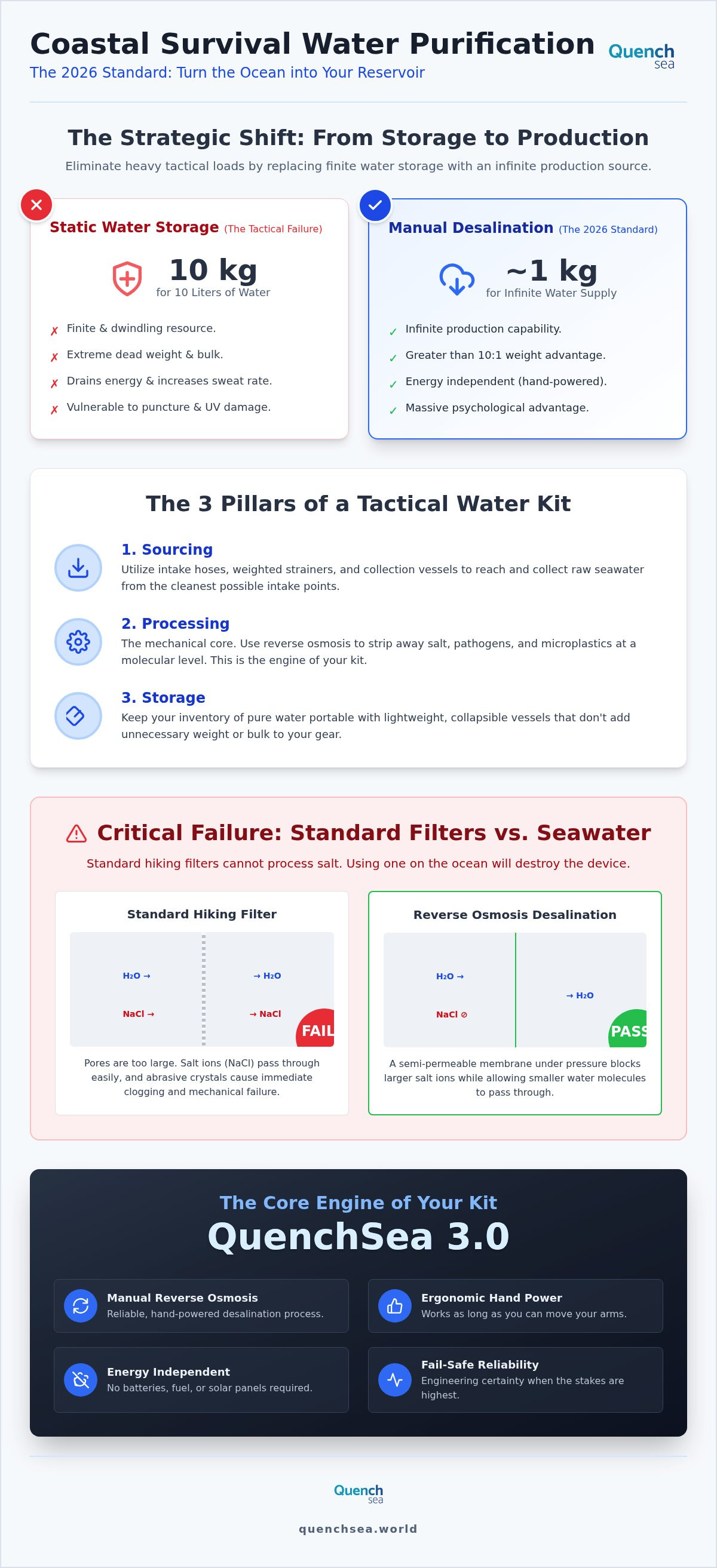
Modern survivalists are moving away from the "carry-it-all" storage model. Instead, they embrace the Infinite Water philosophy. Carrying ten liters of water adds ten kilograms of weight to your pack. That's a logistical burden that slows you down. A portable factory, like a manual desalinator, provides a theoretically limitless supply while weighing a fraction of a static reserve. You must distinguish between a ditch kit and a coastal bug-out kit. A ditch kit is optimized for the confined space of a life raft. A coastal bug-out kit must account for sand, sediment, and fluctuating tide levels on a beach.
The Three Pillars of Coastal Hydration
Every effective kit relies on three distinct mechanical stages to ensure reliability.
- Sourcing: These are the tools used to reach and collect raw seawater. This includes intake hoses, weighted strainers, and collection vessels that can handle high-salinity or brackish water.
- Processing: This is the mechanical core of the kit. It utilizes advanced desalination technologies to strip away salt, pathogens, and microplastics at a molecular level. The QuenchSea 3.0 serves as the engine here.
- Storage: Once the water is pure, it requires lightweight, collapsible vessels. These containers keep your inventory portable without adding unnecessary bulk to your gear.
Why Standard Water Filters Fail on the Coast
Standard hiking filters are useless against the ocean. They are designed to trap bacteria and protozoa, but they cannot process sodium chloride molecules. Salt ions are simply too small for charcoal or hollow-fiber membranes to catch. If you try to pump seawater through a standard filter, you'll likely destroy the device. Salt crystals are jagged and abrasive. They cause immediate mechanical failure through clogging and internal abrasion. Reverse osmosis is the only viable manual method for salt removal in 2026. Without a dedicated coastal survival water purification device, you're just carrying a heavy, broken filter.
Static Water Storage vs. Manual Desalination
Survival logistics often come down to a simple ratio: weight versus utility. If you choose to carry 10 liters of freshwater, you're adding 10 kilograms to your load. For a coastal hiker or someone navigating a bug-out scenario, that weight is a liability. It drains your energy and increases your sweat rate, which ironically forces you to consume your supply faster. A 1kg manual desalination device provides a 10:1 weight advantage before it even produces its first drop. This shift from storage to production is the foundation of modern coastal survival water purification.
The Logistical Burden of Stored Water
Stored water is a finite resource. Once your last pouch is empty, your survival window closes. Beyond the weight penalty, water pouches and cans are physically bulky. In the cramped environment of a life raft, every cubic inch of volume is critical for medical supplies and signaling gear. Plastic pouches are also vulnerable. They can puncture on jagged rocks or degrade under intense UV exposure and heat. If your storage vessel fails, your entire hydration strategy vanishes. You're left with a heavy, wet pack and no way to recover.
Manual Desalination: The Strategic Advantage
A manual pump offers energy independence. Unlike electric water makers, it doesn't rely on batteries that can corrode or solar panels that might break. It works as long as you can move your arms. This creates a massive psychological advantage. Knowing you have the mechanical means to produce water reduces the panic that often leads to poor decision-making. You aren't rationing a dwindling supply; you're managing a renewable resource. Integrating portable desalination technology into your kit transforms the ocean from a threat into a reservoir.
The necessity of production becomes clear when you understand why is drinking sea water dangerous. Seawater has a salinity level far higher than human blood. To flush that salt out, your kidneys must use more water than you actually drank. It's a biological death sentence that leads to rapid organ failure. Effective coastal survival water purification isn't just about convenience. It's the only way to bypass the biological reality of ocean survival and maintain your physical integrity until rescue arrives.
Essential Components for Your 2026 Water Kit
A mission-ready kit is an integrated system of hardware. It's designed to withstand the corrosive nature of the ocean while providing reliable output. The engine of this system is your hand-powered reverse osmosis device. It performs the molecular work of coastal survival water purification by forcing water through a semi-permeable membrane. However, the hardware alone isn't enough. You must include testing tools and hydration supplements. These ensure the water you produce is both safe and effective for long-term health.
A TDS (Total Dissolved Solids) meter is a critical component. It measures the concentration of dissolved substances in your finished water. It gives you a digital verification of your system's performance. In a survival scenario, you don't rely on hope; you rely on data. You should also include electrolyte tablets. Desalinated water is stripped of the minerals your body requires to maintain nerve and muscle function. Replacing these minerals is vital during high-stress situations where physical performance is mandatory.
The Pre-Filtration Module
Seawater isn't just salty. It's filled with sand, kelp, and microplastics. These contaminants are the primary enemies of an RO membrane. A dedicated pre-filtration module "polishes" the intake stream before it reaches the main unit. This usually involves a combination of fine mesh screens and replaceable sediment filters. By excluding these particles, you prevent abrasion and clogging. These issues would otherwise destroy your equipment. Proper intake management isn't a luxury. It's a maintenance protocol that ensures your coastal survival water purification device lasts for its entire rated lifespan.
Vessels and Distribution
Storage must be as efficient as production. Collapsible TPU (Thermoplastic Polyurethane) bladders are ideal. They offer high puncture resistance without the bulk of traditional bottles. When empty, they disappear into your pack. Use a personal canteen with clear volume markings to manage your hydration schedule. This facilitates strict rationing. It's necessary until your production rate is fully established. In tropical zones, consider a small UV purifier as a fail-safe. While reverse osmosis removes biological threats, secondary UV treatment prevents any latent bacteria from colonizing your storage vessels in the heat.
Strategic Sourcing: Finding and Prepping Water on the Coast
Success in coastal survival water purification begins at the intake point. You don't just drop a hose into the surf. Avoid stagnant tide pools. They concentrate pathogens, heavy metals, and industrial runoff. Heavy surf is equally problematic. It introduces air pockets and suspended sand that can bypass basic filters and damage your internal components. Seek out calm, deep water or dig a collection pit in the sand. A beach-well acts as a natural primary filter. It traps large organic matter before the water ever enters your hardware.
Execution is purely mechanical. Maintain a steady, rhythmic pumping cycle. Constant pressure is mandatory to overcome the osmotic pressure of seawater. If your pressure fluctuates, the RO membrane stops producing freshwater and efficiency drops to zero. For specific pressure techniques and timing, refer to the survival desalination device guide. Always conclude with a TDS meter test. Verify the output meets potable standards. If the reading exceeds 500 ppm, inspect your seals for salt bypass or membrane fatigue.
The Dangers of Brackish Water
Survivors often assume coastal pits or lagoons produce drinkable water. This is a lethal error. Brackish water in these areas is frequently still too salty for human kidneys to process. However, processing brackish water is tactically superior. The lower salinity reduces the osmotic barrier. This increases your liter-per-hour output compared to full-strength seawater. When sourcing from mangroves or estuaries, watch for high tannin concentrations. These organic acids foul membranes rapidly. Always prioritize your pre-filter in these high-organic zones.
Maintaining Your Kit in Corrosive Environments
Salt crystallization is the primary cause of manual pump failure. You must perform a freshwater flush after every production session. Use the final 200ml of your pure water to rinse the internal mechanism. This prevents salt crystals from drying and shredding the RO membrane during the next use. Store your equipment in a shaded, ventilated area. High heat in coastal zones accelerates bacterial growth on damp membranes. Reliability depends on field serviceability. Your gear must be maintainable by hand without specialized tools. Choose a desalination device built for the field to ensure long-term operational success.
QuenchSea 3.0: The Core Engine of Your Coastal Kit
The QuenchSea 3.0 is the definitive hardware for modern coastal survival water purification. It functions as the mechanical engine of your kit, converting high-salinity seawater into life-sustaining freshwater without relying on external power. In a survival scenario, complexity is a liability. This device utilizes a rugged, no-fuel-required design specifically engineered for extreme marine safety. It produces practical volumes of water through sustainable manual effort, ensuring you can maintain hydration over extended periods. Because of its compact form factor, the 3.0 integrates seamlessly into standard marine ditch bags and coastal bug-out packs. This ensures you're carrying a portable factory rather than a finite supply.
Engineering for the Extreme
The core of the device is advanced reverse osmosis technology adapted for a handheld form factor. It isn't a delicate piece of lab equipment; it's survival-grade hardware built to withstand impact, intense UV exposure, and the corrosive nature of salt spray. The mechanical design focuses on simplicity. A manual lever drives the high-pressure pump required to force water through the RO membrane. This eliminates the need for complex electronics or vulnerable wiring. By reducing the number of moving parts, the system achieves maximum output with minimal mechanical failure points. It's a tool designed for the reality of the ocean, not a climate-controlled room. It provides the durability needed when rescue is days or weeks away.
Why Professionals Choose QuenchSea
Professional maritime operators and rescue teams prioritize reliability over automation. Complex electric water makers are efficient until their power source fails or their circuit boards corrode. In contrast, the QuenchSea 3.0 remains operational as long as the user can provide manual input. This level of dependability is why the hardware is utilized in humanitarian and defense maritime operations globally. It provides a disaster relief water supply that functions in the most challenging "last-mile" survival environments. When logistics break down, mechanical certainty is the only thing that matters. It empowers the user to take control of their own survival.
Before deploying your kit, perform a final readiness check. Ensure your coastal survival water purification system is primed and ready for immediate action. A failure in the field is a failure of preparation. Follow this protocol:
- Membrane Integrity: Verify the RO membrane is correctly seated and hasn't dried out during storage.
- Pre-Filter Status: Inspect mesh and sediment filters for debris or salt buildup from previous production cycles.
- TDS Calibration: Ensure your digital meter is functioning to provide accurate post-production safety data.
- Seal Inspection: Check O-rings and intake hoses for cracks, leaks, or signs of UV degradation.
Master Your Maritime Readiness
Survival in marine environments depends on your ability to adapt. You've learned that carrying dead weight is a tactical error and that production is the only path to an infinite supply. By focusing on coastal survival water purification through manual reverse osmosis, you eliminate the logistical failure points of finite storage. Strategic sourcing and rigorous pre-filtration ensure your hardware remains operational when you need it most.
The QuenchSea 3.0 is the definitive engine for this mission. It requires no batteries or fuel, relying entirely on manual power to produce life-sustaining freshwater. This is the same compact, lightweight technology trusted by marine and defense professionals worldwide. It fits easily into emergency ditch bags, providing a mechanical solution to a biological crisis. Don't leave your hydration to chance. Equip yourself with the tools to turn the ocean into a resource. You have the knowledge to build a high-performance kit. You're ready to face the horizon with confidence.
Secure your QuenchSea 3.0 for your coastal survival kit today.
Frequently Asked Questions
Can you drink saltwater if you filter it through a standard camping filter?
No. Standard camping filters use hollow fiber or charcoal to trap bacteria and protozoa. They cannot remove dissolved salt ions. Passing seawater through these filters will likely clog the membrane and result in the consumption of high-salinity water. This leads to rapid dehydration. Effective coastal survival water purification requires a reverse osmosis membrane to strip salt at a molecular level. Without RO technology, you're merely drinking filtered saltwater.
How much water can a manual desalination device produce per hour?
Output depends on the specific model and user effort. Under standard manual operation, the QuenchSea 3.0 is designed to produce approximately 4 to 6 liters of freshwater per hour. This rate is sufficient to sustain multiple people in an emergency scenario. Maintaining a consistent pumping rhythm is essential to keep the internal pressure above the osmotic threshold. This ensures maximum throughput and prevents the system from stalling under high salinity.
What should be in a basic coastal survival water kit?
A tactical kit must be modular and redundant. It should include:
- A primary manual desalination device like the QuenchSea 3.0.
- A pre-filtration module for sediment removal.
- A digital TDS meter for quality verification.
- Collapsible TPU bladders for storage.
- Electrolyte replacement tablets to restore vital minerals.
This configuration prioritizes production over the dead weight of stored water. Every component should be ruggedized to withstand the corrosive impact of salt spray.
Do I need to add minerals back into desalinated water?
Yes, especially during high-stress survival. Reverse osmosis removes nearly all dissolved solids, including beneficial minerals like magnesium and calcium. Drinking demineralized water over several days can lead to electrolyte imbalances. Use mineral drops or electrolyte tablets to re-fortify your supply. This prevents muscle cramping and cognitive decline during physically demanding coastal bug-out or rescue situations. Proper mineralization is a technical requirement for long-term physiological integrity.
How long does a reverse osmosis membrane last in a survival kit?
Lifespan is determined by water quality and maintenance. A standard RO membrane can process thousands of liters if you use proper pre-filtration and perform regular freshwater flushes. Without these steps, salt crystals and sediment will shred the membrane within hours. In storage, keep the membrane in a cool, dry environment to prevent bacterial growth or UV degradation of the housing. Reliability depends on your commitment to maintenance protocols.
Is manual desalination better than emergency water pouches?
It is superior for long-term survival. Pouches are finite; once they're gone, your survival window closes. They're also heavy and prone to puncture. A manual device provides an infinite supply as long as you have ocean access. While pouches offer immediate hydration without effort, a desalinator removes the logistical burden of carrying kilograms of water during a coastal evacuation. It transforms the ocean from a threat into a renewable resource.
Can the QuenchSea 3.0 be used on brackish river water?
Yes. The device is highly effective for coastal survival water purification in brackish environments. Brackish water has a lower salt concentration than the open ocean, which reduces the manual effort required to produce freshwater. The lower osmotic pressure allows for a higher liter-per-hour output. Always use the pre-filter to remove tannins and organic debris common in estuaries. These contaminants can foul the membrane faster than salt alone.
What happens if I drink untreated seawater in a survival situation?
Drinking untreated seawater triggers rapid, lethal dehydration. The salt concentration is significantly higher than that of human blood. Your kidneys must use more water to flush out the excess salt than you actually ingested. This creates a net loss of bodily fluids. Symptoms include extreme thirst, delirium, and eventually organ failure. Never consume raw seawater; always process it through a validated desalination system to ensure your survival until rescue arrives.