

In a life raft, the 1.5 liters of water required by international law isn't a survival plan; it's a countdown. You understand the high stakes of maritime safety. You've likely felt the anxiety of an upcoming audit while reviewing the SOLAS requirements for emergency drinking water. It's a valid fear to worry that your water rations might run out before a rescue vessel arrives on the horizon, especially when physical space in survival craft is so limited.
Master the international regulations for life raft water supplies and discover how manual desalination hardware transforms a finite supply into a sustainable one. You'll gain a full understanding of SOLAS Chapter III and the LSA Code; this includes how to supplement traditional sachets with reliable, non-electric tools. We're providing a clear checklist for life raft inspections to ensure your vessel is ready for any scenario. Let's move beyond the minimum standards to achieve absolute reliability at sea. We'll bridge the gap between compliance and survival.
Key Takeaways
- Understand the mandatory 1.5-liter per person freshwater baseline established by SOLAS Chapter III to ensure total audit readiness.
- Identify how the LSA Code permits manual desalinators to supplement SOLAS requirements for emergency drinking water, saving critical space and weight in survival craft.
- Evaluate the engineering advantages of manual reverse osmosis hardware over finite, consumable water sachets during delayed rescue scenarios.
- Master the "ration-first" strategy to balance metabolic energy expenditure with active water production during the first 24 hours of survival.
- Gain a clear inspection checklist to verify that your life raft's desalination units meet 2026 technical standards for salt rejection and durability.
The Core SOLAS Requirements for Emergency Drinking Water
SOLAS Chapter III, Regulation 31 serves as the legal bedrock for life-saving appliances on international voyages. It defines the technical standards for survival. This regulation ensures every individual on a survival craft has access to life-sustaining provisions. For a comprehensive SOLAS Convention overview, one must examine how these chapters integrate to prevent maritime tragedy. The most critical provision is water.
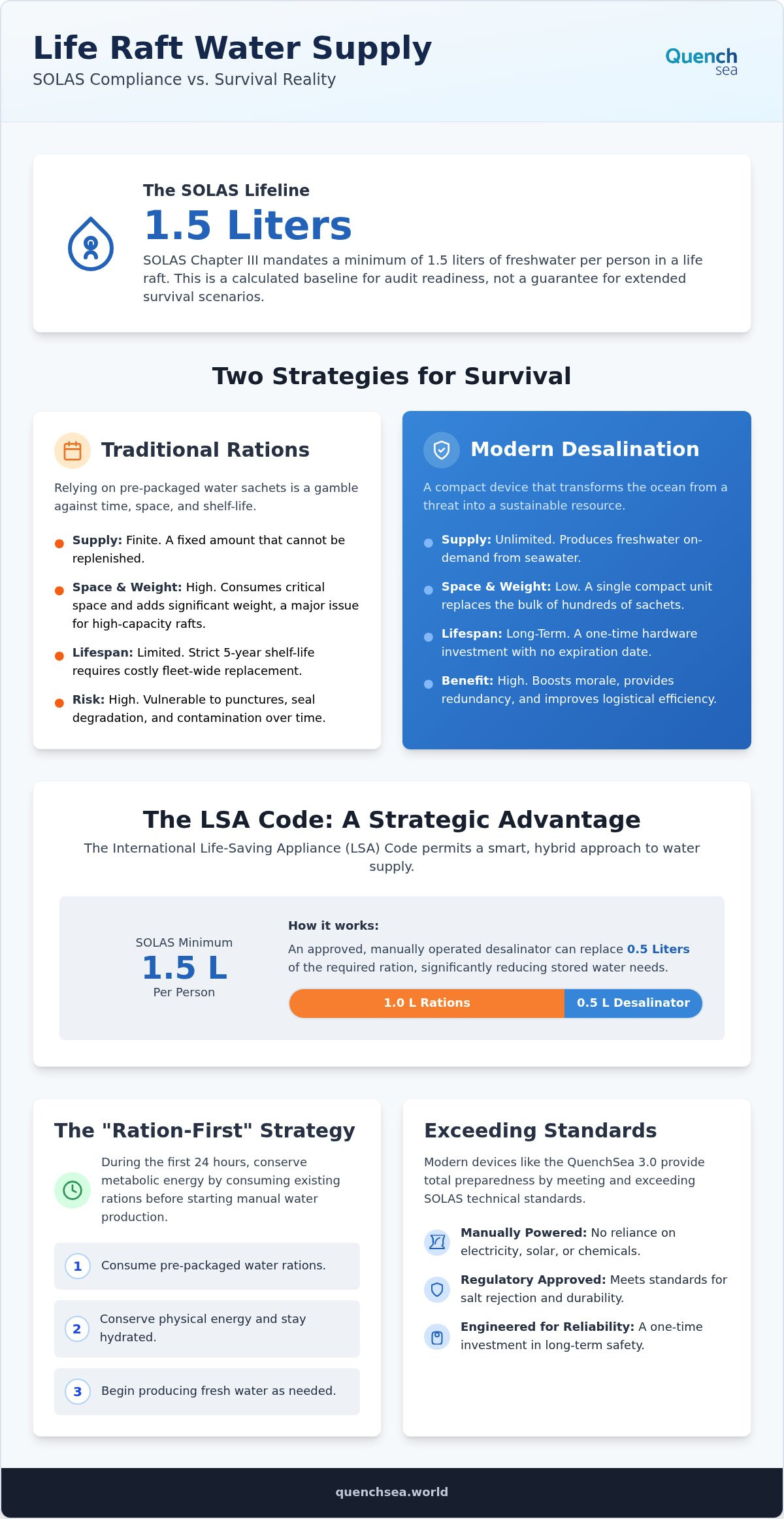
The 1.5 Litre Rule is the absolute minimum standard. SOLAS mandates that every person in a life raft must have 1.5 liters of freshwater available. This volume isn't arbitrary. It's a calculated baseline meant to sustain human metabolic function during the high-stress environment of a survival event. Adhering to these SOLAS requirements for emergency drinking water is the first step in survival planning.
Rations are distributed in hermetically sealed sachets. These units typically range from 100ml to 500ml. Modular packaging prevents mass contamination if a single container fails. It also enables precise rationing. These consumables carry a strict 5-year shelf-life. Once expired, they must be replaced during a certified service to maintain compliance. Hardware doesn't expire, but consumables do.
Understanding the LSA Code Section 4.1
The International Life-Saving Appliance (LSA) Code defines the technical specifics of these water supplies. Section 4.1 focuses on water quality and container integrity. Emergency water differs from standard bottled water. It's often distilled to remove minerals that could increase thirst or cause digestive distress. Sachet materials must be puncture-resistant. They must survive extreme temperature swings and constant salt-spray exposure. Reliability is the only metric that matters here.
Vessel-Specific Requirements
To ensure your fleet is always prepared for these audits, MusterDeck provides a specialized platform for maritime drill compliance and inspection readiness.
Rations vs. Desalinators: Navigating the LSA Code Breakdown
Relying solely on sealed sachets is a gamble against time. While the SOLAS requirements for emergency drinking water mandate a 1.5-liter baseline, the LSA Code provides a strategic alternative for modern vessels. Under specific conditions and with the approval of the Administration, a manually operated desalinator can replace 0.5 liters of the required per-person ration. This substitution isn't just about reducing weight; it's about logistical efficiency. Carrying thousands of 100ml sachets for a high-capacity raft creates a massive footprint. One compact device eliminates that bulk. It transforms the ocean from a threat into a resource.
When a Desalinator is Required
Large-scale life rafts face a logistical nightmare when it comes to water storage. Storing bulk supplies for 50 or 100 people consumes precious floor space and adds significant weight to the craft's deployment system. Most safety officers now prioritize a hybrid approach. They combine a reduced ration of sachets with a high-performance manual desalinator. This redundancy ensures that if a ration supply is contaminated or lost, survivors retain the means to produce freshwater. U.S. regulations for survival craft mirror these international standards, emphasizing the need for reliable, mission-ready equipment on specific offshore routes.
The Limits of Pre-Packaged Rations
Consumables are finite by nature. If a rescue operation extends beyond the typical 72-hour window, a fixed supply of water becomes a liability. Sachet failure is another silent risk. Extreme temperature fluctuations in a stowed life raft can degrade plastic seals over time. This leads to leaks or spoilage that goes unnoticed until the moment of crisis. Replacing expired rations every five years is a recurrent expense that adds up across a fleet. Hardware like the QuenchSea 3.0 Desalination Device offers a one-time investment in long-term reliability. It provides a psychological edge. Survivors who can produce their own water maintain a higher degree of morale and mental clarity.
Regulatory approval is the final hurdle. A compliant desalinator must be manually powered. It cannot rely on solar heat or chemicals to function. These systems must meet strict salt rejection rates to ensure the output is actually potable. When selecting hardware, look for units engineered for the brutal realities of the marine environment. The goal is to move from a mindset of consumption to one of production. This shift empowers the crew. It changes the survival narrative from how long the supplies will last to how long the crew can endure. Meeting the SOLAS requirements for emergency drinking water through hardware ensures your vessel is prepared for the worst-case scenario.
Mechanical reliability separates a tool from a toy. When evaluating hardware against the SOLAS requirements for emergency drinking water, technical standards are non-negotiable. The U.S. Coast Guard regulations for SOLAS liferafts specify that any secondary water production method must be robust enough for the marine environment. This means every component must resist corrosion from high-salinity exposure and constant humidity. Unlike electronic systems that fail when batteries drain, manual desalinators rely on human power. It's a calculated choice. Hand-operated pumps ensure water production remains possible even if the vessel's power grid is lost.
Reverse Osmosis (RO) efficiency is the primary metric for safety. To meet survival standards, a unit must achieve a salt rejection rate of at least 98%. This process strips sodium and minerals from seawater, turning it into life-saving freshwater. Output volume must be sufficient to sustain life raft occupants. A high-performance unit like the QuenchSea 3.0 produces 6 to 8 liters of potable water per hour. This output creates a surplus, allowing survivors to hydrate and maintain cognitive function during a crisis. Engineering to these rigorous standards ensures your equipment fulfills the SOLAS requirements for emergency drinking water while providing a margin of safety that rations alone cannot match.
Membrane Performance and Water Quality
Safe drinking water requires more than just removing salt. The membrane must filter out dissolved solids (TDS) to prevent kidney stress in already dehydrated individuals. The standard Total Dissolved Solids (TDS) level for emergency water makers must remain below 1,000 parts per million (ppm) to ensure the water is safe for immediate human consumption without causing further dehydration. Biological filtration is equally critical. Survival-grade RO membranes act as a physical barrier against bacteria and viruses. This ensures that water drawn from potentially contaminated surface areas remains safe to drink.
Ergonomics and Survival Usability
Survival hardware must be operable by someone at their physical limit. Dehydration and exposure sap muscular strength. Pumping force must be calibrated so a weakened survivor can maintain a steady cadence. Deployment speed is the next priority. In an emergency, you don't have time for complex assembly. A mission-ready device must begin producing water within minutes of being unboxed. Maintenance-free designs are essential. These units sit in vacuum-sealed containers for years. They must function perfectly the moment they're needed, without the risk of seal degradation or internal corrosion.
Optimizing Life Raft Water Supplies for 2026
Optimization starts with a tactical shift. In 2026, meeting the SOLAS requirements for emergency drinking water means more than just checking expiration dates on plastic bags. It requires an active water management strategy. A "Ration First" approach preserves energy during the most critical phase of survival. By integrating manual desalination into your daily routine, you transition from a finite resource model to a sustainable one. Proper storage is vital. Hardware must be secured within the emergency pack to prevent impact damage during launch.
Training is the final pillar. A crew that has never pumped a manual RO unit will struggle in high-seas conditions. Conduct regular drills. Familiarity breeds efficiency. When the adrenaline hits, muscle memory takes over. Ensure your team understands the mechanical resistance and the priming process. This preparation ensures that the hardware performs exactly as intended when seconds count.
The First 24 Hours: Survival Hydration
Survival logic dictates a strict "no water" rule for the first 24 hours. Unless a survivor is injured, the body can sustain itself on existing hydration. This period is for stabilization. Manage metabolic water loss by staying in the shade. Remain still. Every movement burns calories and consumes moisture. Use this time to inspect your desalination device. Ensure the intake hose is clear. Prepare the unit for its first production cycle. This discipline extends your window of survival significantly and ensures you don't waste energy before it is necessary.
Long-Term Water Production Schedules
Once the initial stabilization phase passes, begin production. Fatigue is the enemy of manual operation. Set a strict pumping rotation. Short, intense bursts are more effective than long, exhausting sessions. Each occupant should take a turn to ensure the workload is shared. Calculate your daily output based on total raft occupancy. A high-efficiency unit provides the volume needed to maintain health across the group. For detailed tables on consumption rates, see our Life Raft Water Supply Guide.
Consistency wins. Maintain the schedule. Document every liter produced. This data provides a psychological boost to the crew. They see a growing surplus rather than a dwindling supply. To ensure your vessel is equipped with the latest survival hardware, explore the QuenchSea 3.0 technical specifications. Integrating this hardware into your SOLAS requirements for emergency drinking water plan turns a desperate situation into a manageable one.
QuenchSea 3.0: Exceeding SOLAS Standards for Total Preparedness
Engineering for survival requires stripping away complexity. The QuenchSea 3.0 Desalination Device is the hardware-focused answer to the limitations of traditional rations. While meeting the technical SOLAS requirements for emergency drinking water is the baseline, this device aims for a higher standard: total water security. It utilizes advanced manual reverse osmosis technology to produce 6 to 8 liters of freshwater every hour. This transforms the ocean into an infinite resource. It eliminates the fear of a dry life raft. When the rescue window shifts from hours to days, hardware becomes the only reliable lifeline.
Survival-grade materials define this unit. It's built to withstand the brutal realities of the marine environment. The internal RO membrane provides a physical barrier against salt and biological contaminants. It's compact. It's lightweight. It fits easily into standard emergency grab bags or life raft equipment packs. This design ensures that high-performance water production is always within reach. Reliability is mission-critical. There is no room for failure in a ditch-bag scenario.
Why QuenchSea 3.0 is the Safety Officer's Choice
Safety officers face a constant battle with storage volume. Storing enough water sachets for a high-capacity raft is a logistical nightmare. One QuenchSea 3.0 unit provides more water in a single day than hundreds of standard 100ml sachets. It reduces the weight and footprint of survival gear. Maintenance is simple. The device is engineered to remain ready for use even after years of storage in harsh conditions. It offers a clear advantage for vessels looking to exceed the minimum SOLAS requirements for emergency drinking water. For a deeper look at the technical specifications, read the QuenchSea 3.0 Desalination Device Buyer's Guide.
The Future of Marine Safety
Maritime safety is moving toward sustainable, hardware-based solutions. We are shifting from a reliance on finite consumables to the adoption of survival technology. This device isn't just for commercial shipping. It supports humanitarian and defense standards worldwide. It provides a calculated, mechanical solution to a biological necessity. By choosing manual RO technology, you empower your crew with the means to survive indefinitely. Don't leave your safety to chance or a limited supply of plastic pouches. Equip your vessel with QuenchSea 3.0 today and secure your freshwater supply for the long haul.
Secure Your Sustainable Freshwater Supply
Meeting the SOLAS requirements for emergency drinking water is the non-negotiable baseline for maritime compliance. However, true preparedness requires moving beyond the rigid limitations of finite rations. Manual reverse osmosis hardware transforms the surrounding ocean from a threat into a sustainable resource. By integrating high-performance desalination into your life raft strategy, you effectively eliminate the dangerous countdown associated with dwindling supplies. This shift from consumption to production provides a critical psychological and physical edge in high-stakes survival scenarios.
The QuenchSea 3.0 Desalination Device offers a mission-critical solution for modern vessels. It's engineered for the most extreme marine conditions and requires zero external power or batteries. This lightweight, portable tool ensures your crew maintains access to freshwater regardless of how long rescue takes. It's a calculated, mechanical investment in long-term survival that rations alone cannot match. Secure your crew's survival with QuenchSea 3.0 today. Take command of your vessel's safety protocols and face the open ocean with absolute, hardware-backed confidence. You have the tools to endure.
Frequently Asked Questions
What is the minimum amount of water required by SOLAS per person?
SOLAS mandates a minimum of 1.5 liters of freshwater per person in every life raft or lifeboat. This volume serves as the global baseline for survival craft provisions. It ensures basic metabolic function during the initial stages of a maritime emergency. While 1.5 liters is the legal standard, it remains a finite resource. It does not account for the high-stress variables of delayed rescue timelines on the open sea.
Can a manual desalinator replace all water rations in a life raft?
No, a manual desalinator cannot replace your entire water supply. Current LSA Code regulations allow a desalinator to substitute only 0.5 liters of the 1.5-liter requirement per person. You must still carry at least 1.0 liter of pre-packaged freshwater in sealed sachets. This hybrid strategy ensures immediate hydration is available for the crew while the hardware is deployed and primed for long-term production during a survival event.
How long do SOLAS-approved water rations last?
SOLAS-approved water rations typically have a maximum shelf life of five years from the date of manufacture. You must verify the expiration dates during annual safety inspections. Once the five-year window closes, the sachets must be replaced immediately to maintain vessel compliance. Hardware solutions like manual RO devices do not expire. They provide a reliable, long-term supplement to these perishable supplies, ensuring you have water long after the rations fail.
Are manual water makers required for commercial vessels?
Manual water makers are not universally mandatory under current international regulations; they are required only if specifically mandated by a vessel’s flag state administration. However, many safety officers voluntarily include them to exceed the basic SOLAS requirements for emergency drinking water. Adding a manual desalinator provides a critical redundancy layer. It protects the crew if the primary rations are lost, contaminated, or exhausted during an extended survival event.
What happens if a life raft's water supply is found to be expired?
Expired water rations result in an automatic failure of the safety equipment certificate during a maritime audit. Marine inspectors may detain the vessel or issue heavy fines until the supplies are replaced with certified, in-date sachets. Maintaining compliance is critical for both legal operation and the actual survival of the crew. Regular audits of the life raft's emergency pack prevent these costly operational delays and ensure mission-readiness in any environment.
Can you drink seawater if you have a manual RO device?
You must never drink raw seawater, but you can drink it once it has been processed through a manual RO device. The reverse osmosis membrane strips away over 98% of salt and minerals, turning undrinkable seawater into potable freshwater. This technical process is the only safe way to utilize the ocean as a hydration source. Drinking raw seawater leads to rapid dehydration, organ failure, and death in a survival situation.
What are the storage temperature requirements for SOLAS water rations?
SOLAS water rations are engineered to survive extreme temperature ranges, typically between -30°C and +65°C. These thermal limits ensure the sachets remain intact in both arctic and tropical environments. However, constant temperature fluctuations can eventually degrade the packaging seals and compromise the water quality. Storing your rations in a stable, protected environment within the life raft emergency pack maximizes their five-year durability and ensures they are safe for consumption.
How do I test a manual desalinator without damaging the membrane?
Test your manual desalinator using freshwater or a manufacturer-approved storage solution to maintain membrane integrity. Never pump salt water through the unit during a drill unless you perform a full freshwater flush immediately after use. If salt crystals dry inside the RO membrane, they will cause permanent damage and failure. Proper maintenance ensures the device meets the SOLAS requirements for emergency drinking water performance standards when a real crisis occurs.