

Thirst at sea is a cold mathematical problem with a lethal deadline. You've likely seen survival myths about solar stills or plastic bags, but these low-yield methods rarely keep pace with human metabolic needs. Finding the most reliable way to make seawater drinkable requires moving past hobbyist gear and into the realm of survival-grade engineering. It's a matter of output versus effort.
We recognize the urgency of dehydration in marine environments and the dangerous confusion between simple purification and true desalination. This guide promises to equip you with the technical confidence to transform salt water into life-saving freshwater when reliability is non-negotiable. You'll learn why manual reverse osmosis is the industry benchmark for high-yield results without the need for power or fuel.
We'll examine the step-by-step RO process, compare mechanical methods against thermal alternatives, and help you secure a fail-safe backup for your vessel's water maker. Prepare for the reality of 2026 survival with hardware that actually works.
Key Takeaways
- Understand why boiling seawater is a lethal mistake and how to beat the 'hydration clock' with high-yield desalination.
- Identify manual reverse osmosis as the most reliable way to make seawater drinkable without relying on fuel or batteries.
- Compare the caloric cost and hourly yield of mechanical methods versus passive thermal stills to optimize your survival effort.
- Learn to manage water safety by targeting TDS levels below 500ppm and using pre-filtration to protect critical membranes.
- Explore the engineering behind QuenchSea 3.0, the industry benchmark for portable, high-volume manual desalination.
The Reliability Gap: Why Common Survival Hacks Fail at Sea
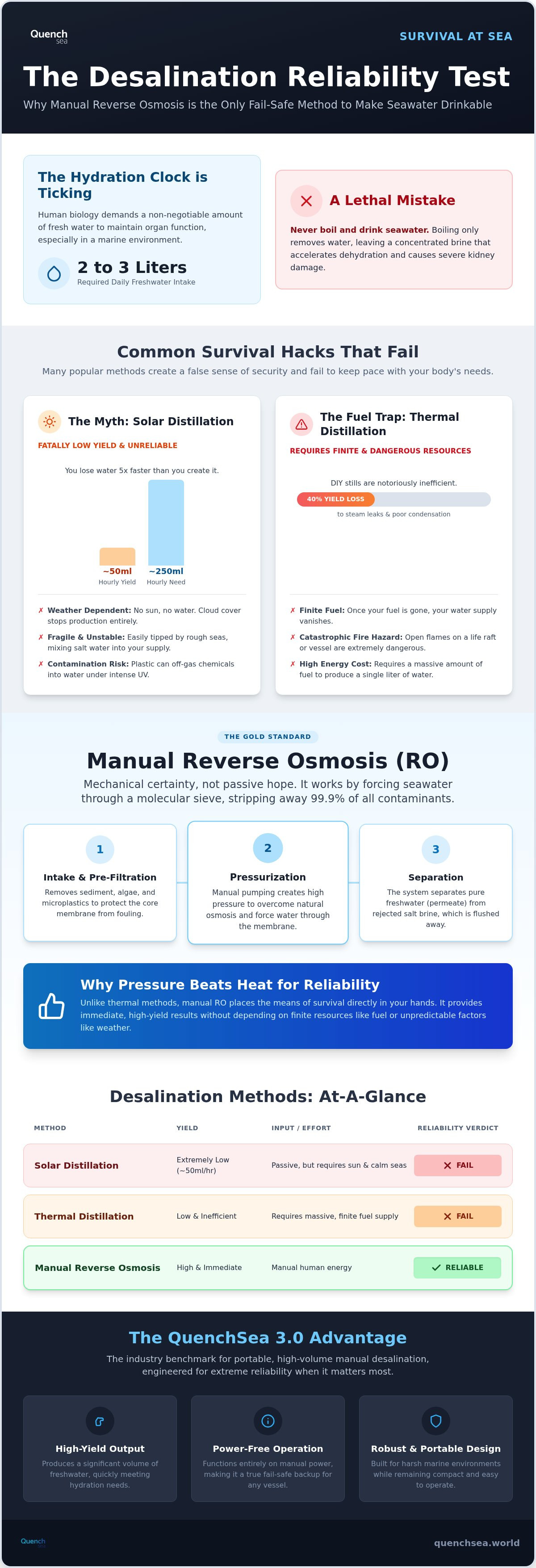
The hydration clock starts the moment you're stranded. Human biology demands 2 to 3 liters of freshwater every day to maintain basic organ function. At sea, this requirement is non-negotiable. Many survivors waste precious energy on "hacks" that provide a false sense of security. Identifying the most reliable way to make seawater drinkable is the difference between a controlled recovery and a fatal outcome. You cannot afford to guess when your life depends on a steady yield of potable water.
Don't boil salt water and expect a solution. Boiling only removes the H2O as steam, leaving behind a concentrated brine. If you drink the remaining liquid, you accelerate dehydration by forcing your kidneys to work harder. Understanding Why is Drinking Sea Water Dangerous? is critical before you attempt any field-expedient purification. Passive systems often fail because they lack the mechanical advantage required to keep pace with human thirst.
The Fatal Flaw of Solar Distillation
Solar stills are the most common survival myth. They rely on passive evaporation, and the yield is pathetic. A standard solar still produces roughly 50ml of water per hour under ideal conditions. Your body requires at least 250ml per hour to offset losses in high-heat marine environments. You're losing water five times faster than you're creating it. Weather dependency adds another layer of risk. Cloud cover stops production entirely. Rough seas can tip your basin, mixing salt water with your meager freshwater supply. Fragile plastic components also risk off-gassing chemicals into your drinking water under intense UV exposure.
Thermal Distillation and Fuel Scarcity
Thermal distillation requires a heat source to boil water and a condenser to capture steam. The energy math doesn't work for small vessels or life rafts. You need a massive amount of fuel to produce a single liter of water. Fuel is a finite resource. Once it's gone, your water supply vanishes. Open flames on a life raft present a catastrophic fire hazard. Even if you manage a safe fire, DIY stills are notoriously inefficient. Most setups lose 40% of their freshwater yield to steam leaks and poor condensation. This is why professionals rely on Manual Reverse Osmosis. It bypasses the need for heat and provides a direct, mechanical path to hydration. It remains the most reliable way to make seawater drinkable when calories are your only currency.
Manual Reverse Osmosis: The Gold Standard for Reliable Desalination
Reverse osmosis (RO) is a mechanical certainty, not a passive hope. It works by forcing seawater through a semi-permeable membrane at high pressure. This membrane acts as a molecular sieve. It strips away 99.9% of salts, viruses, and bacteria. While industrial plants use massive electrical pumps, manual RO converts human energy directly into freshwater yield. This mechanical advantage eliminates the need for external power sources. When you're offshore, this is the most reliable way to make seawater drinkable because it places the means of survival directly in your hands.
Unlike thermal methods that require hours of energy expenditure before the first drop appears, RO provides immediate results. When Comparing Desalination Methods, the efficiency of pressure-driven systems is unmatched in portable applications. You can master these high-yield techniques by reviewing our guide to Freshwater from Seawater Portable technology. The transition from salt water to potable water becomes a simple matter of mechanical input.
The 3-Step Reverse Osmosis Process
Reliability depends on a linear, sequential process designed to protect the hardware. First, intake and pre-filtration remove sediment, algae, and microplastics. This step is critical; it prevents the core membrane from fouling or tearing under load. Second, pressurization begins. You must overcome natural osmotic pressure through manual pumping. This requires consistent, rhythmic force to push water molecules through the microscopic pores of the membrane. Third, separation occurs. The device divides the stream into permeate (pure freshwater) and concentrate (rejected brine). The brine is flushed away immediately, which keeps the system clean and prevents salt buildup from stalling the process.
Why Pressure Beats Heat for Reliability
Heat is a liability in a survival scenario. Pressure is an asset you control. Manual RO offers instantaneous output. Water flows the moment you begin the pumping cycle. There's no waiting for a basin to heat up or a fire to catch. This system also offers total thermal independence. It functions perfectly in freezing Arctic waters or the pitch darkness of a midnight storm. Manual pressure is the most reliable energy source for desalination because it relies solely on human mechanics rather than environmental variables.
If you're looking for a tool built for these exact high-stakes environments, consider the engineering behind the QuenchSea 3.0. It provides a tactical advantage when every liter of water counts toward your survival.
Comparing Desalination Methods: Speed, Yield, and Effort
Survival is a game of ratios. The most critical ratio is water yield versus caloric expenditure. If you spend more energy procuring water than the water provides in metabolic support, you are accelerating your own decline. When evaluating various desalination methods, you must look at the hourly yield. Manual RO stands out as the most reliable way to make seawater drinkable because it delivers high volume without depleting your core physical assets. It's about mechanical efficiency.
Setup time is another factor that kills. In a marine emergency, you don't have hours to wait for evaporation or fire preparation. A manual pump is ready the moment it leaves your ditch bag. It provides a first drink in minutes, not hours. Reliability also means physical stability. In a storm, solar stills blow away and open flames become impossible to manage. A manual device remains tethered to you, functioning regardless of wind speed or sea state. It is a tactical tool for a tactical environment.
The Survival Threshold Comparison
Compare the numbers to understand the reliability gap. A solar still produces a meager 0.5L to 1L per day. This is a high-risk gamble that fails to meet basic biological needs. Thermal distillation increases the yield to 1L or 2L per hour, but it demands a constant, dangerous fuel source. Manual RO, such as the technology found in a Saltwater Reverse Osmosis System Portable, produces 4L to 6L per hour. This isn't just an improvement; it's a total shift in survival capability. It offers high reliability with only moderate physical effort.
Portability and Storage Factors
Weight is a liability on a life raft or in a disaster relief scenario. Storing 20 liters of water adds 20kg of dead weight to your gear. In contrast, a 1kg manual RO device can produce those same 20 liters in roughly four hours of operation. This 20:1 weight-to-yield ratio makes manual desalination the most reliable way to make seawater drinkable for long-term survival. It frees up space for medical supplies and communication gear. For any serious ditch bag, a compact, high-yield device is the only logical choice. It turns the entire ocean into your reservoir without the burden of carrying it on your back.
Potability and Safety: Managing TDS and Maintenance
Survival isn't just about volume. It's about chemical safety. Total Dissolved Solids (TDS) measures the concentration of dissolved substances in your water. For long-term health, 500 parts per million (ppm) is the safety target. While the human palate can detect salt, it's a subjective and dangerous metric. Relying on taste alone is a gamble you shouldn't take. High-precision engineering makes manual RO the most reliable way to make seawater drinkable, but you must monitor the output to ensure the membrane remains intact.
Pre-filtration is the most critical step for maintaining RO reliability because it shields the sensitive membrane from abrasive sediments and biological fouling that would otherwise cause immediate mechanical failure. Without this first line of defense, microplastics and algae will clog the system. You must also be aware of your environment. Harmful algal blooms, or red tides, release neurotoxins. While RO removes the algae, some toxins are molecularly small enough to bypass the membrane. If the water is discolored or smells of rot, move your intake or wait for clearer conditions.
Maintenance for Long-Term Reliability
Biofouling is the enemy of stored gear. Saltwater left inside a device will stagnate. Bacteria grow. Crystals form. Always flush the system with freshwater after use. If freshwater isn't available, use the cleanest salt water possible for a final flush to remove debris. Membrane storage is equally vital. The heart of your desalinator must never dry out completely. Follow the manufacturer's protocol for long-term preservation. Perform visual inspections monthly. Check for hairline cracks in the housing or seal failures in the pump. Catching these issues during routine checks prevents a crisis when you're offshore. This discipline of maintenance is just as important for your home; for those in Singapore, A ACME Design provides professional window and glass repair to ensure your property remains secure.
Biological Safety Standards
RO membranes are formidable barriers. They physically block pathogens, including bacteria and viruses, which are far larger than water molecules. This ensures biological safety in disaster zones or contaminated marine environments. Some systems incorporate activated carbon. This stage improves taste and adsorbs chemical toxins that might bypass the RO stage. Finally, monitor your hydration. Track your hourly output against your physical exertion. If you aren't producing 250ml per hour, you are falling behind the hydration clock. Stay disciplined with your equipment to stay alive.
Secure your water supply with the QuenchSea 3.0 Desalination Device to ensure performance when reliability is non-negotiable.
The QuenchSea 3.0 Advantage: Engineering for Extreme Reliability
When mechanical failure is not an option, the hardware you carry must be beyond reproach. The QuenchSea 3.0 is the world's most accessible manual RO device, specifically engineered to bridge the gap between industrial-grade desalination and portable survival needs. It represents the most reliable way to make seawater drinkable by stripping away the complexity of electronics and internal combustion. It relies on a single, dependable variable: human mechanical input. This device transforms the vast energy of the ocean into a controlled, high-yield freshwater stream.
The 3.0 model utilizes survival-grade materials designed for the brutal reality of marine environments. Corrosion-resistant hardware ensures that salt spray and humidity won't compromise the pump's integrity over time. High-flow engineering allows the device to produce up to 4 to 6 liters of freshwater per hour. This output is achieved through a refined lever system that maximizes pressure while minimizing physical fatigue. You can find a detailed breakdown of these technical specifications in our QuenchSea 3.0 Desalination Device Guide. It's built for those who prioritize performance over fluff.
Why Professionals Trust the 3.0 Model
Reliability is proven in the field, not the lab. The QuenchSea 3.0 is field-tested by defense and humanitarian organizations operating in high-stress disaster zones. Its compact footprint is optimized for life rafts and emergency ditch bags where space is a premium. In a crisis, your cognitive load is high. You don't have time for complex assembly or troubleshooting. The 3.0 model features intuitive operation that allows a user to begin desalination within seconds of deployment. It is a mission-driven tool for professional mariners and survivalists alike.
Securing Your Water Independence
True water independence requires a fail-safe backup for your vessel's primary water maker. Integrate the QuenchSea 3.0 into your safety protocol by conducting quarterly drills. Practice the intake setup and pumping rhythm to ensure muscle memory during an actual emergency. For 2026 preparedness, maintain your device by keeping the membrane hydrated and the seals lubricated. This proactive approach ensures your equipment is ready the moment the hydration clock starts ticking. Don't wait for a system failure to realize you need a manual solution. It remains the most reliable way to make seawater drinkable when all other systems fail.
Prepare for the unexpected with QuenchSea 3.0 and secure your survival-grade water supply today.
Mastering Your Marine Survival Strategy
We've stripped away the survival myths of solar stills and the lethality of boiling brine. You now recognize that mechanical pressure is the only definitive path to high-volume hydration. Reliability is a choice made during preparation, not a hope found in the middle of a crisis. Manual reverse osmosis stands as the most reliable way to make seawater drinkable because it eliminates dependency on environmental variables like cloud cover or fuel scarcity.
To secure your water independence, choose a tool trusted by marine professionals and emergency responders worldwide. The QuenchSea 3.0 produces up to 6 liters of freshwater per hour through 100% manual operation. It requires no electricity and no fuel. It's built for the harsh reality of the open sea. Secure the most reliable survival water maker: QuenchSea 3.0.
Take command of your environment. With the right hardware in your ditch bag, the ocean is no longer a threat. It becomes your reservoir. Stay prepared and stay hydrated.
Frequently Asked Questions
Can you boil seawater to make it drinkable?
No, boiling seawater alone does not make it drinkable. Boiling evaporates the water but leaves the salt behind, creating a concentrated brine that accelerates dehydration. To make seawater safe through heat, you must capture and condense the steam using a distillation setup, which is fuel-intensive and often inefficient in survival scenarios.
How much water can a manual desalination device produce per hour?
A high-performance device like the QuenchSea 3.0 produces between 4 and 6 liters of freshwater per hour. This output is significantly higher than the 250ml per hour required for basic human metabolic support. It represents the most reliable way to make seawater drinkable because it provides a consistent, high-volume supply without the need for external power.
Does a manual RO device require a lot of physical strength to operate?
No, these devices utilize mechanical advantage to reduce the physical burden on the user. The lever systems are engineered to convert rhythmic pumping into high-pressure filtration with minimal fatigue. This allows individuals of varying strength levels to maintain water production even during the physical stress of an emergency situation.
How long does a reverse osmosis membrane last in a survival device?
The lifespan of a membrane depends on the quality of the intake water and your maintenance routine. Many membranes can process up to 1,000 liters of water if they are regularly flushed and stored correctly. Preventing salt crystallization and biofouling through proper cleaning is the best way to ensure your desalinator remains operational for years.
Is it safe to drink desalinated water for long periods?
Yes, desalinated water is safe for consumption as long as the filtration system maintains a Total Dissolved Solids (TDS) level below 500ppm. High-quality RO membranes are designed to hit this target consistently. While the water is pure, in long-term scenarios you should ensure you are getting necessary minerals from your food supply to balance your electrolytes.
What happens if I drink seawater without desalinating it?
Drinking raw seawater is a lethal mistake. Your kidneys must use more freshwater to flush out the ingested salt than the seawater itself provides, which triggers a rapid and fatal dehydration cycle. Using a manual desalinator is the most reliable way to make seawater drinkable and prevent the organ failure associated with salt toxicity.
Does QuenchSea remove bacteria and viruses from the water?
Yes, the QuenchSea 3.0 uses a reverse osmosis membrane that acts as a molecular barrier. It physically blocks 99.9% of pathogens, including bacteria and viruses, which are much larger than water molecules. This ensures that the water you produce is biologically safe as well as desalinated.
What is the difference between a water filter and a desalinator?
A standard water filter only removes suspended solids, sediment, and biological threats like protozoa. It cannot remove dissolved salt molecules from the water. A desalinator uses reverse osmosis or distillation to strip salt at the molecular level. You cannot use a typical hiking or camping filter to turn ocean water into freshwater.