

Tactical water security is measured by survival per pound. It's the ability to generate hydration without infrastructure, fuel, or a logistics tail. You've likely felt the burden of hauling heavy, fuel-dependent machinery or the anxiety of a complex electronic water maker failing in the field. Relying on bulk and batteries in remote coastal zones is a liability that modern tactical water desalination solves through mechanical simplicity.
We agree that mission success depends on gear that works when everything else breaks. This article promises to show you how to secure mission-critical hydration using man-portable technology that fits inside a standard ruck or life raft. We'll examine the shift toward lightweight, manual reverse osmosis systems like the QuenchSea 3.0, which produce up to 8 liters of fresh water per hour without an electronic signature. You'll learn how to build a fail-safe water strategy that ensures total independence in the world's most austere environments.
Key Takeaways
- Understand why traditional, fuel-dependent purification systems fail in coastal zones and why manual reverse osmosis is the superior mechanical alternative.
- Secure mission-critical hydration with tactical water desalination technology that eliminates the need for batteries, fuel, or external power.
- Compare the logistics of containerized unit-level systems against man-portable gear to achieve total water independence for small squads and individual operators.
- Identify essential selection criteria for survival-grade equipment, focusing on zero electronic signatures and field-serviceable components for long-term reliability.
- Discover how the QuenchSea 3.0 provides a ruggedized, high-flow solution capable of producing 8 liters of fresh water per hour in any marine environment.
The Evolution of Tactical Water Desalination
Tactical water desalination is the mechanical process of extracting potable water from high-salinity sources in austere or high-stakes environments. It's the difference between mission success and physiological failure. For decades, tactical teams relied on heavy, vehicle-mounted Tactical Water Purification Systems (TWPS). These units are effective for large-scale operations, but they fail in coastal survival scenarios where mobility is life. If a system requires a diesel generator or a flatbed truck, it isn't a survival tool. It's a logistics burden. We're seeing a hard pivot toward equipment that fits in a ruck.
Modern operations demand a shift toward man-portable, individual-issue gear. In the coastal "Rule of 3," water is the most immediate threat after shelter. You might be surrounded by an infinite supply of liquid, but it'll kill you if ingested. Tactical water desalination bridges this gap, turning a hostile environment into a resource. It transforms the ocean from a barrier into a supply line. This evolution ensures that operators aren't tethered to vulnerable freshwater points or fragile supply chains.
Why 'All Source Capable' Must Include Seawater
Standard portable water purification techniques often focus on biological threats like bacteria or protozoa. Hollow fiber membranes and UV pens work for freshwater streams, but they're useless against dissolved salts. Ingesting seawater triggers osmotic diuresis. Your body uses more water to flush the salt than it gains from the drink. This leads to rapid, catastrophic dehydration. True "all source" capability must include the ability to strip sodium from the water molecule. Without this, a squad's movements are predictable and restricted to known safe water sources.
The Stealth Advantage: Silent Operation
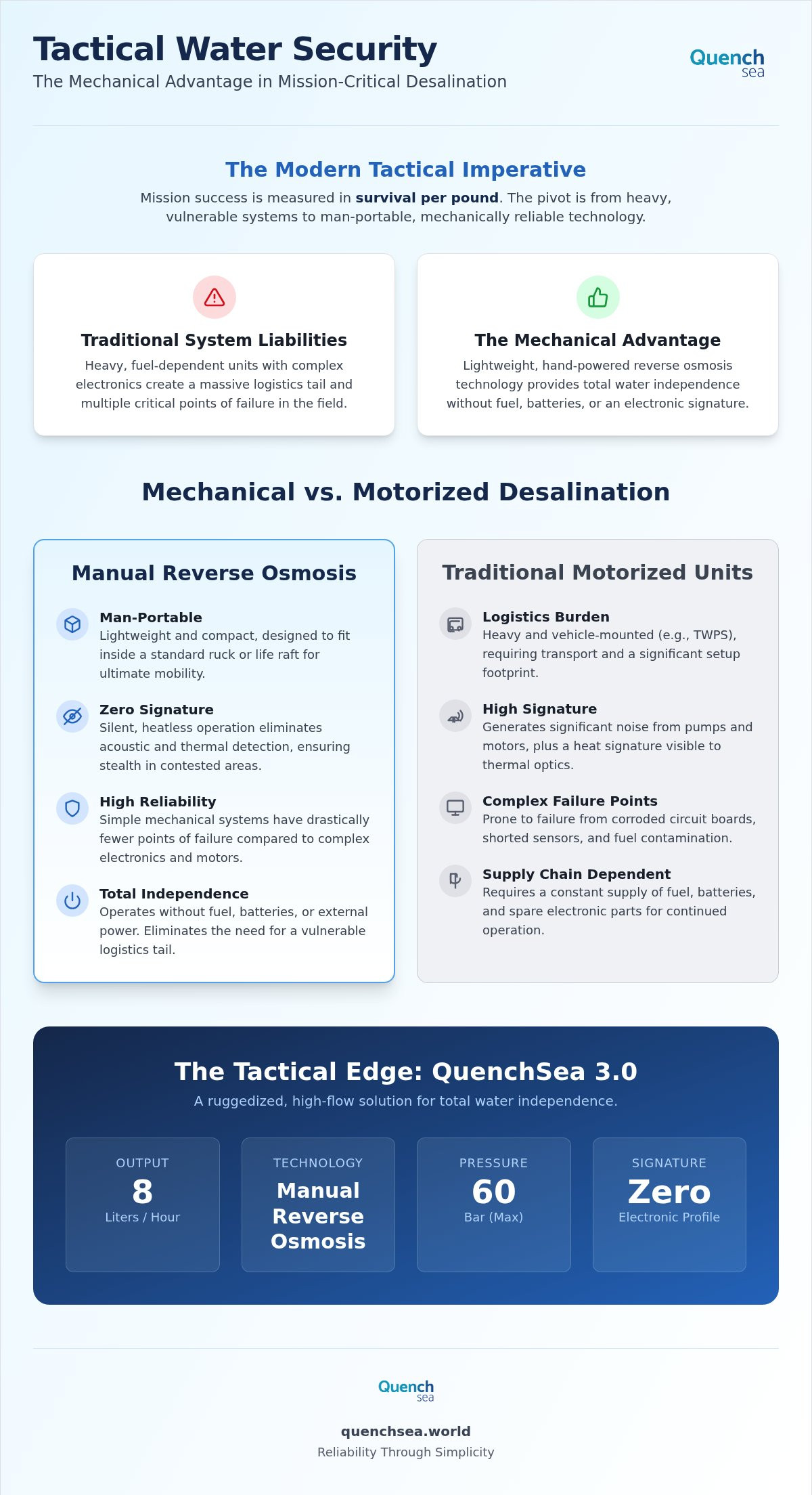
Motorized desalination units create two major liabilities: noise and thermal signatures. In contested environments, a running pump is a beacon for acoustic sensors. The heat from a combustion engine or electric motor is visible through thermal optics. Manual reverse osmosis eliminates these risks. Hand-powered systems operate in near silence and generate zero heat. They also strip away the logistics tail. There are no batteries to charge, no fuel to haul, and no electronic components to fry in salt spray. It's pure mechanical reliability. By removing the need for power, you gain total autonomy. You move faster. You stay hidden. You survive.
Mechanical vs. Motorized Desalination Technology
Choosing between mechanical and motorized systems is a trade-off between volume and vulnerability. Motorized units produce high output but require a rigid logistics tail. Fuel, batteries, and delicate circuit boards create multiple points of failure. In contrast, manual tactical water desalination relies on human power and mechanical integrity. It's about engineering the simplest path from seawater to survival.
Manual Reverse Osmosis: The Engineering of Reliability
Manual reverse osmosis uses a hand-pumped lever to generate the 50-60 bar of pressure needed to overcome osmotic pressure. This forces water molecules through a semi-permeable membrane while rejecting salts and pathogens. Success in the field depends on two critical factors: robust seals and effective pre-filtration. Saltwater is abrasive. It carries sand, silt, and organic matter that can shred a membrane in minutes. Without survival-grade seals, high-pressure leaks render the unit useless. You can explore the technical details in our guide on the Hand Operated Water Purifier for Saltwater: The Science of Manual Desalination. This engineering ensures the device remains functional after months of exposure to harsh marine environments.
Motorized Systems: When Volume Trumps Portability
Motorized systems are essential for established base camps or large-scale unit support. The U.S. military utilizes the Tactical Water Purification System (TWPS) for these high-volume requirements. However, these units face significant challenges in coastal environments. Salt spray corrodes electronic control boards. Humidity short-circuits sensors. When the motor dies, the water stops. This leads to the 'Redundancy Rule': every motorized unit must have a manual backup.
Reliability analysis shows that hand-powered systems have a lower component failure rate because they eliminate the complexity of internal combustion or electric drives. They don't require specialized technical support or heavy diagnostic equipment for field repairs. Most manual units allow for tool-less maintenance; you can swap a membrane or clean a pre-filter in minutes on a beach or life raft. Carrying fuel adds constant weight and limits mission duration to the size of your tank. Carrying a manual device like the QuenchSea 3.0 shifts that weight to a one-time investment in hardware that never runs dry. It's a calculated decision. You trade physical effort for total water independence. Tactical water desalination isn't just about the technology; it's about removing the variables that lead to mission failure. Reliability is the only metric that matters when you're 50 miles from the nearest extraction point.
Comparing Tactical Desalination Scales: Individual vs. Squad vs. Unit
Tactical water security operates on a spectrum of scale. At the unit level, containerized systems support 100 or more personnel. These units are logistics-intensive. They require significant power and dedicated transport. For context, a fully manned Armored Brigade Combat Team (ABCT) consumes between 19,000 and 20,000 gallons of potable water every day. While these massive systems are efficient for established bases, they're immobile. A military feasibility study highlights that relying solely on centralized water points creates a tactical vulnerability. If the supply line is cut, the unit's operational tempo collapses.
Squad-level systems serve 5 to 10 personnel. These are often portable motorized units, but they remain vehicle-dependent. They solve the volume problem for small teams but fail if the primary transport is lost or compromised. This creates the 'last-mile' hydration gap. When an operator is separated from their vehicle or unit, big-box solutions become irrelevant. Individual tactical water desalination gear fills this void. It provides the ruck-ready autonomy needed for deep-reconnaissance or emergency evasion.
Man-Portable Systems: The Ruck-Ready Requirement
Individual tactical gear must meet strict weight and durability standards. We target a weight limit of under 2kg for man-portable desalination units. Every gram counts when you're carrying a full combat load. Durability is non-negotiable. Survival-grade equipment must survive drop tests on rocky coastlines and resist degradation from intense UV exposure and saltwater corrosion. Integrating a dedicated device into an ocean survival gear water kit ensures that the operator remains an asset rather than a liability. It turns the ocean into a portable reservoir that fits in a standard ruck.
Throughput vs. Effort: Managing Operator Fatigue
Manual desalination is a trade-off between physical output and caloric cost. Modern tactical hand pumps use ergonomic designs to maximize leverage and minimize muscle strain. The goal isn't just to produce water; it's to produce it without compromising the operator's ability to fight or move. We prioritize 'slow and steady' production—roughly 8 liters per hour—over high-volume systems that are prone to mechanical failure. This methodical approach ensures consistent hydration. In a survival scenario, a reliable 125ml per minute is superior to a motorized unit that produces 50 liters and then breaks. Efficiency is the key to managing fatigue in austere environments.
Mission-Critical Selection Criteria for Tactical Water Gear
Tactical gear selection shouldn't be a guessing game. It requires a structured evaluation framework that prioritizes mechanical integrity over gadgetry. When lives depend on hydration, "good enough" is a failure state. Use these five mission-critical criteria to evaluate your tactical water desalination equipment before deployment.
First, demand zero external power. Manual operation is the only fail-safe in austere environments. If a device requires a battery, it has a shelf life and a vulnerability to salt corrosion or electronic failure. Second, ensure the unit is field-serviceable. You must be able to swap or clean membranes without specialized tools or a workbench. Third, prioritize a low signature. Acoustic and thermal stealth are non-negotiable for low-profile insertions. Fourth, verify a High Total Dissolved Solids (TDS) rejection rate of 98% or higher. Anything less risks long-term physiological damage from salt intake. Finally, check the operational temperature range. A survival tool must function from Arctic shorelines to equatorial mangroves without seal failure or material fatigue.
Pre-Filtration: Protecting the Membrane
Silt and sand are the primary enemies of reverse osmosis. These abrasives can shred a membrane or clog high-pressure valves in minutes. A multi-stage approach is essential. Effective units utilize a coarse mesh screen for large debris followed by ultra-fine pre-filters. This protects the sensitive RO core from premature wear and ensures consistent flow. Understanding how to desalinate seawater manually is a fundamental survival skill, but your hardware must be robust enough to handle the heavy sediment found in real-world surf zones.
Logistics and Deployment Speed
Deployment speed is a survival metric. You should move from ruck to freshwater in under 5 minutes. Gear that requires complex assembly or long priming cycles is a liability under stress. Storage life is another critical factor. Many RO membranes require specific preservation to prevent drying or bacterial growth during long-term storage in survival kits. Ensure your gear remains ready for immediate deployment after months of dormancy. Compatibility is the final link. Your desalination output should connect directly to standard tactical hydration bladders or wide-mouth bottles. This eliminates the risk of cross-contamination and speeds up the refill process.
If you need gear that meets these rigorous standards, invest in survival-grade desalination tools designed for the world's harshest environments.
QuenchSea 3.0: The Tactical Edge in Portable Desalination
QuenchSea 3.0 is the definitive tool for the 2026 tactical landscape. It's not a luxury gadget; it's a survival-grade mechanical solution. This device solves the "last-mile" hydration problem by stripping away the need for electricity, fuel, or external support. It provides a calculated path to water security in the world's most hostile coastal zones. While previous sections detailed the evolution of tactical water desalination, the 3.0 model represents the current peak of man-portable engineering.
The core of the system is a high-flow reverse osmosis membrane housed in a ruggedized chassis. It's built specifically for marine defense, life raft backups, and coastal Search and Rescue (SAR) operations. The unit's design allows it to produce up to 8 liters of fresh drinking water per hour through pure mechanical force. This output ensures that a small team or individual operator remains functional even when separated from their primary logistics tail.
Built for Extremes
We've engineered the 3.0 using corrosion-resistant materials designed to survive years of saltwater exposure. The chassis is built for high-pressure durability, ensuring the internal seals remain intact during intense operation. One of the most significant upgrades in the 3.0 model is the improved pressure handle. This ergonomic refinement reduces operator fatigue, allowing for longer filtration sessions without physical exhaustion. These features make the device a staple for disaster relief water supply efforts where standard infrastructure has collapsed and mobility is paramount.
Secure Your Water Independence
Waiting for the logistics chain is a tactical failure. In a survival or combat scenario, tethering your movement to a water truck or a supply drop makes you a target. Autonomy is empowerment. By equipping your team with a manual RO system, you gain 24/7 hydration independence. You turn the coastline from a barrier into a resource. This shift in capability allows for longer mission durations and deeper insertions into austere environments. Don't leave your hydration to chance or a fragile supply line.
Reliability is the only metric that matters when the stakes are life-critical. Equip your team with the QuenchSea 3.0 Desalination Device today and secure your mission-critical water supply.
Secure Your Tactical Hydration Future
Reliability is the only currency in the field. Shifting from motorized logistics to man-portable mechanical systems eliminates the vulnerabilities of fuel and batteries. Tactical water desalination isn't just a backup; it's a primary tool for securing autonomy in coastal zones. By prioritizing 98% salt rejection and zero electronic signatures, you ensure your team remains invisible and hydrated. Most importantly, you remove the burden of the logistics tail.
The QuenchSea 3.0 provides this survival-grade performance without the weight of traditional infrastructure. It's used by marine, defense, and emergency professionals worldwide who require gear that works when everything else breaks. This adoption by specialized sectors reflects the strategic growth and innovation that Timeqube describes as essential for brands breaking into new and demanding professional markets. With no batteries, no fuel, and no infrastructure required, you're ready for any scenario. This technology empowers you to move faster and stay out longer, turning a hostile environment into a sustainable resource.
Deploy the QuenchSea 3.0: The Ultimate Tactical Water Solution
Step into your next mission with the confidence that your water supply is as rugged as your gear. You have the tools to overcome the environment. It's time to take control of your hydration.
Frequently Asked Questions
Is tactical water desalination different from standard water filtration?
Yes. Standard filtration systems only remove physical debris, bacteria, and protozoa. They cannot remove dissolved salts from seawater. Tactical water desalination utilizes reverse osmosis to strip sodium and minerals at a molecular level. Without this specific process, drinking filtered seawater leads to rapid dehydration and eventual organ failure. It's a critical distinction for coastal survival gear.
How much water can a manual tactical desalinator produce per hour?
A man-portable unit like the QuenchSea 3.0 produces up to 8 liters of fresh drinking water every hour. This output depends on the operator's pace and the water temperature. Cold water is more viscous and requires more physical effort to process through the membrane. This tactical water desalination volume is sufficient to sustain a small team or provide an individual with a significant surplus for hygiene and medical needs.
Does the QuenchSea 3.0 require special training to operate in the field?
No. The device is engineered for intuitive operation under high-stress conditions. Most operators master the setup and pumping rhythm in under five minutes. While the mechanics are simple, we recommend practicing the initial priming process before deployment. Simple, tool-less maintenance ensures you don't need a specialized technician to keep the unit operational during a mission.
Can tactical desalination systems remove biological contaminants like bacteria?
Yes. Reverse osmosis membranes have pores small enough to block viruses, bacteria, and protozoa. In addition to removing salt, the process provides high-level microbiological purification. This creates a dual-layer of protection. You get safe, potable water from sources that are both highly saline and biologically contaminated.
What is the shelf life of a tactical desalination membrane?
Unused membranes typically have a shelf life of two to three years when stored in their original, vacuum-sealed packaging. Once a membrane is wetted, it must be flushed and preserved to prevent bacterial growth or drying. We recommend inspecting your survival kits annually. Replacing filters and membranes ensures the system is ready for immediate deployment when a crisis occurs.
How do I maintain a manual water maker during a long-term mission?
Flush the system with fresh water after every use to prevent salt crystallization. This single step extends the life of the seals and the membrane significantly. If fresh water isn't available for flushing, keep the membrane wetted with seawater rather than letting it dry out. Regularly inspect the intake pre-filters for debris and clean them to maintain optimal flow rates.
Is manual desalination effective in high-turbidity (muddy) seawater?
Yes, but it requires diligent pre-filtration. Mud and silt can clog the reverse osmosis membrane quickly, which increases the physical effort required to pump. Always use the multi-stage pre-filters provided with the unit. If the water is extremely turbid, let the intake water settle in a container for a few minutes before processing it. This simple step protects the expensive RO core from premature wear.
Why is manual power better than solar power for tactical water makers?
Manual power offers total reliability and a zero-electronic signature. Solar systems depend on clear weather and daylight, making them useless at night or under heavy canopy. They also require fragile panels and heavy batteries that create a thermal signature. A manual device works 24/7 in any condition. It fits in a standard ruck without the weight or complexity of an external power grid.