

Imagine paddling through the remote Gulf of Carpentaria with 40 kilograms of water ballast dragging your hull into the chop. Every stroke is a fight against the very weight meant to keep you alive. It's a dangerous paradox. Carrying enough water for a long-haul expedition is exhausting, yet running out in a remote coastal zone is often fatal. This is where sea kayaking desalination transforms from a luxury into a critical survival tool. Modern manual units have replaced the need for heavy storage and fragile solar stills.
You already know that on a small craft, space and power are your most limited resources. You can't afford the battery drain of an electric system or the complexity of traditional setups. This guide will teach you how to master the technical requirements of manual desalination to secure your water supply in any environment. We'll examine why hand-powered reverse osmosis is the only viable choice for 2026. We will focus on the mechanical integrity and the 6 to 8 liter per hour output of the QuenchSea 3.0 to ensure your next mission remains self-sufficient and safe.
Key Takeaways
- Eliminate the dangerous 40kg weight penalty of stored water by integrating a lightweight, hand-powered desalination strategy into your expedition kit.
- Master the three-stage filtration process to remove 98% of salt and biological contaminants without relying on fragile electronics or battery banks.
- Evaluate the critical trade-offs between physical effort and energy expenditure when selecting sea kayaking desalination equipment for remote coastal zones.
- Learn intake best practices to protect your reverse osmosis membrane from sediment and harbor contaminants in shallow water environments.
- Discover why the QuenchSea 3.0 provides a robust, zero-installation solution for water security in the harshest marine conditions.
The Hydration Crisis in Small Craft Expeditions
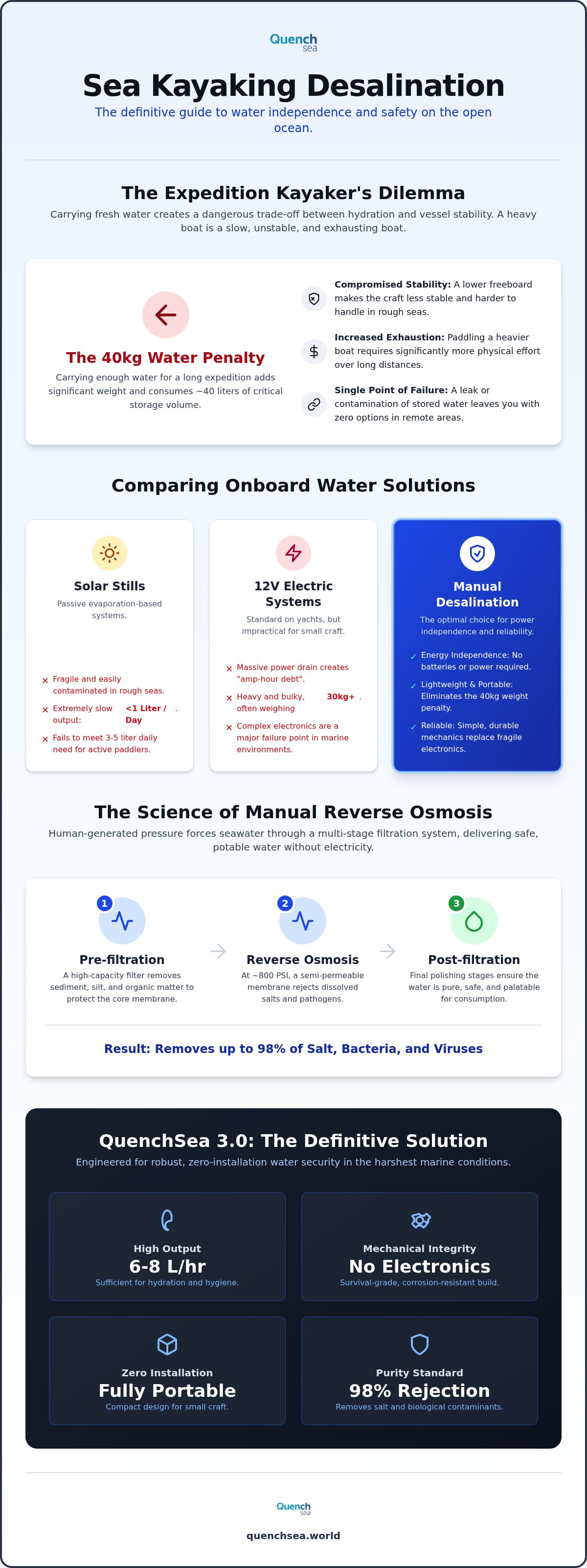
Survival logistics follow the "Rule of 3." You have three minutes without air, three hours without shelter in extreme conditions, and three days without water. For the offshore paddler, water is the primary tactical constraint. Traditional expedition planning requires carrying every drop of fresh water from the launch point. This creates a dangerous "Weight vs. Safety" dilemma. Carrying 40kg of water consumes 40 liters of internal volume. It lowers your freeboard and compromises secondary stability. A heavy boat is harder to maneuver, slower to roll, and more exhausting to paddle over long distances.
Relying solely on stored tank water is a strategic risk. A single leak or a contaminated source leaves you with zero options in remote coastal zones. High-exertion paddling accelerates dehydration. The temptation to supplement with ocean water is a death trap. Understanding why is drinking sea water dangerous is vital; salt intake forces your kidneys to expel more fluid than you ingest. This leads to rapid cellular dehydration and organ failure. Effective sea kayaking desalination eliminates this risk by turning the surrounding environment into your reservoir.
The Limitations of Solar Stills and Distillers
Evaporation-based systems are inadequate for active expeditions. Solar stills are passive, fragile, and slow. They typically produce less than one liter of water per day. Active kayakers require 3 to 5 liters for hydration and hygiene. In rough seas, solar stills are useless. Saltwater frequently contaminates the fresh water reservoir during hull movement. DIY distillers require burning fuel, which adds weight and fire risk. Modern mechanical pressure systems provide the only reliable output for high-demand users.
Power Constraints of 12V Systems on Small Boats
Electric watermakers are standard on yachts, but they fail on small craft. A 12V desalinator creates a significant "amp-hour debt." Small sailboats and pocket cruisers rarely have the alternator capacity or battery bank size to support these units. Solar arrays large enough to offset the draw add windage and weight. Portable electric units often weigh 30kg or more. Manual desalination allows you to trade physical effort for energy independence, keeping your vessel light and your systems simple.
Manual Reverse Osmosis: The Science of Power Independence
Manual Reverse Osmosis (RO) is a mechanical solution to a biological problem. It operates on a simple principle: human-generated pressure. Unlike electric systems that rely on complex circuitry, manual RO forces seawater through a semi-permeable membrane using a physical pump. This process removes 98% of salt, bacteria, and viruses. It delivers fresh water without a single watt of electricity. For the sea kayaker, this means the environment itself becomes a renewable resource.
Mechanical simplicity equals reliability. In the harsh, corrosive environment of the open ocean, electronics are a liability. Saltwater intrusion kills circuit boards and drains batteries. A manual device strips away these failure points. It replaces them with durable, hardware-focused engineering. The result is a survival-grade tool that works every time you pull the lever. The system follows a rigorous three-stage filtration sequence to ensure safety:
- Pre-filtration: A high-capacity filter traps sediment, silt, and organic matter to protect the core membrane.
- Reverse Osmosis Membrane: This semi-permeable layer allows water molecules through while rejecting dissolved salts and pathogens.
- Post-filtration: Final polishing stages ensure the output meets high purity standards and is palatable for consumption.
The Engineering of Manual Pressure
Achieving the necessary pressure for reverse osmosis is a matter of physics. Most systems require approximately 800 PSI to separate salt from water effectively. High-efficiency manual units use a lever-arm design to create a mechanical advantage. This design allows you to generate high pressure with manageable physical effort. It's about efficiency, not just strength. Maintaining a consistent rhythm is the key to high-quality freshwater output. If the pressure drops, the salt rejection rate falls. Precise engineering ensures that the Total Dissolved Solids (TDS) in your water stay well within safe limits. For those seeking a streamlined, hand-powered solution, the QuenchSea 3.0 provides the mechanical integrity needed for extreme conditions.
Membrane Integrity in Portable Devices
The RO membrane is the heart of any sea kayaking desalination setup. These membranes are sophisticated engineering marvels, but they are vulnerable to fouling. Silt, algae, and oil can clog the pores, rendering the device useless. This is why pre-filters are non-negotiable in coastal environments where water is often turbid. You must also consider the "cost of failure." If a membrane dries out or grows bacteria during storage, it will fail when you need it most. Proper maintenance involves "pickling" the unit with a preservative solution after use. This chemical treatment keeps the membrane hydrated and sterile, ensuring it is ready for your next offshore mission.
Manual vs. Electric: Choosing Your Desalination Strategy
Selecting a watermaker for a small craft is a tactical decision based on weight, power, and the cost of failure. Large yachts often prioritize high-volume electric systems that produce 100 liters per hour. For the solo explorer or pocket cruiser, these systems are liabilities. A portable electric watermaker typically weighs 30kg and requires a dedicated power source. In contrast, a 1kg hand-powered unit provides total energy independence. You swap battery capacity for physical effort. This trade-off is essential when every kilogram of gear slows your hull speed and increases fatigue.
Maintenance profiles also differ significantly. Electric units rely on sensitive circuit boards, high-pressure pumps, and complex sensors. In a salt-spray environment, these components are prone to corrosion and electrical shorts. Manual systems prioritize mechanical simplicity. They utilize durable seals and lever-action pumps that resist the elements. For budget-conscious paddlers, the cost-to-benefit ratio of manual sea kayaking desalination is clear. You gain a survival-grade tool that doesn't require a generator or a massive solar array to function.
Portability and Storage Flexibility
Space is a luxury in a kayak hatch or a small boat locker. Much like the way Saltwater Interiors approaches the design of bespoke coastal spaces with a focus on both beauty and utility, a sea kayaker must treat every cubic centimeter of storage as a precious resource. A 30kg electric case is impossible to stow in a standard 17-foot sea kayak. Manual units are designed for "stow-ability." They fit easily into bulkheads or emergency ditch bags. This makes them the ultimate "Plan B" for larger vessels as well. If the primary electric watermaker fails or the boat loses power, a manual device ensures you aren't left without hydration. Being ditch-bag ready means you can evacuate your vessel with a guaranteed water supply in seconds.
The "No Holes" philosophy is a core tenet of small craft safety. Installing a traditional watermaker requires through-hull fittings. Every hole in your hull is a potential failure point. Manual desalination requires zero installation. You draw water directly from the ocean using a intake hose. This maintains hull integrity and simplifies your setup. Reliability in extreme temperatures is another factor. While electronics may overheat or fail in freezing conditions, mechanical levers continue to operate. Field repairability is the final advantage. If a seal leaks on a remote beach, you can often service a manual pump with basic tools. You can't fix a fried circuit board in the wilderness.
Practical Implementation for Coastal and Offshore Paddling
Transitioning from theoretical knowledge to field operation requires discipline. You must define your daily water budget based on the environment. In high-heat coastal zones, a survival ration of 2 liters per day is the absolute minimum. For sustained expedition paddling, a comfort ration of 5 liters per day is necessary to prevent muscle fatigue and heat stroke. Integrating a manual water maker for boat into your daily camp routine ensures you never start a day in a hydration deficit. Consistency is key. Establish a morning or evening pumping schedule to refill your bladders. Training your paddling partners is equally critical. Every member of the crew must master the steady, rhythmic stroke required to maintain optimal PSI. This ensures the system remains efficient and the water stays pure.
Managing Pre-filtration in Coastal Zones
Coastal waters are often high-turbidity environments. Silt, sand, and algae are the primary enemies of sea kayaking desalination. If these particles reach the RO membrane, they cause irreversible fouling. To protect your hardware, avoid sourcing water from harbors or areas with heavy boat traffic where oil and fuel films sit on the surface. These chemicals can permanently damage the membrane's chemical structure. In shallow coastal areas, use a "settling" technique. Fill a 10-liter bucket and let it stand for 30 minutes. This allows heavy sediment to drop to the bottom. Draw your intake water from the top 10 centimeters of the bucket. This simple step can triple the lifespan of your pre-filters and keep your RO membrane performing at its 98% rejection rate.
The Watermaker in Your Ditch Bag
Weight is the enemy in a survival situation. A survival desalination device is the most weight-efficient way to carry water. While a 20-liter water jug weighs 20kg, a manual RO unit weighs approximately 1kg and produces an unlimited supply. This makes it the centerpiece of any emergency ditch bag. Rapid deployment is essential. Practice unpacking and assembling the unit until the process becomes muscle memory. Beyond survival, using a manual watermaker reduces reliance on single-use plastics. You eliminate the need to carry and dispose of bottled water in sensitive marine ecosystems. This aligns your expedition with global responsibility goals while maximizing your safety. For a robust and dependable solution, invest in the QuenchSea 3.0 to secure your water supply for every offshore mission.
QuenchSea 3.0: The Definitive Small Craft Solution
The QuenchSea 3.0 represents the pinnacle of survival-grade engineering for the solo explorer. It is not a luxury accessory. It is a mission-critical tool designed to function in the harshest marine environments on earth. For the sea kayaker, every gram of equipment must earn its place. Traditional watermakers are too heavy, and manual alternatives often lack the necessary output. The QuenchSea 3.0 solves this by balancing mechanical integrity with high-volume production. It turns the ocean into a reliable freshwater source, allowing you to focus on the paddle, not the payload.
Technical performance is the primary metric for water security. The QuenchSea 3.0 delivers a salt rejection rate of 98%, ensuring the output is safe and palatable. Under standard manual operation, the device produces 6 to 8 liters of fresh water per hour. This exceeds the production rates of many legacy survival units that only manage 4.5 liters per hour. The RO membrane is built for endurance, processing between 1,000 and 2,000 liters before requiring replacement. This makes it a dependable partner for everything from coastal weekenders to trans-oceanic crossings.
Zero-Power Freshwater Production
Energy management is a constant struggle on small vessels. By utilizing hand-powered reverse osmosis, the QuenchSea 3.0 frees up your limited battery capacity for navigation, VHF radios, and safety lights. You don't need a generator or a complex solar array to stay hydrated. The ergonomic design features a lever-arm that provides a significant mechanical advantage. This allows for sustainable pumping during solo voyages without causing excessive fatigue. When compared to market competitors, the output-to-weight ratio is unmatched. You get a high-performance system in a package compact enough for a standard kayak hatch or an emergency life raft.
The Strategic Choice for 2026
In 2026, the cost of water security has shifted. While electric systems can exceed $4,000, they introduce multiple points of failure. The QuenchSea 3.0 offers an affordable, robust alternative that prioritizes reliability over automation. It is the only viable sea kayaking desalination solution for those who value simplicity and independence. For full technical specifications and maintenance requirements, view the QuenchSea 3.0 Desalination Device guide. Every purchase also supports global humanitarian missions, providing clean water to those in water-stressed regions. It is a tool that empowers the individual while contributing to a global responsibility. Secure your hydration. Simplify your vessel. Master your environment.
Secure Your Freedom on the Open Water
Traditional water storage is a liability that compromises your vessel's stability and your own safety. True endurance in remote coastal environments requires a shift from carrying water to producing it. By mastering sea kayaking desalination, you eliminate the dangerous weight penalty of 40kg jugs and the constant fear of running out. Manual reverse osmosis provides the mechanical integrity needed for extreme environments. It ensures that your hydration is never dependent on battery levels, solar arrays, or fragile electronics.
The QuenchSea 3.0 is the definitive tool for this mission. It requires no electricity or fuel. It's lightweight and survival-ready. This device is trusted by marine safety professionals to deliver high-purity water through a robust, hand-powered pump. It strips away the unnecessary to focus on what truly works. Don't leave your survival to chance or outdated storage methods. Secure your freshwater independence with the QuenchSea 3.0. The ocean is no longer a barrier; it's your reservoir. Prepare for your next expedition with total confidence and a lighter hull.
Frequently Asked Questions
Is a manual watermaker enough for a crew of two on a small sailboat?
Yes, a manual watermaker is sufficient for a crew of two if you maintain a disciplined schedule. A crew of two typically requires 6 to 10 liters daily for survival and basic hygiene. Since the device produces 6 to 8 liters per hour, one hour of pumping covers your collective needs. This approach eliminates the need for heavy, space-consuming tanks on pocket cruisers and ensures you have a renewable source of fresh water.
How hard is it to pump a manual desalination device like the QuenchSea 3.0?
It requires steady physical effort but uses a lever-arm design for mechanical advantage. This engineering reduces the force needed to reach the 800 PSI required for reverse osmosis. It's comparable to using a high-pressure floor pump for bicycle tires. Most users find a rhythmic, slow stroke is more sustainable than rapid pumping during long-distance sea kayaking desalination sessions. Consistency is more important than speed for membrane efficiency.
How long do the reverse osmosis membranes last in a portable watermaker?
The RO membrane in a QuenchSea 3.0 typically processes between 1,000 and 2,000 liters of water before requiring replacement. This lifespan depends heavily on water quality and maintenance. Using pre-filters to remove sediment and "pickling" the unit with preservative during storage are essential steps to reach the maximum volume. Always carry a spare membrane for multi-month expeditions to ensure you aren't left without a functional system in remote areas.
Can I use a portable watermaker in a harbor or marina?
No, you should avoid using any desalination device in harbors, marinas, or near industrial runoff. These areas often contain high concentrations of oils, fuels, and chemicals that can permanently damage the sensitive RO membrane. These contaminants are often too small for standard pre-filters to catch. Always source your intake water from the open ocean or clear coastal zones to ensure the purity of your output and the long-term reliability of your hardware.
Does the QuenchSea 3.0 remove bacteria and viruses as well as salt?
Yes, the reverse osmosis process is highly effective against biological contaminants. The semi-permeable membrane rejects 98% of dissolved salts and is small enough to block bacteria, viruses, and microplastics. This provides a comprehensive safety net for offshore travelers. It transforms raw seawater into sterile, potable water that meets high purity standards without needing chemical additives or boiling. It's a survival-grade solution that addresses both hydration and biological safety in extreme environments.
What maintenance is required for a manual sea kayaking watermaker?
Routine maintenance involves three core actions to ensure long-term reliability. First, rinse the system with fresh water after use to prevent salt crystallization in the valves. Second, replace pre-filters when they become discolored or when pumping resistance increases. Third, use a preservative solution if the device will be stored for more than seven days. This prevents biological growth on the membrane surface and maintains the mechanical integrity of the internal seals.
How much fresh water can I realistically produce in one hour of manual pumping?
You can realistically produce 6 to 8 liters of fresh water per hour with the QuenchSea 3.0. This output rate is significantly higher than older manual survival models, which often peak at 4.5 liters per hour. The actual volume depends on your ability to maintain a consistent rhythm and the temperature of the seawater. Colder water generally requires more pressure to process, while warmer water flows through the membrane with slightly less resistance.
Is it better to carry extra water tanks or a portable watermaker on a kayak?
A portable watermaker is the superior choice for long-distance sea kayaking desalination and water security. Carrying 40 liters of water adds 40kg of dead weight, which degrades hull performance and increases capsizing risk. A 1kg manual unit provides an unlimited supply from the surrounding environment. It reduces your physical workload and keeps your kayak light, responsive, and safe. It's a calculated mechanical solution that replaces heavy, static storage with active, renewable production.