

On a remote atoll, seawater is abundant; dependable drinking water isn’t. This remote atoll freshwater maker manual starts with a practical truth: a hand-powered desalination device can work without electricity or fuel, but it’s only one part of a reliable water plan.
Limited wells, irregular rainfall, and hard-to-replenish supplies make backup options essential. Manual reverse osmosis can provide another source when power fails or fuel runs short, though operating the device takes physical effort and careful handling. Stored water and rainwater collection can help cover needs when conditions change or equipment is down.
This guide covers how to plan a mix of water sources, follow a disciplined operating routine, and prepare for basic care and downtime. It also explains where QuenchSea 3.0 fits in an off-grid setting, without treating desalination as a complete solution to every water risk. Use it to plan seawater access, manage reserves, and keep freshwater options ready when conditions shift.
Key Takeaways
- Map freshwater needs by use, then account for seasonal supply, storage, and replenishment at your specific atoll.
- Use this remote atoll freshwater maker manual as a planning aid, and follow the current device manual for operating steps.
- Compare seawater desalination, rainwater collection, and stored water by effort, availability, and reliance on weather or existing reserves.
- Keep clean containers ready, protect stored water, and separate untreated seawater from produced freshwater.
- Assess whether QuenchSea 3.0 fits your seawater access, operating capacity, and backup plan. It uses hand-powered reverse osmosis without electricity, batteries, or fuel.
Remote atoll freshwater planning: identify the site’s real water constraints
Freshwater availability, storage, and replenishment vary by atoll and season. A plan that works during a rainy period may fail when rainfall drops, storage runs low, or resupply is delayed. Start by listing what water is available now, what can be replenished, and what each source is intended for. Seawater may be close at hand, but it only becomes a practical freshwater source when you have a suitable device, the capacity to operate it, and a clean way to collect and store the output.
A manual freshwater maker uses human effort to press seawater through a reverse-osmosis membrane, separating much of its dissolved salt from the water. This is one of several desalination processes. A hand-powered unit reduces reliance on electricity and fuel, but still depends on seawater access, physical effort, correct operation, and equipment readiness.
Assess the atoll’s water sources before choosing a method
Map each source and its limits. Mark practical seawater collection points, rain-catching surfaces, storage locations, and freshwater sources managed locally. Note access conditions, exposure to runoff, and whether collection or transport becomes harder in certain weather. Ask local water managers about seasonal changes and existing treatment or handling practices.
Assess risks at the site rather than assuming all sources are alike. Saltwater intrusion can affect groundwater, while runoff, waste, or other local contamination may affect water quality. Open-ocean and lagoon water can differ in salinity, sediment, and exposure to nearby activity. Follow the device’s source-water instructions for the water you plan to use. Desalination removes salt and reduces dissolved solids, but it does not resolve every chemical or biological contamination risk.
Set a realistic water plan for people and conditions
Separate immediate drinking needs from water used for cooking, hygiene, cleaning, and other tasks. Estimate each category for the group and expected conditions, using locally appropriate public-health or emergency guidance rather than relying on a universal quota. This makes priorities clear if supplies tighten and helps protect drinking reserves from being used casually for lower-priority tasks.
Next, match storage and replenishment to the site. Consider how much protected water is already available, how rain collection may change with the weather, when resupply could be interrupted, and how often people can operate a manual device. Keep a clear reserve for urgent needs and avoid treating any single source as guaranteed. Seawater desalination can add resilience, but it is not a complete water system.
For a broader preparedness framework, the remote survival desalination guide places emergency desalination in the context of backup planning. Use this remote atoll freshwater maker manual as a starting point, then adapt the plan to local sources, users, weather, and the device’s current instructions.
How to use a manual freshwater maker on an atoll
A manual freshwater maker uses hand-powered pressure to push seawater through a reverse-osmosis membrane. The membrane separates much of the dissolved salt from the water, but reliable use depends on following the device’s instructions from setup through storage. Treat the current manufacturer’s manual as the authority for every model-specific step. The workflow below is a planning framework, not a substitute for those instructions.
QuenchSea 3.0 operates without electricity, batteries, or fuel. Its hand-powered design is useful when those energy sources are unavailable, though producing water still takes physical effort. Output depends on the device instructions and operating conditions, so don’t plan around an assumed production rate.
Prepare the device and seawater intake
Before use, set up a clean work area and keep the freshwater container separate from seawater, discharge, and waste. Read the current QuenchSea 3.0 manual, then inspect and assemble the unit exactly as directed. Don’t improvise connections or skip a preparation step because another device uses a different procedure.
Choose an accessible seawater source and position the intake according to the manual. Consider nearby runoff, sediment, or other local contamination, and follow any source-water restrictions specified by the manufacturer. Clear-looking water isn’t proof that it’s free of contaminants. If the site or water conditions fall outside the manual’s guidance, use another appropriate source.
Operate, collect, and handle produced water
Follow the product’s sequence for starting and operating the hand-powered mechanism. Apply effort as directed, and watch for the operating cues described in the manual rather than relying on a guessed pumping rhythm or pressure. Direct the freshwater outlet into a clean, designated container. Keep it separate from intake water and discharge throughout the process.
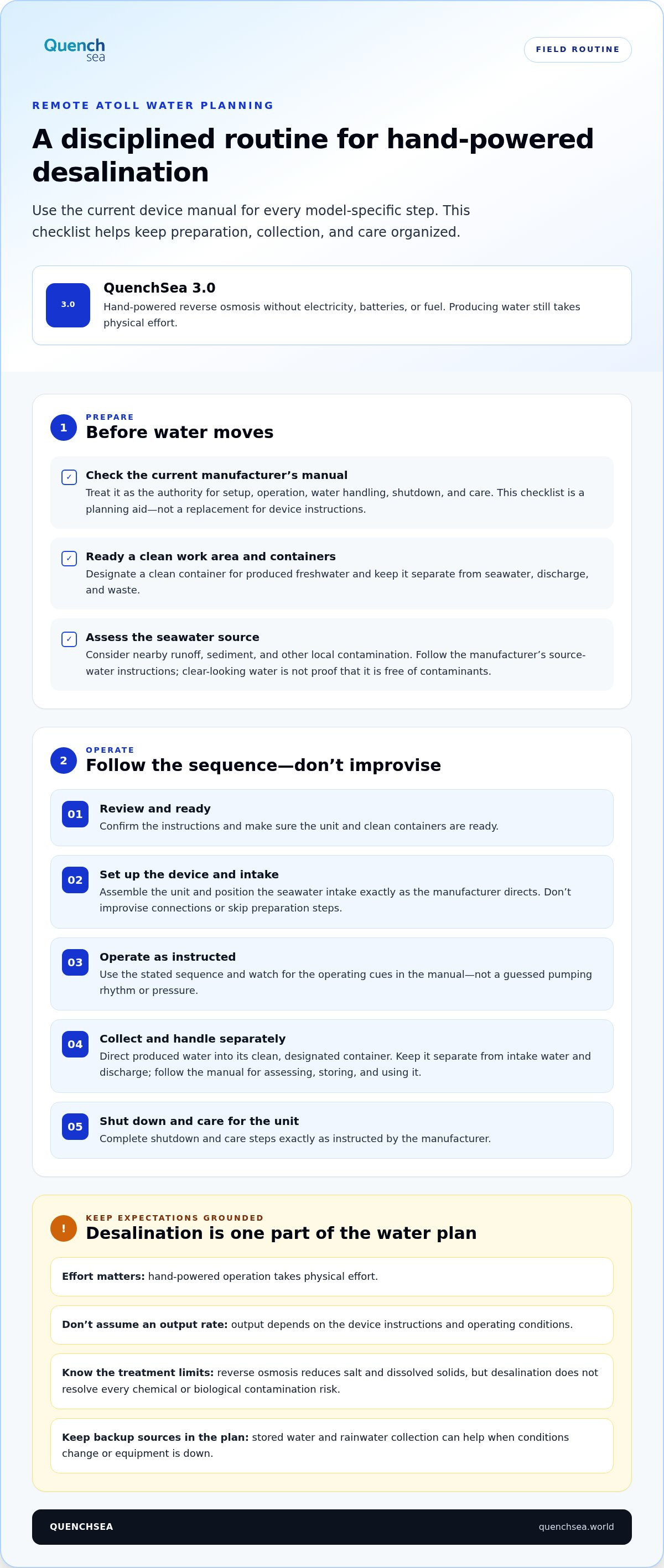
Use this ordered routine as a field check, verifying each device-specific action against the current manual:
- Review the instructions and make sure the unit and clean containers are ready.
- Set up the device and seawater intake as the manufacturer directs.
- Operate the hand-powered mechanism according to the stated sequence.
- Collect produced water separately, then follow the manual’s guidance for assessing, storing, and using it.
- Complete shutdown and care steps exactly as instructed.
Reverse osmosis reduces salt and dissolved solids, but desalination is not a solution to every chemical or biological hazard. Follow the device’s guidance for assessing water quality and handling output. Store produced water in clean, protected containers, clearly marked apart from untreated seawater. If operating conditions change or output seems unusual, stop and consult the manual before continuing.
A disciplined routine makes a manual unit easier to integrate into an atoll water plan. For a closer look at the hand-powered option, explore the QuenchSea 3.0 desalination device and assess how it fits your site’s seawater access, user capacity, and backup arrangements.
Manual desalination vs. rainwater and stored water on a remote atoll
No single source is dependable in every atoll or season. Manual desalination draws on seawater when a suitable intake is accessible, rain collection can replenish supplies when conditions allow, and stored water can bridge a shortfall. Each has a different dependency: access and effort, weather and catchment, or the volume already held in reserve. Compare those limits against local conditions, not a universal ranking.
| Water source | Availability and dependency | Effort and limits |
|---|---|---|
| Manual seawater desalination | Requires accessible seawater and a ready, functioning device; seawater may be available beyond the immediate operating site. | Requires hands-on operation and device care. It is designed for seawater desalination, not as a universal purifier for every water source or contaminant. |
| Rainwater collection | Depends on rainfall, suitable catchment, and safe storage. Supply can vary with weather and local conditions. | Requires maintaining clean catchment surfaces and handling collected water safely. Collection may not replenish reserves during dry periods. |
| Stored water | Available while a protected reserve remains. It is finite and depends on the volume stored and actual demand. | Requires containers, space, and protection from contamination. Manage it so the reserve lasts through interruptions. |
| Groundwater or freshwater lens | Depends on local geology, access, and current water quality. | Requires site-specific assessment. Salinity or contamination can make a source unsuitable for its intended use. |
Where manual seawater desalination fits
A hand-powered reverse-osmosis maker adds a source option where seawater is accessible and electricity or fuel can’t be relied upon. Its usefulness still depends on the device, seawater conditions, user capacity, and correct operation. Don’t assume it can treat rainwater, groundwater, or any other source. For marine-use comparison context, the manual boat water maker guide discusses non-electric desalination in an onboard setting.
Why rainfall and stored water still matter
Rain collection can reduce reliance on device operation, but only when rainfall, clean catchment, and protected storage align. Stored water offers a ready reserve, not an ongoing source. Estimate how long it may last from the amount on hand and the group’s actual demand. Groundwater and freshwater lenses also vary by site, so assess their availability and quality locally instead of building a plan around an assumption.
Resilience comes from combining sources with different failure points. Rainwater may replenish reserves when weather cooperates, stored water can cover a gap, and seawater desalination can provide another option when the device and intake are usable. Translate that logic into a site plan: define each source’s role, protect reserves, and decide what happens if one source becomes unavailable.
Atoll field checklist: keep the manual freshwater maker ready
A device is useful only if the group can operate it correctly, protect the water it produces, and respond when conditions change. Keep the current manufacturer’s instructions with the unit. Verify every device-specific setup, operating, cleaning, and storage step against that manual. This checklist highlights the decisions to make without replacing model-specific directions.
Prepare supplies and a backup plan
Inventory the device and the accessories identified in its current operating instructions. Keep clean, dedicated containers for produced freshwater, and label them so nobody confuses them with untreated seawater or discharge. Store water in a protected place and maintain a separate reserve for interruptions. Identify locally appropriate alternative safe sources before they’re needed.
Assign clear roles within the group. One person can operate the unit, another can manage clean-water collection, and someone can monitor containers and reserves. Adjust roles to the group’s size and abilities. Plan for difficult weather that limits access to an intake, interrupts operation, or makes water handling unsafe. If the device is temporarily unavailable, use the reserve and the site’s backup sources rather than improvising repairs.
Use a pre-use, during-use, and post-use routine
- Before use: Read the relevant manual instructions, inspect the unit as directed, and gather the specified accessories. Prepare clean collection containers and keep untreated water, produced water, and waste-handling areas separate.
- During use: Follow the prescribed operating sequence. Watch for changes in operation, keep the collection point clean, and monitor the reserve so the group knows how much protected water remains.
- After use: Follow the manufacturer’s instructions for rinsing, cleaning, inspection, and storage. Don’t add a cleaning method or schedule based on guesswork; use the instructions for the device and conditions.
Separation matters at every handoff. Keep hands, containers, and equipment used for untreated seawater or discharge away from collected freshwater. Close and protect containers after collection, and mark their contents clearly.
Stop and troubleshoot safely
If operation differs from the manual, stop. Don’t force a component, alter a connection, or continue based on an assumed fix. Check the instructions for the relevant condition. If they don’t resolve it, keep the unit out of use and rely on the backup plan until it can be handled according to the manufacturer’s guidance.
For emergency planning beyond routine field use, the life raft water supply guide offers related context. A remote atoll freshwater maker manual is most useful when it supports a practiced routine, clear responsibilities, and a realistic reserve plan. Explore the QuenchSea 3.0 desalination device as a hand-powered option for seawater desalination without electricity, batteries, or fuel.
When QuenchSea 3.0 fits a remote atoll freshwater plan
QuenchSea 3.0 is designed for an atoll plan where seawater is accessible and electricity or fuel can’t be relied upon. It uses hand-powered reverse osmosis to desalinate seawater and operates without electricity, batteries, or fuel. That independence is useful in marine, emergency, and off-grid coastal settings. The device is one part of a water system, which still needs suitable source water, clean handling, protected storage, and alternatives if conditions prevent use.
Match the device to the operating environment
Assess whether users can reach an appropriate seawater intake and operate the device as directed. Consider who will use it, how operation fits the group’s capacity, and what water sources remain available if seawater access is limited or the unit is temporarily unavailable. Follow the current QuenchSea 3.0 manual for setup, operation, and care. Don’t assume the device can treat other sources or address every contamination risk.
Manual desalination can complement rain collection, locally assessed freshwater sources, and stored reserves. The right combination depends on the site and conditions. A remote location with difficult shore access, for example, needs a different contingency plan from one where users can reach an appropriate intake consistently. Treat seawater access as a practical requirement, not a given.
Choose the next step with clear expectations
Before choosing equipment, review the whole water plan. Identify the sources available at the site, the group’s needs, existing storage, and how supplies can be replenished. Decide what the group will do during poor weather, restricted intake access, or device downtime. A QuenchSea 3.0 buyer’s guide can help with product-focused evaluation, while the current device manual provides instructions for use.
Use this decision checklist:
- Source: Is suitable seawater reliably accessible?
- Demand: Can the available users operate the device as needed?
- Storage: Are clean containers and protected reserves ready?
- Contingency: Is there another safe source if operation stops or access changes?
- Handling: Can the group keep untreated water, produced water, and discharge separate?
If these checks fit your conditions, QuenchSea 3.0 can add a power-independent seawater option to your broader plan. It doesn’t replace source assessment, safe water handling, or backup arrangements. Keep expectations grounded in the device’s instructions rather than assuming a particular output. Explore QuenchSea 3.0 as you build a freshwater plan around local needs, user capacity, and dependable alternatives.
Put your atoll water plan into practice
Test the plan before you depend on it. Walk the route to the seawater intake, assign roles, check storage arrangements, and rehearse what the group will do if weather or equipment interrupts the routine. Use the remote atoll freshwater maker manual as a working field reference, then adapt it as local conditions and available sources change.
For marine safety, emergency preparedness, and off-grid coastal use, QuenchSea 3.0 offers hand-powered reverse-osmosis desalination without electricity, batteries, or fuel. Treat it as one part of a broader water plan, supported by source assessment, safe handling, and backup supplies.
Choose equipment with the real operating environment in mind, and make sure users understand the current device instructions before they need them. Explore QuenchSea 3.0 and take the next step toward a more prepared, adaptable freshwater plan.
Frequently Asked Questions
Can a manual freshwater maker desalinate lagoon water?
Only if the device’s current instructions allow that source and local conditions are suitable. Lagoon water can differ from open-ocean seawater in salinity, sediment, and exposure to nearby activity, so don’t treat the two as interchangeable. Follow the manufacturer’s source-water guidance and account for visible or known contamination. If the source falls outside those instructions, use another locally appropriate water source rather than testing the device by trial and error.
How much freshwater can a manual seawater maker produce in a day?
There isn’t one dependable daily output figure for every device or field situation. Use the current manufacturer documentation for the model’s stated output, then account for the conditions and operating routine you can realistically maintain. A simple field log of operating sessions and collected volume can help compare actual supply with drinking and cooking needs. Don’t base your plan on a generic estimate; keep reserve water and another source available. This is essential in a remote atoll freshwater maker manual plan.
Is water produced by reverse osmosis automatically safe to drink?
No. Reverse osmosis removes salt and reduces dissolved solids, but that alone doesn’t prove every possible contaminant has been removed. Follow the device’s instructions and applicable local guidance for the source water, output assessment, and handling. Clean collection equipment can help prevent contamination after production, but it can’t establish that the source itself was suitable. Don’t rely on appearance or taste alone as proof of safety.
Can a manual freshwater maker replace rainwater collection on an atoll?
It shouldn’t automatically replace it. A seawater maker adds another source when suitable seawater is accessible, while rain collection can replenish supplies when rainfall and catchment conditions allow. Either method can be unavailable at times, and both require safe handling and storage. Keep them as complementary options where practical. If rain collection is your main source, identify what the group will use during a dry spell or if the catchment becomes unusable.
Does a hand-powered desalination device need electricity or fuel?
QuenchSea 3.0 is hand-powered and operates without electricity, batteries, or fuel. Users still need to supply the physical effort and follow the device-specific instructions. The lack of a power connection doesn’t tell you how much water it will produce or how long a session will take. Use the current manual to plan operation, and consider who can take part if the person usually operating it becomes tired or unavailable.
What should I do if my freshwater maker stops working in the field?
Stop using it and consult the current troubleshooting instructions before attempting any repair. Don’t force a component or change the setup based on guesswork. Set aside any output whose handling or production you can’t verify, and keep it separate from your reserve. Shift to the planned backup source while the device remains out of use. Record what happened and follow the manufacturer’s directions for deciding whether operation can safely resume.
Can a manual seawater maker treat freshwater or brackish water too?
Don’t assume it can. QuenchSea 3.0 is designed for seawater desalination, and freshwater or brackish water may fall outside its source-water instructions. Before using any source, check the current manual for approved conditions and restrictions. A nearby brackish well may look like a convenient substitute when ocean access is difficult, but that doesn’t establish that the device is suitable for treating it.