

Your survival shouldn't depend on a battery that can fail or a fuel tank that runs dry. In high-stakes marine environments, complexity is a liability. You already know that stored freshwater is heavy, bulky, and finite. Carrying enough for an extended emergency is often a logistical nightmare. The QuenchSea 3.0 Desalination Device changes that equation by turning physical effort into biological survival. It's a mechanical life insurance policy for sailors and travelers who refuse to be stranded by a technical glitch.
This 2026 guide explores how you can achieve total water independence using a rugged device that requires zero electricity. We'll examine the 60-bar manual hydraulic system that produces 6 to 8 liters of fresh water every hour. You'll learn about the TÜV Nord certification and the 98% salt rejection rate that keeps your supply compliant with WHO drinking water standards. This is the definitive breakdown of a 6 kg tool designed to replace bulky rations with a reliable, human-powered solution that works when everything else fails.
Key Takeaways
- Learn how the QuenchSea 3.0 Desalination Device produces 6 to 8 liters of fresh water per hour without relying on power or batteries.
- Understand the 60-bar manual hydraulic system that converts physical labor into biological survival in extreme marine environments.
- Replace bulky, finite water rations with a 6 kg tool that consistently meets World Health Organization standards for safe drinking water.
- Discover the tactical deployment steps needed to secure your intake lines and prime the system for immediate emergency use.
- Build a resilient survival kit that eliminates dependency on solar panels, external fuel, or complex electronic components.
What is the QuenchSea 3.0 Desalination Device?
The QuenchSea 3.0 Desalination Device is a mechanical solution to a biological problem. It's built for those who find themselves in environments where freshwater isn't just a convenience; it's the difference between life and death. This isn't a luxury gadget. It's a survival-grade tool designed to strip salt from seawater using only manual force. By removing the need for batteries, solar panels, or fuel, it eliminates the common failure points found in traditional electronic water makers. When the grid fails or your vessel loses power, your ability to hydrate remains intact.
The 3.0 model represents the peak of portable hydraulic engineering. It utilizes a sophisticated process to understand how manual reverse osmosis works at a scale that fits in a tactical kit. In extreme conditions, you can't rely on external energy. Whether you're on a marine life raft, a yacht with a failing electrical system, or stationed in a coastal disaster zone, this device provides a predictable path to hydration. It transforms a limitless resource, the ocean, into life-sustaining freshwater through high-pressure filtration. Every design choice focuses on mechanical integrity and user empowerment in the face of scarcity.
Key Components of the 3.0 System
The device is a collection of high-performance parts engineered to withstand the corrosive nature of salt water. Efficiency is the priority here.
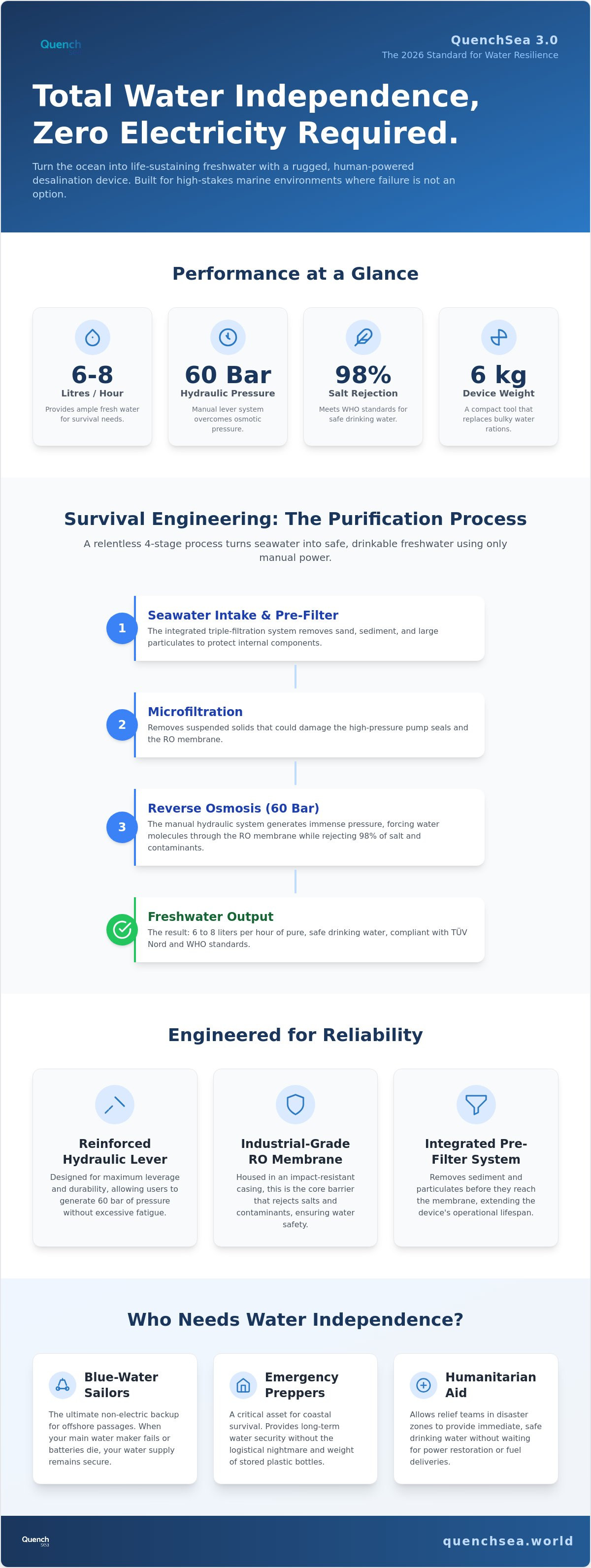
- Reinforced hydraulic lever: This is the engine of the device. It's designed for maximum leverage and durability, allowing the user to generate 60 bar of pressure without excessive fatigue.
- Industrial-grade RO membrane: Housed in a ruggedized, impact-resistant casing, this membrane acts as the primary barrier. It rejects 98% of salts and contaminants to ensure safe output.
- Integrated triple-filtration pre-filter: Before seawater reaches the membrane, this system removes sediment and particulates. It protects the core components and extends the operational lifespan of the device.
Who is this Device For?
The QuenchSea 3.0 Desalination Device serves specific niches where reliability is non-negotiable. It bridges the gap between bulky stored rations and fragile electric systems.
- Blue-water sailors: Most yachts rely on complex, power-hungry water makers. If your batteries die, your water supply vanishes. This device acts as the ultimate non-electric backup for offshore passages.
- Emergency preppers: For those focused on coastal survival and the "Rule of 3," this tool is a critical asset. It provides long-term water security without the weight of stored plastic bottles.
- Humanitarian organizations: In disaster zones where infrastructure has collapsed, rapid deployment is vital. This tool allows relief teams to provide immediate, safe drinking water to affected populations without waiting for power restoration or fuel deliveries.
Beyond emergency survival, establishing efficient water management for your property is a key part of long-term self-sufficiency; to find professional-grade tools for your landscape, you can explore Hozelock for advanced irrigation and garden systems.
Survival Engineering: How Manual Reverse Osmosis Works at 60 Bar
Desalination is a battle against physics. To separate salt from seawater, you must overcome osmotic pressure. This requires immense force. The QuenchSea 3.0 Desalination Device uses a specialized hydraulic system to reach 6,000 kPa, or 60 bar, of pressure. This isn't an arbitrary number. It's the mechanical threshold where seawater yields its salt. You provide the physical labor. The device provides the hydraulic advantage. By converting manual strokes into high-pressure flow, the system forces water molecules through a semi-permeable membrane while leaving contaminants behind.
Physical exhaustion is a real threat in survival scenarios. To combat this, the 3.0 model features an integrated energy recovery system. This mechanism recycles the pressure from the brine discharge to assist the next stroke. It significantly reduces the effort required to maintain flow. While academic research often explores new performance benchmarks for water filtration, this device applies those high-level engineering principles to a rugged, handheld tool. It's built to work when your body is tired and the environment is hostile.
The 4-Stage Purification Process
The purification sequence is linear and relentless. Each stage protects the next to ensure the system doesn't clog or fail prematurely.
- Stage 1: Microfiltration. Removes suspended solids, sand, and large sediment that would otherwise damage the internal seals.
- Stage 2: Ultrafiltration. A finer barrier that targets parasites, bacteria, and microplastics, ensuring the water is biologically safe before it hits the RO core.
- Stage 3: High-pressure Reverse Osmosis. The demineralization stage. This is where the 60 bar of pressure strips away dissolved salts.
- Stage 4: Final Polishing. A final pass to improve taste and ensure the output is ready for immediate consumption.
Why 60 Bar Matters for Water Safety
In the world of desalination, 60 bar is the gold standard. Lower pressure systems often struggle with high salinity, resulting in water that still tastes "brackish" or contains high levels of Total Dissolved Solids (TDS). The QuenchSea 3.0 Desalination Device maintains a consistent 98% salt rejection rate. This ensures the output remains well within WHO contaminant levels for safe drinking water. Reliability comes from the durability of the hydraulic seals. These components are engineered to withstand repeated high-pressure cycles without leaking. When you're miles from shore, you need a device that handles the strain as well as you do. If you're ready to upgrade your emergency kit, you can explore the technical specifications of the 3.0 model today.
Performance Benchmarks: 6-8 Litres of Freshwater Per Hour
The QuenchSea 3.0 Desalination Device delivers 6 to 8 litres of drinkable freshwater every hour. This output remains consistent across various seawater temperatures and salinities. In survival situations, the quality of the water is as vital as the quantity. The device maintains a salt rejection rate of 98%. This keeps the output below 1,000 Total Dissolved Solids (TDS), which meets World Health Organization standards for safe drinking water. You aren't just getting "less salty" water; you're getting hydration that won't strain your kidneys or cause further dehydration. It's a reliable, technical solution for high-salinity environments.
The weight-to-output ratio is where the engineering logic becomes undeniable. A single unit weighs 6 kg. To store 100 litres of water on a vessel, you'd need 100 kg of dedicated weight capacity and significant storage space. Over an emergency period, this 6 kg tool can produce up to 192 litres in a single day under ideal conditions. It effectively replaces hundreds of kilograms of stored supplies. It turns a finite, heavy resource into an infinite, on-demand supply. This transition from storage to production is the foundation of modern marine resilience.
Manual Effort vs. Water Yield
Efficiency is built into the physical design. The lever features an ergonomic grip meant for sustained, rhythmic pumping rather than short bursts of speed. It doesn't require the frantic motion of a bike pump. Instead, you use a deliberate stroke to maintain the 60 bar of pressure required for reverse osmosis. From a survival perspective, the "litres per calorie" ratio is highly favorable. You're trading manageable physical energy for a high-yield biological necessity. The effort compares to using a manual bilge pump but provides a much higher survival return on investment.
QuenchSea 3.0 vs. Traditional Water Rations
Space is a luxury in a life raft or a tactical grab bag. Traditional water rations are bulky, heavy, and eventually run out. The QuenchSea 3.0 Desalination Device offers a sustainable alternative that bridges the gap between expensive electric units and low-yield solar stills. For offshore cruisers, it serves as a critical decision-making tool. Carrying 200 kg of water is a logistical burden. Carrying a 6 kg device that produces water indefinitely is a strategic advantage. This cost-benefit analysis favors the mechanical solution for any long-distance sailor. It offers a level of security that stored plastic bottles cannot match. You gain independence from your supply chain the moment you begin to pump.
Deployment Strategy: Integrating QuenchSea into Your Tactical Kit
Deployment efficiency is a survival requirement. In a high-stress environment, you don't have time to consult a manual. You need a streamlined process that relies on muscle memory. The QuenchSea 3.0 Desalination Device is designed for rapid activation, but its performance depends on correct integration into your tactical kit. Whether you're on a sinking vessel or a remote coastline, these steps ensure your first liter of water is safe and consistent. Precision during the first few minutes of operation dictates the longevity of the entire system.
Success starts with a disciplined four-step operational sequence:
- Step 1: Secure the hoses. Clearly identify the intake and outtake lines. Secure them to your raft or station to prevent cross-contamination. If seawater enters your collection vessel, the entire batch is compromised.
- Step 2: Prime the hydraulic system. Start with a series of short, deliberate strokes. You aren't trying to produce water yet; you're purging air and building the internal pressure required to reach the 60-bar threshold.
- Step 3: Monitor and discard. Once the permeate begins to flow, discard the first 500ml. This initial volume flushes out any residual storage solutions or particulates from the system.
- Step 4: Flush after use. Salt is corrosive. After each production session, flush the system with a small amount of the freshwater you've produced. This prevents scaling and crystal formation within the membrane.
Grab Bag and Life Raft Integration
Accessibility is the priority for Marine Safety: Essential Water Supply for Life Rafts. Store the device at the top of your grab bag. It must be reachable within seconds during a "vessel abandoned" scenario. Use heavy-duty lanyards to secure the unit to the raft's structural points. In turbulent seas, a dropped device is a lost life-line. Ensure your deployment area is clear of sharp debris that could puncture the intake hoses. Preparedness is about removing variables before they become crises.
Maintenance and Membrane Longevity
The RO membrane is the heart of the QuenchSea 3.0 Desalination Device. It requires specific care to maintain its 98% rejection rate. If you plan to store the device for more than two weeks, you must "pickle" the membrane using a preservative solution. This prevents the growth of bacteria and mold in the humid marine air. Watch for signs of fouling, such as increased resistance during pumping or a noticeable drop in output volume. Always use the provided triple-filtration pre-filter. It’s your first line of defense against sediment and pathogens that cause premature membrane failure.
A well-maintained device is a reliable partner. You can buy the QuenchSea 3.0 Desalination Device to ensure your emergency water supply is always ready for deployment.
Investing in Resilience: Why QuenchSea 3.0 is the 2026 Standard
Water security is no longer a luxury. In 2026, the QuenchSea 3.0 Desalination Device has become the industry benchmark for portable survival. High-cost electric units often fail when you need them most. Solar stills are too slow for high-stakes emergencies. This device bridges that gap. It offers a rugged, mechanical certainty that electronic systems simply cannot provide. Through the Hydro Wind Energy partnership, users have access to a global support network and proven hardware. This isn't just a backup tool. It's a primary insurance policy for anyone operating in extreme marine environments.
The device has earned its reputation in the defense and humanitarian relief sectors. These are fields where equipment must perform under the harshest conditions imaginable. The transition from a crowdfunded project to a commercially available standard reflects its mechanical integrity. Every offshore vessel, life raft, and coastal survival kit requires a manual RO backup. It's the only way to guarantee a freshwater supply when your primary desalinator fails or your power bank dies. Simplicity is your greatest asset when the environment turns hostile. Reliability is the result of stripping away every unnecessary component.
This principle of reliability extends beyond hardware into the digital realm where security is paramount. To learn more about digital transaction simulation systems used to verify software integrity, one can examine how modern developers are building more resilient financial tools.
The Mission Behind the Hardware
Innovation at this scale carries a social responsibility. The manufacturer has committed to a bold mission: providing clean water to 100 million people by 2035. This isn't just a corporate slogan. It's a logistical framework. Individual purchases directly support humanitarian water access programs in regions facing extreme scarcity. Within the 2026 disaster relief landscape, the QuenchSea 3.0 Desalination Device is a critical asset. It allows aid workers to deploy water solutions instantly without the need for fuel or electricity. Your investment in personal resilience fuels a global effort to end water poverty.
Ready for the Unexpected
Our world is increasingly tech-heavy. We rely on batteries for everything from navigation to communication. However, in a survival scenario, dependency is a weakness. The "no-battery" reliability of the 3.0 model ensures you're never stranded by a dead cell or a broken solar panel. It converts your physical effort into life-sustaining hydration. This is the ultimate tool for those who prioritize autonomy. Don't leave your survival to chance. Secure your QuenchSea 3.0 Desalination Device today and complete your tactical kit with the 2026 standard in portable filtration.
Secure Your Absolute Water Independence
Survival in a marine environment is a matter of mechanical preparation. You've analyzed how the 60-bar hydraulic system converts physical effort into life-sustaining hydration. You've seen the data behind the 6 to 8 liter hourly output. This isn't just another piece of gear. It's a definitive lifeline. Featured in WIRED, CNN, and Yahoo, the QuenchSea 3.0 Desalination Device has proven its worth in the world's most demanding environments. It delivers a consistent 98% salt rejection rate without relying on a single battery or solar panel. This human-powered tool eliminates the weight of stored water and the fragility of electronic systems. It's time to bridge the gap between vulnerability and total resilience. Whether you're a blue-water sailor or a coastal prepper, your tactical kit isn't complete without a manual backup that works when everything else fails.
Order the QuenchSea 3.0 Desalination Device for Your Emergency Kit. Take control of your safety and ensure your supply never runs dry. When the ocean is your only neighbor, make sure you have the engineering to make it provide for you. Stay prepared, stay hydrated, and stay empowered.
Frequently Asked Questions
How much effort is required to pump the QuenchSea 3.0?
Pumping the QuenchSea 3.0 Desalination Device requires a steady, rhythmic effort rather than high-speed exertion. The 60-bar hydraulic system is engineered to maximize leverage, allowing a single user to maintain flow without immediate exhaustion. It feels similar to using a manual bilge pump. Consistent strokes are more effective than short, rapid bursts for maintaining the pressure required for salt rejection. Success depends on pacing rather than raw power.
Does the QuenchSea 3.0 remove bacteria and viruses?
Yes, the device removes pathogens, including bacteria and viruses, through its multi-stage filtration process. The ultrafiltration stage specifically targets biological contaminants before the water reaches the reverse osmosis membrane. This ensures the output is safe for consumption and meets World Health Organization standards for drinking water quality. It provides a comprehensive barrier against waterborne illnesses in high-stakes survival scenarios.
How long does the reverse osmosis membrane last before replacement?
The lifespan of the reverse osmosis membrane depends on usage frequency and maintenance rigor. Under normal conditions with regular freshwater flushing, a membrane can process thousands of liters. However, you must "pickle" the membrane with a preservative solution if storing the unit for more than two weeks. This prevents biological growth and scaling that would otherwise cause premature failure and drop in output quality.
Can I use the QuenchSea 3.0 on brackish water or just seawater?
You can use the QuenchSea 3.0 Desalination Device on both brackish water and seawater. The system is engineered to handle high-salinity ocean water, so brackish water actually requires less physical effort to process. The 60-bar pressure capacity ensures effective salt rejection regardless of the initial salt concentration. This makes it a versatile solution for various coastal or inland survival scenarios where water sources are contaminated.
What is the maximum TDS level the device can handle effectively?
The device effectively handles standard seawater TDS levels averaging 35,000 parts per million (ppm). It reduces these levels to below 1,000 TDS in the final permeate, meeting WHO standards. While it can process water with higher concentrations, the physical effort required to overcome osmotic pressure will increase as salinity rises. It remains the standard for converting raw ocean water into drinkable freshwater.
Is the QuenchSea 3.0 approved for military or defence use?
The QuenchSea 3.0 is widely utilized across defense and humanitarian sectors due to its rugged reliability. Its non-electric design makes it a standard choice for units operating in remote or contested environments where logistics are limited. The device's ability to provide rapid-deployment water security without a power grid is a primary reason for its adoption by professional survival experts and military personnel globally.
How do I clean the device after using it in salt water?
You must flush the system with freshwater after every production cycle. This process removes residual salt and brine from the internal components, preventing corrosive damage and membrane scaling. If freshwater is scarce, use the last 500ml of your produced water to rinse the system. Regular maintenance is the most effective way to ensure the mechanical integrity of your device over long-term deployments.
Can I drink the water immediately after it passes through the device?
Yes, the water is safe to drink immediately after the initial 500ml discard. You must discard the first half-liter of permeate during every new session to ensure any residual storage solution or particulates are cleared from the system. The remaining output is demineralized, filtered, and ready for consumption. It requires no additional boiling or chemical treatment to be safe for immediate hydration.