

Standard freshwater filters are a liability in coastal disaster zones. When the surge recedes and the wells turn brackish, traditional humanitarian aid water purification methods fail. You've seen the logistical nightmare of transporting thousands of plastic bottles to remote islands. You've watched expensive equipment clog and corrode because it wasn't built for high salinity. It's a systemic failure that leaves survivors thirsty in the middle of an ocean.
You need a solution that doesn't depend on a failing power grid or a complex fuel supply chain. This article demonstrates how portable desalination technology is fundamentally changing the response for coastal and island communities in 2026. We'll explore how the QuenchSea 3.0 provides a reliable, non-electric way to produce potable water while slashing last-mile logistics costs. We are moving beyond the era of "filtering" and into a future of immediate, hand-powered hydration for every survivor. This is about stripping away the unnecessary to focus on what actually works in the field.
Key Takeaways
- Identify why traditional filters fail during coastal surges and how to navigate the "salinity trap" in flooded zones.
- Understand the mechanical efficiency of manual reverse osmosis for producing potable water without a power grid.
- Learn tactical deployment strategies for selecting seawater sources that preserve equipment integrity and extend membrane life.
- Discover how integrating portable desalination into humanitarian aid water purification reduces the massive logistical burden of bottled water transport.
- Explore the technical specifications that make the QuenchSea 3.0 a reliable tool for last-mile survival in extreme environments.
The Critical Gap in Humanitarian Aid Water Purification
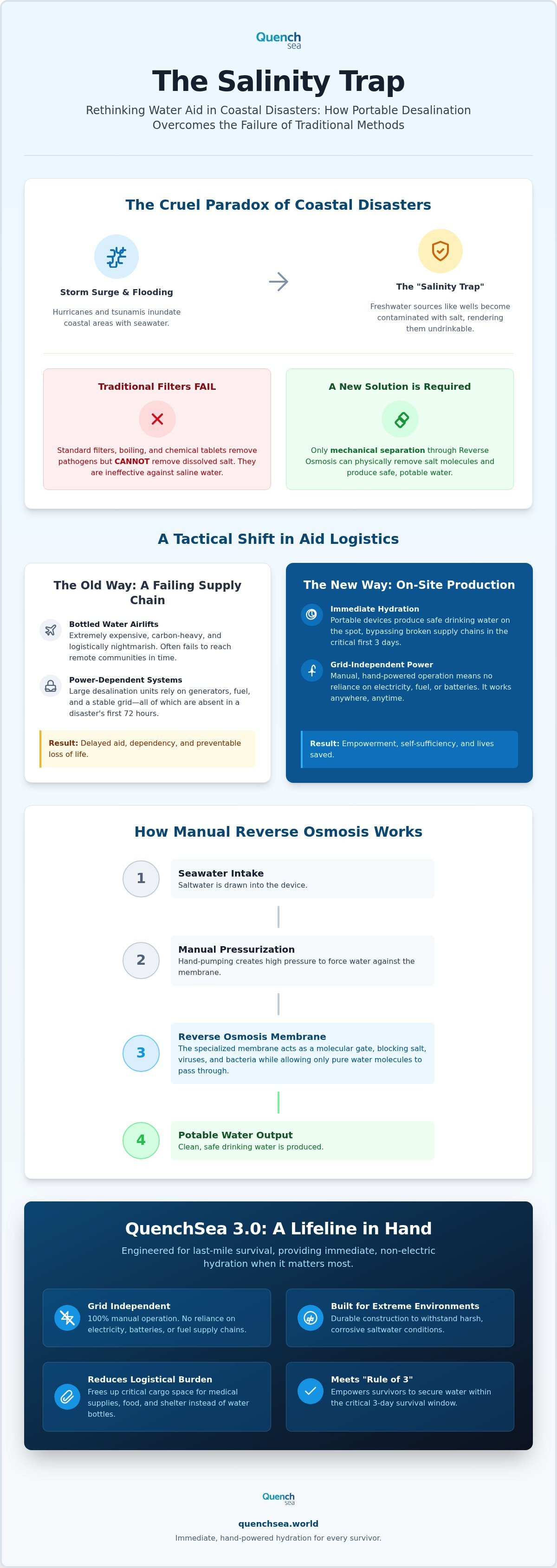
Coastal disasters like tsunamis and hurricanes create a cruel paradox. Floodwaters saturate the landscape, yet survivors face lethal thirst. This is the "Salinity Trap." Most existing humanitarian aid water purification assets are designed for inland freshwater. They remove bacteria and viruses but remain chemically incapable of processing salt. When storm surges turn freshwater wells brackish, these standard filters become useless. The crisis isn't a lack of water. It's a lack of the right technology to treat the water that's already there.
Effective disaster response in 2026 requires a tactical shift. We must move away from centralized logistics toward decentralized, portable production. The first 72 hours determine the survival rate. During this window, infrastructure is usually non-existent. Relief agencies cannot wait for roads to be cleared or power grids to be restored. They need "Last-Mile" solutions that work the moment they hit the ground. Various Portable water purification techniques exist, but for coastal relief, reverse osmosis is the only viable path forward.
The Rule of 3 in Disaster Relief
Survivalists follow the Rule of 3. You can last three minutes without air, three weeks without food, but only three days without water. In high-stress disaster zones, this timeline accelerates. Dehydration leads to cognitive decline, fatigue, and eventual organ failure. It also forces survivors to consume contaminated water, sparking secondary health crises like cholera. Utilizing survival desalination devices changes the equation. It empowers individuals to secure their own hydration immediately, bypassing the wait for external aid.
Logistical Bottlenecks of Bottled Water
The traditional model of airlifting bottled water is a logistical failure. It's expensive, carbon-heavy, and physically demanding. One pallet of water only serves a small group for a few days. When ports are blocked and roads are destroyed, these supplies never reach the most vulnerable island communities. On-site humanitarian aid water purification via desalination removes the weight from the supply chain. By converting seawater directly at the point of need, agencies can reallocate cargo space for medical supplies and shelter. This isn't just an engineering choice. It's a strategic necessity. It's about empowering communities with the tools to survive rather than keeping them dependent on an unreliable delivery schedule.
Why Traditional Disaster Relief Water Solutions Fail in Coastal Zones
Standard humanitarian aid water purification kits often rely on Aquatabs or UV pens. These tools are excellent for neutralizing pathogens in freshwater. They are useless against sodium chloride. In a coastal disaster, the flood isn't just dirty; it's saline. This creates a technical ceiling that chemical treatments cannot breach. Relying on tablets in a storm surge isn't just a mistake. It's a failure of planning that leaves survivors with water they cannot drink.
Chemical vs. Mechanical Purification
Boiling or bleaching water removes bacteria. It doesn't remove salt. Understanding why drinking sea water is dangerous is critical for field operators. The high mineral content forces kidneys to use more water to flush the salt than the survivor actually consumes. This accelerates dehydration and triggers rapid organ failure. Chemical purification can't stop this biological process. Only mechanical separation works.
Mechanical intervention is the only viable solution. While standard filters clog instantly in brackish conditions, reverse osmosis (RO) membranes reject dissolved solids. This technology has been a staple in large-scale humanitarian desalination projects for years. However, those systems are usually massive and immobile. For rapid response, you need that same RO capability in a portable format. Membranes survive where filters fail because they address the chemistry of the water, not just the debris.
The Problem with Power Dependency
Most professional desalination units require high-voltage electricity. In 2026, we still see aid agencies relying on gas-powered generators. These are heavy. They require fuel that's often unavailable in a crisis. They fail in humid, salt-heavy air. Battery-operated systems aren't much better. Saltwater corrosion destroys sensitive electronics within days of deployment. A dead battery in a disaster zone is just extra weight.
Manual power is the ultimate fail-safe. It eliminates the need for a functioning grid or a supply of diesel. When the logistics chain breaks, a hand-powered device remains operational. It's about removing every possible point of failure. If you want to ensure your team is prepared for the next coastal surge, consider a portable manual desalinator as a standard gear requirement. This shift ensures humanitarian aid water purification happens regardless of the environment's hostility.
Manual Reverse Osmosis: A Tactical Shift in Aid Logistics
Manual reverse osmosis isn't just a backup. It's a fundamental change in how we approach humanitarian aid water purification. Traditional logistics rely on a "push" model; sending finished supplies from a central hub to the disaster zone. Manual RO enables a "pull" model. The resource is harvested directly at the point of impact. This eliminates the wait times that cost lives during the critical first 72 hours. It's about moving the factory to the survivor rather than moving the water to the victim.
The Science of Hand-Powered Desalination
The QuenchSea 3.0 utilizes mechanical leverage to overcome osmotic pressure. Seawater is forced through a semi-permeable membrane at high pressure. This process strips away salts, pathogens, and microplastics without a single watt of electricity. It's engineering stripped to its essential components. By removing the motors and circuit boards, you remove the primary causes of mechanical failure in saltwater environments. "Humanitarian-grade" hardware must be simple enough to operate under extreme stress yet robust enough to handle the corrosive nature of the ocean.
Decentralizing the Water Supply
Decentralizing the supply chain is the only way to reach isolated survivors. When agencies provide an affordable water supply for any coastal location, they reduce the strain on the entire relief effort. Every family equipped with a manual unit is one less family waiting for a helicopter drop. This tactical shift transforms a vulnerable population into a self-sufficient one. It turns a disaster relief water supply from a fragile external delivery into a robust, localized asset. Tactical deployment means equipping every life raft, emergency kit, and field medic with the means to generate freshwater on demand.
The cost-benefit analysis of this approach is clear. A single reusable device replaces thousands of plastic bottles and disposable filters. It's a one-time investment in long-term resilience. In 2026, the goal isn't just to deliver water. It's to deliver the capacity to produce it. This empowers survivors and allows humanitarian aid water purification efforts to scale rapidly without the logistical weight of traditional supplies. We're trading the heavy burden of liquid transport for the lightweight efficiency of mechanical innovation.
Implementation Guide: Deploying Portable Desalination in the Field
Success in the field depends on more than just hardware. It requires a disciplined operational protocol. When deploying humanitarian aid water purification assets, the first step is source selection. Avoid stagnant tide pools or water heavy with visible silt. Collecting seawater from deeper, moving water reduces the particulate load on the system. This simple choice extends membrane life and ensures the device operates at peak efficiency during the most critical hours of a mission. If the intake is clear, the mechanical output remains high.
Operational Best Practices for Aid Workers
Manual desalination is a physical process. To sustain output without exhausting personnel, establish a rotating pumping schedule. A team of three can maintain a consistent flow by swapping operators every 20 minutes. This ensures the 15-liter daily requirement per person is met across the camp. If the source water is turbid, use a basic cloth or sand pre-filter to catch large debris before it reaches the QuenchSea 3.0 intake. The feed-to-fresh ratio for manual RO units defines the volume of input seawater required to produce a specific amount of potable permeate. Maintaining a steady, rhythmic cadence is more effective than short bursts of high-intensity pumping. Consistent pressure is the key to optimal reverse osmosis.
Maintenance for Long-Term Relief Missions
Tropical environments accelerate biofouling. If a unit sits idle with seawater inside, bacteria and algae will colonize the membrane surface within 48 hours. Always flush the system with fresh water before storage. For long-term deployments, keep a kit of essential spare parts, including replacement O-rings and backup RO membranes. These components are the only wear items in an otherwise purely mechanical system. Training local leaders on these maintenance steps ensures the technology remains a community asset long after the initial response team departs. Empowerment is as important as the equipment itself.
Integrating these devices into existing WASH (Water, Sanitation, and Hygiene) programs creates a multi-layered defense against waterborne disease. While large-scale tanks handle bulk hygiene needs, portable units secure the drinking supply. This dual-track approach provides a safety net when centralized systems fail. To equip your response team with the latest in field-ready desalination, order the QuenchSea 3.0 for your emergency kits today. Reliability in the field is a choice made during the procurement phase, not the disaster phase. Don't wait for the next surge to realize your kit is incomplete.
QuenchSea 3.0: Empowering Last-Mile Humanitarian Water Access
The QuenchSea 3.0 is the definitive tool for humanitarian aid water purification in 2026. It bridges the gap between massive, immobile desalination plants and the immediate, individual needs of survivors. Developed by Hydro Wind Energy, this device is the result of a specific mission: to provide low-cost, high-impact water solutions for the world's most vulnerable regions. In coastal disaster zones, where infrastructure is the first casualty, the ability to generate freshwater from the surrounding ocean is the difference between recovery and catastrophe. For broader environmental management and large-scale water treatment, QM Environmental International B.V. provides advanced microbial solutions that help restore safety to disrupted ecosystems. We've moved beyond the era of dependency on external supply chains.
Reliability in extreme environments requires a total rejection of complexity. The QuenchSea 3.0 uses high-impact, corrosion-resistant materials designed to withstand the abrasive nature of sand and salt. There are no batteries to charge or fuel tanks to fill. The manual interface is intuitive. It requires zero specialized training. This simplicity ensures that any aid worker or survivor can begin producing water within minutes of unboxing. It is a mechanical solution to a biological crisis.
Portability is the secondary pillar of its design. A functional desalination plant that fits into a standard backpack changes the logistics of a relief mission. It allows responders to move faster and reach communities that are cut off from traditional supply routes. By integrating the device into a life raft water supply or individual coastal survival kits, agencies provide a permanent safety net rather than a temporary fix. It's about stripping away the weight to increase the speed of aid.
Partnering for Global Change
NGOs and international relief organizations can no longer rely on freshwater sources that may not exist after a storm surge. Portable reverse osmosis is a critical component of climate change adaptation. As sea levels rise and saltwater intrusion threatens coastal aquifers, the need for decentralized water production will only grow. Hydro Wind Energy is committed to scaling this technology to meet that global demand. We provide the hardware that allows humanitarian aid water purification to scale without the traditional costs of fuel and transport.
Building a resilient future for coastal and island nations starts with preparation. It's about equipping every first responder with tools that don't fail when the power goes out. You can lead this shift in disaster response by modernizing your equipment today. We invite you to get the QuenchSea 3.0 for your relief kit and join the mission to end coastal water scarcity. This isn't just a product purchase. It's a calculated investment in the "Last-Mile" survival of those who need it most.
Securing the Future of Coastal Resilience
The 2026 landscape of disaster relief requires a tactical departure from outdated logistics. We've identified the salinity trap as a primary failure point for traditional filters. We've also demonstrated why manual reverse osmosis is the only viable path for decentralized, last-mile hydration. Modern humanitarian aid water purification must prioritize mechanical reliability over complex, power-dependent systems. This shift ensures that aid reaches those cut off from the grid during the critical first 72 hours of a crisis.
The QuenchSea 3.0 is a survival-grade tool built for these exact high-stakes environments. It's hand-powered and requires zero fuel. This device features the rugged durability demanded by marine and defense professionals worldwide. By stripping away the electronics, we've created a fail-safe device that stays operational when the grid goes dark. It turns a logistical nightmare into a streamlined, mechanical certainty. It's time to move beyond the era of transporting heavy water bottles and start producing freshwater at the point of impact.
To protect your team and the communities you serve, equip your mission with the QuenchSea 3.0 today. Preparation is the only defense against the unpredictable. Empower your responders with the tools to turn the ocean into a life-saving resource.
Frequently Asked Questions
How much water can a manual desalination device produce per hour?
The QuenchSea 3.0 produces practical volumes of freshwater for survival situations through manual pressure. Output depends on the operator's cadence and water temperature; warmer water typically flows more easily through the membrane. While specific rates vary by conditions, it's engineered to meet individual daily requirements in high-stress environments. This manual approach ensures a steady supply without the need for fuel or electricity, making it a cornerstone for humanitarian aid water purification in remote coastal zones.
Is the water produced by manual reverse osmosis safe for long-term consumption?
Yes, the permeate produced via reverse osmosis is safe for drinking. The technology removes salt and reduces dissolved solids to levels that meet international guidelines. For long-term use in relief missions, it's vital to maintain the device and replace membranes according to the manufacturer's schedule. This ensures the water quality remains consistent. It provides a reliable alternative to brackish groundwater that often causes chronic health issues in disaster-affected populations.
Can these devices remove viruses and bacteria as well as salt?
Reverse osmosis membranes are highly effective at rejecting pathogens. The semi-permeable membrane acts as a physical barrier against bacteria, viruses, and parasites while simultaneously stripping away salt. This dual-action capability is what makes it superior to standard freshwater filters in coastal settings. It ensures that the water isn't just desalinated but also biologically safe. This level of protection is essential for preventing secondary health crises like cholera in flooded regions.
What happens if the seawater is contaminated with oil or chemicals?
Heavy oil or chemical contamination will foul the RO membrane and significantly reduce its lifespan. In disaster zones with fuel spills, operators should seek the cleanest source water possible. Use pre-filtration techniques to remove surface oils and large particulates before the water enters the device. If the membrane becomes contaminated with hydrocarbons, it'll require replacement to maintain the safety and taste of the freshwater output. Always monitor the source environment carefully.
How long does the reverse osmosis membrane last in a disaster relief setting?
Membrane lifespan depends entirely on source water quality and maintenance discipline. In a typical disaster relief setting, a membrane can process hundreds of liters if it's regularly flushed with freshwater. Biofouling and sediment are the primary threats to longevity. Replacing the RO membrane pairs is a simple field repair that restores the system to full capacity. Keeping spare membranes in the kit is a standard best practice for any long-term humanitarian mission.
Why is hand-powered desalination better than solar-powered for immediate aid?
Hand-powered devices provide a level of immediate reliability that solar systems can't match. Solar units depend on clear weather and intact panels; both are rare during hurricanes or tsunamis. A manual device like the QuenchSea 3.0 works 24/7 in any weather condition. It eliminates the weight of batteries and the fragility of electronics. For rapid response teams, the mechanical simplicity of a hand pump is the ultimate fail-safe against infrastructure collapse.
Do I need special training to operate the QuenchSea 3.0?
No specialized technical training is required to operate the QuenchSea 3.0. The manual interface is designed for intuitive use under extreme stress. Most aid workers and survivors can master the pumping cadence within minutes. This ease of operation is a critical advantage for large-scale deployments where rapid community adoption is necessary. It allows responders to distribute the devices quickly without the bottleneck of lengthy training sessions or complex technical manuals.
Can this device be used for brackish water as well as seawater?
The device is highly effective for both seawater and brackish water. Brackish sources actually put less osmotic pressure on the membrane, which can result in a higher output rate with less physical effort. This versatility is vital for humanitarian aid water purification because floodwaters often create varying levels of salinity. Whether you're dealing with full-strength ocean water or a salt-contaminated well, the reverse osmosis process delivers safe, potable freshwater every time.