

The ocean is the most deceptive desert on earth. You are surrounded by millions of gallons of water, yet without the right equipment, you're facing a lethal biological countdown. Most survivalists recognize that dehydration at sea is a mathematical certainty if they rely on luck rather than physics. This guide provides the tactical blueprint for converting emergency seawater to drinking water when your primary supply fails. It's a high-stakes engineering problem that demands a disciplined, mechanical solution.
We'll strip away the confusion surrounding desalination and focus on what actually works in extreme environments. You'll learn the definitive hierarchy of water production methods, from basic solar distillation to the mechanical precision of reverse osmosis. We'll also examine the physical requirements of water production so you can prepare for the manual effort involved. This article eliminates the guesswork and helps you select survival-grade tools that deliver results under pressure. By the end, you'll understand how to transform a life-threatening environment into a manageable resource using calculated, hardware-focused reality. You don't need luck; you need a system that works when the power goes out and the pressure is on.
Key Takeaways
- Understand the physiological mechanics of osmotic dehydration and why saltwater consumption accelerates life-threatening fluid loss.
- Master the definitive hierarchy of desalination methods to convert emergency seawater to drinking water using mechanical leverage instead of power.
- Learn the essential pre-filtration protocols required to protect survival-grade membranes from surface oils and biological fouling.
- Identify how environmental variables like water temperature dictate the efficiency and output of manual desalination hardware.
- Evaluate the tactical advantages of manual reverse osmosis systems for maintaining hydration autonomy in fuel-restricted scenarios.
The Saltwater Paradox: Why You Cannot Drink Seawater
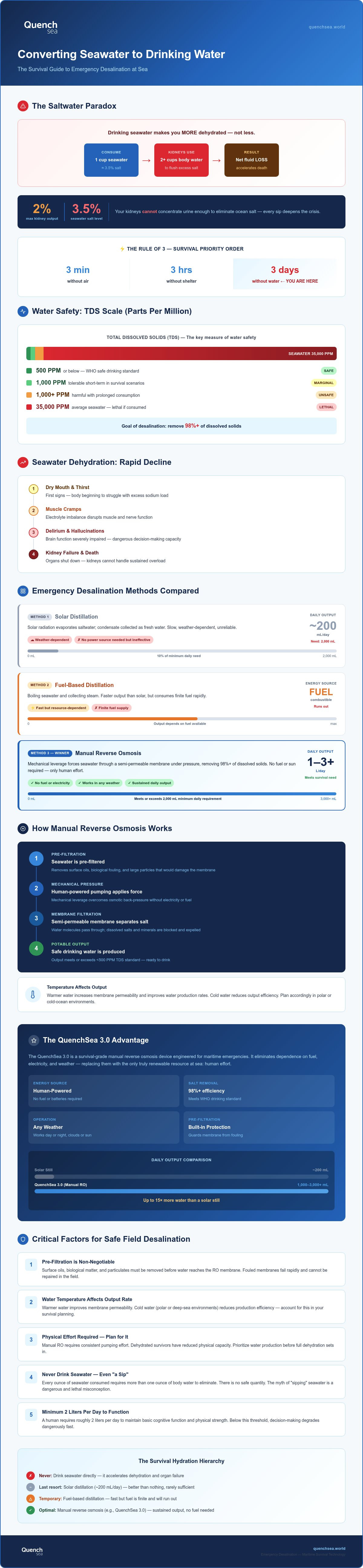
Survival at sea is a battle of biology against chemistry. The ocean contains millions of tons of salt. Your body, however, only functions within a narrow salinity range. When you consume seawater, you trigger a process called osmosis. High salt concentrations in your gut pull freshwater out of your bloodstream and cells to achieve balance. You end up more dehydrated than before you took a drink. This is the Saltwater Paradox. You are surrounded by water, yet it is a lethal fluid without mechanical intervention.
Survivalists live by the "Rule of 3." You can last three minutes without air, three hours without shelter in extreme conditions, and three days without water. At sea, where exposure is constant, water is your most immediate biological priority. Forget food. Your body cannot process calories without hydration. Some believe that "sipping" small amounts of seawater can stave off thirst. This is a dangerous myth. Every ounce of saltwater consumed requires more than an ounce of internal freshwater to flush the excess minerals. You are literally drinking yourself to death. To survive, you must master the Desalination process to convert emergency seawater to drinking water.
The Biological Reality of Thirst
Your kidneys are the primary defense against toxicity. They filter blood to produce urine, but they cannot produce urine with a salt concentration higher than 2 percent. Seawater is roughly 3.5 percent salt. To get rid of the salt from one cup of seawater, your kidneys must use at least two cups of your body's existing water supply. This deficit leads to rapid physical decline. Symptoms begin with dry mouth and progress to muscle cramps. As dehydration worsens, you face delirium and hallucinations. Eventually, your kidneys shut down entirely. Understanding these risks is vital for any maritime professional. You can learn more about the physiological impacts in our article Why is Drinking Sea Water Dangerous?
Defining Potable Water Standards
Survival engineering relies on precision measurements. We use Total Dissolved Solids (TDS) to define water safety. TDS measures the concentration of dissolved minerals in parts per million (PPM). Seawater is a dense chemical soup, often reaching 35,000 PPM. Human health standards are much stricter. Safe drinking water generally remains below 500 PPM. In a survival situation, water up to 1,000 PPM may be tolerable for short periods, but it is far from ideal. The goal when converting emergency seawater to drinking water is to strip away 98 percent or more of these solids. Achieving this threshold is the difference between life-saving hydration and biological failure.
Comparing Emergency Desalination Methods: Speed vs. Effort
Survival is a calculation of resources. In a life raft, your most valuable resource is time. Choosing a method for converting emergency seawater to drinking water requires balancing speed against physical effort. Three primary technologies dominate the field: solar distillation, fuel-based distillation, and reverse osmosis. Each method utilizes different physics to achieve the same objective: meeting safe drinking water standards under extreme duress. However, the energy-to-water ratio varies wildly between them. Fuel-based systems are fast but rely on finite combustibles. Chemical pouches are lightweight but offer limited, one-time use. For sustained survival, you need a system that relies on the only renewable energy source you have: yourself.
The Solar Still Myth
Solar stills are often glorified in basic survival manuals. The theory is simple. You use solar radiation to evaporate saltwater and collect the condensation. In reality, they are often catastrophic failures for active survival. The physics of evaporation is slow. A standard solar still typically produces only a few hundred milliliters of water per day. A human needs roughly two liters to maintain basic cognitive function and physical strength. Unless you have a massive array of plastic sheeting, you'll dehydrate before the first liter is full. Furthermore, these systems are vulnerable. Cloud cover halts production. Rough seas spill your collection. In high-stakes scenarios, you can't bet your life on the weather.
Why Reverse Osmosis Wins
Reverse osmosis (RO) operates on a completely different scale. It doesn't wait for the sun or require a fire. Instead, it uses mechanical leverage to force saltwater through a semi-permeable membrane. This process overcomes osmotic pressure directly. The result is a dramatic increase in speed. While a solar still measures output in drops, a manual RO system measures it in liters per hour. This efficiency makes a survival desalination device the tactical standard for maritime professionals and serious survivalists.
Manual Reverse Osmosis (MRO) provides true hydration autonomy. It eliminates the need for batteries, solar panels, or fuel. You provide the pressure; the membrane provides the water. This mechanical simplicity is why MRO is the professional choice for life rafts and emergency kits. If you are looking for a reliable way to secure your water supply, consider a rugged tool like the QuenchSea 3.0 to bridge the gap between slow DIY methods and heavy electric systems. It's about having a predictable, high-output solution when every hour counts.
How to Convert Seawater to Drinking Water: A Step-by-Step Guide
Converting emergency seawater to drinking water is a disciplined mechanical process. It isn't just about pumping; it's about managing a pressurized system under stress. You must follow a strict protocol to protect your hardware and ensure the water you produce is safe. This step-by-step guide outlines the tactical approach to manual desalination. Every action you take directly impacts the longevity of your membrane and the quality of your hydration.
- Step 1: Source clean seawater. Look for the clearest water available. Avoid surface slicks, oily debris, or areas with heavy floating algae. These contaminants will foul a membrane in minutes.
- Step 2: Implement pre-filtration. Never run raw seawater directly into your primary pump. Use a sacrificial filter to catch larger particulates.
- Step 3: Build osmotic pressure. Engage the mechanical pump with a steady, rhythmic motion. You're working against the laws of chemistry; don't rush the stroke.
- Step 4: Flush the system. Discard the first 100 to 200 milliliters of water. This initial "flush" clears any residual salt or stagnant water from the internal lines.
- Step 5: Verify the output. Test the water using a TDS meter if available. If not, use a small taste test to confirm the absence of heavy salinity before full consumption.
Phase 1: Pre-Filtration and Setup
Sediment and plankton are the primary enemies of survival hardware. They clog the microscopic pores of a reverse osmosis membrane, rendering it useless. The desalination process demands high-purity intake to function efficiently. Use a fine mesh or a clean cloth pre-filter to catch suspended solids before they reach the device. It's a simple step that extends the life of your equipment significantly. Stability is also vital. Secure your device to a bulkhead or the floor of the life raft. You need solid leverage to maintain the pressure required for conversion without wasting physical energy.
Phase 2: The Desalination Process
Consistency is more important than speed. Maintain a steady pumping rhythm to optimize internal pressure. RO systems function by splitting the intake into two streams: the "permeate," which is your freshwater, and the "reject," which is the concentrated brine. A typical manual system has a specific recovery ratio; don't be alarmed by the amount of brine being discharged. To overcome the natural osmotic pressure of the ocean, you must apply enough mechanical force to exceed the resistance of the semi-permeable membrane. This mechanical threshold is what makes the conversion of emergency seawater to drinking water possible without electricity or fuel. Watch your flow rates. A sudden drop in freshwater output usually indicates a clogged pre-filter or a change in water temperature.
Critical Factors for Safe Field Desalination
Operating a desalination device in the field requires more than just physical strength. You must account for environmental variables that dictate mechanical efficiency. Temperature, biological load, and post-use maintenance are the three pillars of sustainable water production. Ignoring these factors leads to equipment failure when you can least afford it. When converting emergency seawater to drinking water, your hardware is a precision instrument. Treat it as such. Reliability in extreme environments isn't accidental; it's the result of disciplined maintenance and situational awareness.
Operating in Extreme Conditions
Water temperature is a primary driver of membrane performance. Cold ocean water is more viscous. It's effectively "thicker" at a molecular level. This increased viscosity requires more physical force to push through the RO membrane. If you're operating in sub-polar or deep-water environments, expect a lower flow rate and higher resistance. Conversely, in tropical climates, the water flows easier, but the operator faces a different risk: heat exhaustion. You must manage your exertion levels carefully. Pumping for water shouldn't cost you more sweat than the freshwater you produce. This balance is central to the Rule of 3 survival priorities. Hydration is critical, but so is maintaining your core temperature and energy reserves.
Long-Term Device Maintenance
Biological fouling is a silent killer of survival gear. Seawater isn't just salt and water; it's a living soup of bacteria and plankton. If you leave saltwater inside your device after use, these organisms die and rot. This biological decay creates a biofilm that permanently clogs the membrane. To prevent this, you must flush the system with freshwater after every session. If freshwater is too scarce, even a "dry" storage protocol is better than leaving stagnant brine in the lines.
For those preparing a "ditch bag" for long-term storage, salt crystallization is another threat. Evaporating seawater leaves behind abrasive crystals that can tear seals and score pump cylinders. Use a membrane preservation kit if the device will be stored for more than a few weeks. These kits use food-grade biocides to keep the membrane hydrated and sterile. Regular testing is also mandatory for maritime safety. Don't wait for a crisis to discover a dried-out seal. If you want a device engineered for these harsh realities, the QuenchSea 3.0 Desalination Device includes robust seals designed for survival-grade reliability. Always carry spare pre-filters. They are your first line of defense against the elements.
Tactical Hydration: The QuenchSea 3.0 Advantage
In a total system failure, complexity is a liability. You need a tool that operates independently of the power grid. The QuenchSea 3.0 represents the peak of manual reverse osmosis engineering. It provides a reliable pathway for converting emergency seawater to drinking water without the need for fuel, batteries, or solar panels. This is true hydration autonomy. While electric water makers are convenient on a functioning yacht, they're useless when the electronics fry or the fuel runs dry. The QuenchSea 3.0 relies on the only renewable energy source you can always count on: your own physical leverage. It's a survival-grade solution for a high-stakes problem.
This device isn't a luxury gadget. It's a rugged piece of hardware built for the harshest marine environments. Every component is selected for durability and mechanical integrity. By stripping away the need for complicated circuitry, we've created a device that's as dependable as a manual winch. It bridges the gap between slow, unreliable DIY methods and expensive, fragile electronic systems. Whether you're a blue-water sailor or a coastal survivalist, this tool ensures the ocean remains a resource rather than a threat. It's a critical component of a modern disaster relief water supply strategy, providing immediate access to potable water in the most challenging conditions.
Engineered for the Worst-Case Scenario
Survival gear must withstand the environment it's meant to conquer. The 3.0 model features high-pressure seals and corrosion-resistant materials designed for long-term marine exposure. We've engineered the pump to handle the high salinity and pressure requirements of the desalination process without failing under stress. Portability is a core requirement. It's the essential "ditch bag" component for any serious mariner. We've also optimized the mechanical leverage in the 3.0 model. This reduces the physical burden of pumping, allowing you to produce more water with less metabolic cost. It's about efficiency when your energy reserves are low.
The Future of Humanitarian Water
The mission behind QuenchSea goes beyond individual preparedness. We believe in high-impact, low-cost water solutions for everyone. This technology has the power to scale from individual survival to community-wide disaster relief. In the wake of hurricanes or tsunamis, traditional infrastructure often fails. A manual RO device provides a tactical advantage for last-mile survival. It empowers people to secure their own clean water without waiting for external aid. Don't leave your hydration to chance. Secure your survival today and Order the QuenchSea 3.0 to ensure you're never without a lifeline.
Master Your Maritime Autonomy
Survival is a choice made long before you leave the dock. You now understand that the ocean's salinity is a biological barrier that only mechanical leverage can break. Relying on slow solar distillation or finite chemical pouches is a high-risk gamble. The definitive way to convert emergency seawater to drinking water is through manual reverse osmosis. This process provides the speed and volume required to keep a crew hydrated when primary systems fail. It eliminates the confusion of DIY methods and replaces it with engineering certainty.
You don't need electricity, batteries, or fuel to secure your water supply. You need a tool designed for the harshest marine environments. The QuenchSea 3.0 is hand-powered and produces practical output for multiple people in a life raft. It's the tactical bridge between desperation and recovery. Don't leave your safety to chance. Equip your life raft with the QuenchSea 3.0 manual desalinator today. With survival-grade hardware and a disciplined mindset, you can transform a hostile environment into a manageable resource. You're ready to face the horizon with total confidence.
Frequently Asked Questions
Can you really turn seawater into drinking water with a hand pump?
Yes. Manual reverse osmosis devices use physical leverage to force saltwater through a semi-permeable membrane. This mechanical action overcomes the osmotic pressure of the ocean. It's a proven engineering solution for converting emergency seawater to drinking water without external power sources. You provide the pressure; the hardware provides the filtration.
How much water can a manual desalination device produce per hour?
Output depends on the operator's rhythm and water temperature. Most survival-grade manual units produce several liters of freshwater per hour. This rate is significantly higher than solar stills, which often yield less than one liter per day. Mechanical leverage ensures you produce enough water to support multiple people in a life raft scenario.
Is the water from a survival desalinator safe to drink immediately?
Freshwater produced by a functioning RO membrane is safe for immediate consumption. The process removes salt, bacteria, and viruses. You should always discard the initial "flush" water to clear the system of stagnant brine. Testing the output for salinity ensures the device is converting emergency seawater to drinking water effectively before you begin full hydration.
How long do the filters last in an emergency water maker?
Filter longevity depends entirely on the quality of the intake water. RO membranes can process thousands of liters if you use proper pre-filtration to remove sediment and oils. Pre-filters are sacrificial components and should be replaced whenever flow rates drop significantly. Protecting the primary membrane is your main priority for long-term device survival.
Do I need a battery or solar panel to operate the QuenchSea 3.0?
No. The QuenchSea 3.0 is a purely mechanical device. It requires no electricity, batteries, or solar panels to function. This design ensures total hydration autonomy in the worst-case scenarios. You are the power source. As long as you can operate the pump handle, you can produce life-saving freshwater.
What happens if I drink seawater in a survival situation?
Drinking seawater triggers osmotic dehydration. The high salt concentration pulls water out of your cells and into your gut. Your kidneys must then use more freshwater than you consumed to flush the excess salt. This leads to rapid physical decline, delirium, and eventually organ failure. Never drink raw seawater; always use a mechanical conversion method.
Can a manual desalinator be used for brackish or dirty freshwater?
Reverse osmosis technology works on brackish water and can remove biological contaminants from freshwater. However, "dirty" water containing heavy silt or mud will clog the membrane rapidly. Always use the cleanest source possible. Pre-filter any non-marine water sources through a cloth or mesh to extend the life of your survival hardware.
How do I maintain my desalinator when it is not in use?
Maintenance focuses on preventing biological growth and salt crystallization. Flush the system with freshwater after every use to remove brine. If you're storing the device long-term in a ditch bag, use a food-grade preservative solution to keep the membrane hydrated. Regular testing of the seals ensures the device remains mission-ready for your next voyage.