

Imagine you're 800 miles from the nearest coast when your house bank fails and your primary desalinator goes silent. That sudden lack of mechanical hum isn't just a technical annoyance. It's a direct threat to your crew's survival. You already know that complex electronics are often the first components to surrender to a harsh salt environment. This is why a manual backup watermaker for yacht security is no longer optional for offshore voyaging. Relying on a single, power-dependent system for your life-sustaining water supply is a gamble that seasoned sailors cannot afford to take.
This guide demonstrates why a hand-powered system is the ultimate failsafe for modern crossings. You'll learn how to choose a device that functions reliably without a single watt of electricity. We will cover the essential technical standards for 2026 and show you how to integrate compact, survival-grade hardware into your emergency ditch bag. We'll explore how to maintain safe drinking water standards using nothing but human power. True redundancy isn't a second battery; it's a mechanical tool that works when your vessel's electronics fail.
Key Takeaways
- Understand why mechanical redundancy is the only true failsafe against yacht electrical failure or lightning strikes.
- Learn how a manual backup watermaker for yacht safety converts physical effort into freshwater without relying on a power grid.
- Compare the mechanical integrity of manual pumps against the vulnerability of complex electronic desalination systems.
- Discover strategic stowage techniques to keep your emergency water supply accessible in a ditch bag during rapid abandonment.
- Evaluate the tactical features of the QuenchSea 3.0 engineered for 2026 marine survival and long-term offshore reliability.
Why Your Yacht Needs a Manual Backup Watermaker
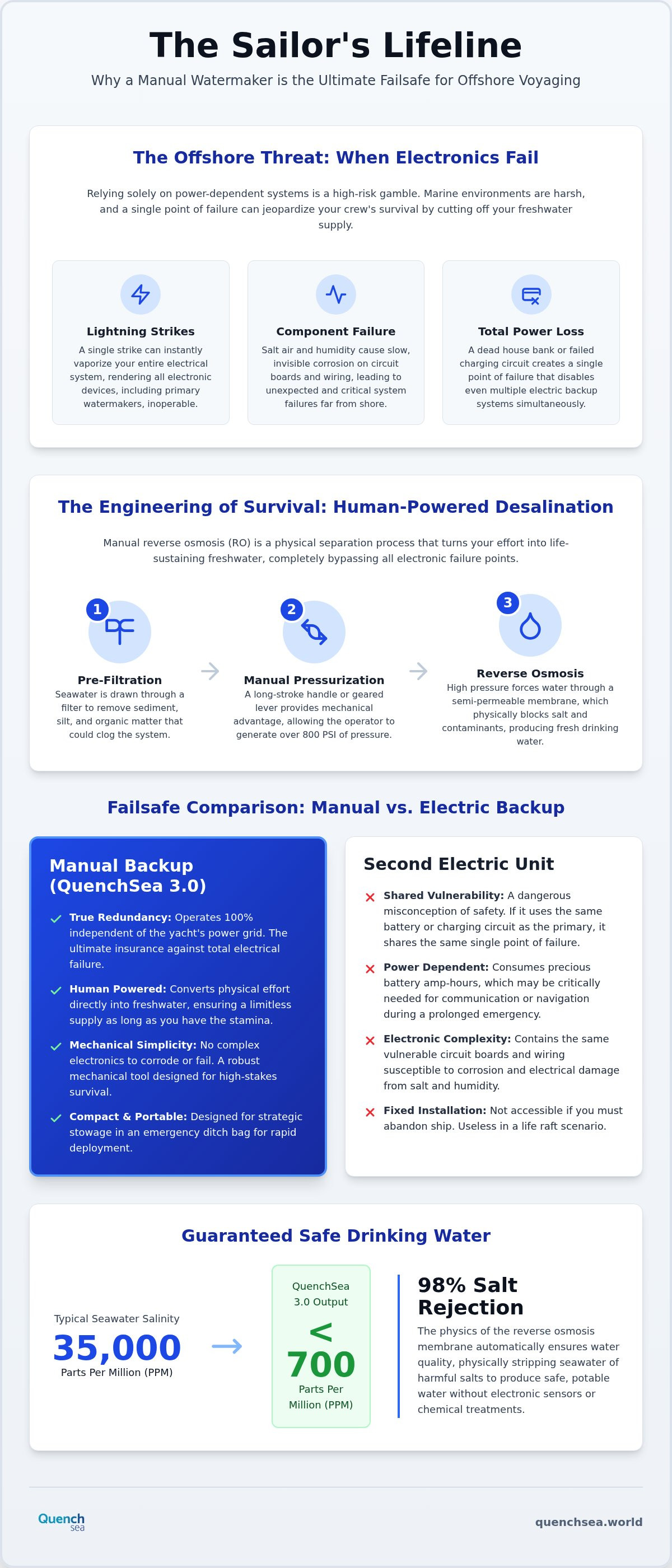
Marine environments destroy electronics. Salt air penetrates sealed housings, while humidity causes slow, invisible corrosion on circuit boards. A single lightning strike can vaporize your entire electrical bus in milliseconds, leaving you with a dead primary watermaker and no way to recharge your batteries. A backup watermaker for yacht security is a redundant system that operates completely independent of the vessel's primary power grid. It's the mechanical insurance policy that ensures your survival when the boat's heart stops beating.
Relying on bottled water rations for long-range offshore crossings is a high-risk strategy. Freshwater is heavy, consumes storage space, and offers zero margin for error if your voyage is delayed by weather or hull damage. A manual desalinator provides a "Plan C" that yields an infinite supply of hydration. Beyond the physical necessity, there's a profound psychological benefit. Knowing you can produce water on demand prevents the resource-driven panic that often leads to poor decision-making during a maritime emergency.
The Limitations of Electric Redundancy
Many owners believe a second electric unit provides sufficient safety. This is a dangerous misconception. If both units draw power from the same house bank or rely on the same charging circuit, they share identical vulnerabilities. During a prolonged emergency, such as a rig failure or a slow leak, you can't afford to waste precious battery amp-hours on water production. A single point of failure is any critical component, such as a battery bank or a wiring harness, whose failure renders all connected systems inoperable regardless of how many backup pumps you have installed.
Transitioning to Manual Failsafes
Modern safety protocols for 2026 emphasize the role of human-powered technology. Integrating a manual water maker for boat systems ensures you aren't tethered to a failing electrical grid. Reverse osmosis (RO) is a water purification process that utilizes a semi-permeable membrane to strip 98% of salts from seawater. By translating human physical effort into the high PSI required for this process, these devices bypass every electronic failure point on your yacht.
Non-electric hardware is the global gold standard for offshore survival. It transforms a complex engineering problem into a simple mechanical task. When your primary systems fail, your survival depends on tools that don't require a manual, a battery, or a miracle to start. A reliable backup watermaker for yacht redundancy is the only way to guarantee hydration in total power loss scenarios.
The Engineering of Survival: How Manual RO Works
Reverse osmosis is not a complex chemical treatment; it is a physical separation process governed by pressure. Seawater contains a high concentration of dissolved solids that exert osmotic pressure. To extract freshwater, you must force the saltwater through a semi-permeable membrane with more strength than the salt exerts in the opposite direction. In a survival situation, this requires precision engineering to ensure every ounce of human effort translates into productive output.
A manual backup watermaker for yacht safety relies on a high-pressure pump to bridge this gap. The system utilizes three critical stages. First, a pre-filter removes sediment and organic matter that would otherwise clog the system. Second, a piston-driven pump builds the necessary force. Finally, the RO membrane itself separates the brine from the permeate. Unlike fixed yacht systems that require automated back-flushing and complex pickling routines, manual units are designed for immediate, high-stakes deployment with minimal setup.
Manual Pressure vs. Electric Pumps
Electric pumps use 12V or 24V motors to maintain a constant, high-volume flow. Manual units replace these motors with mechanical advantage. Long-stroke handles or geared levers allow a human operator to generate the 800+ PSI required for desalination without immediate exhaustion. Modern engineering has refined these piston seals to minimize friction, which is vital when your emergency water supply depends on your own physical stamina. Protecting the membrane is essential; users must rinse the system after use to prevent salt crystallization from puncturing the microscopic pores.
Salt Rejection and Water Quality
Reliable manual units achieve 98% salt rejection. This process strips seawater of its 35,000 ppm salt content, yielding drinking water well below the 700 ppm threshold. You don't need electronic sensors to verify this; the physics of the membrane handles the separation automatically. Pre-filters are the unsung heroes of this process, stripping out plankton and silt that would otherwise "blind" the membrane and increase the physical force required to pump.
While solar stills are a traditional survival tool, they are fundamentally inefficient for volume production. A solar still might produce a few cups of water per day under perfect conditions, whereas a manual RO system produces several liters per hour. If you're serious about vessel self-sufficiency, exploring portable desalination tools is the next logical step in your safety refit. A manual backup watermaker for yacht owners provides the high-volume output that solar evaporation simply cannot match.
Comparing Backup Options: Electric vs. Hand-Powered
Electric watermakers prioritize convenience and high-volume output. A standard yacht system produces 30 to 60 liters per hour but demands significant amperage. In contrast, a manual backup watermaker for yacht owners focuses on survival. It produces approximately 6 to 8 liters per hour. This output requires physical exertion; however, it remains available when your batteries are depleted. Desalination technology on yachts often fails because of electronic complexity rather than membrane failure. Purely mechanical seals and pistons are far more resilient than circuit boards in salt-laden environments.
Weight and footprint are critical for offshore vessels. Fixed electric installations are bulky and require heavy cabling and hull penetrations. A second fixed unit can cost upwards of $3,000. A portable manual unit offers a superior cost-benefit ratio for emergency use. It takes up minimal locker space and requires no permanent wiring. Reliability is the ultimate metric. Electronics fail. Mechanics endure. When the power grid goes dark, a manual handle is the only interface that matters.
When to Choose a Portable Manual Unit
Portability is a life-saving feature. If you are forced to abandon ship, a fixed watermaker stays with the sinking hull. A manual device fits into a ditch bag, providing a sustainable life raft water supply. This allows you to produce freshwater on deck or in a raft without needing a 12V connection. Troubleshooting is straightforward. You can inspect seals and pre-filters visually. There are no proprietary software codes or hidden fuses to diagnose in a storm.
The "Plan C" Strategy
Survival experts recommend a layered approach to resource management. Plan A is your primary electric watermaker. Plan B is your stored tank water. A manual backup watermaker for yacht redundancy serves as Plan C. It is the final layer of the safety net. It does not rely on external fuel, solar panels, or battery banks. It only requires human effort. This independence makes it the gold standard for 2026 offshore safety protocols. You shouldn't bet your life on a battery that might already be submerged.
Emergency Integration: Stowing Your Backup Watermaker
Proper gear placement determines survival. A backup watermaker for yacht redundancy belongs in your primary ditch bag, not a deep locker or the engine room. If the hull is breached or a fire spreads, you won't have time to dig through spare lines or heavy toolboxes. Your emergency desalinator must be accessible within seconds of a "prepare to abandon ship" order. This ensures that even if the vessel's primary systems are submerged, your ability to produce freshwater remains intact.
Environmental protection is vital for long-term reliability. Store the unit in a padded, waterproof case to shield it from physical impact during rough transfers to a life raft. While these devices are rugged, extreme temperature fluctuations can degrade the RO membrane over several years. Keep the ditch bag in a cool, dry, and shaded location near the companionway. This prevents the "greenhouse effect" inside lockers from compromising the seals or pre-filters before they are ever deployed.
Ditch Bag Essentials
The survival desalination device is the core of your hydration kit, but it requires supporting accessories. Pack at least three meters of food-grade intake hose and a weighted strainer to keep the intake below the surface. Include a two-pack of spare pre-filters to handle turbid water or plankton blooms that can occur near the surface. A collapsible five-liter collection vessel is mandatory for efficient distribution among the crew. Distribute these items within the bag to maintain buoyancy, ensuring the kit won't sink if dropped during a chaotic evacuation.
Operational Readiness
Establish a rigorous "dry run" protocol every six months. Deploy the unit on deck and pump a small amount of freshwater through the system to ensure the piston seals remain lubricated and the handle operates smoothly. Don't use seawater for routine tests unless you are prepared to pickle the membrane immediately afterward. Preservation chemicals, or pickling fluid, prevent biological growth and salt crystallization during long storage periods. If you neglect this maintenance, the membrane may "blind" or foul, rendering the backup watermaker for yacht security useless when you need it most.
Physical exhaustion is a significant factor in survival scenarios. Desalination requires rhythmic, sustained physical effort that can be taxing in high-stress environments. Every crew member must practice the correct pumping technique to avoid gear damage and maximize output. Rotating operators every fifteen minutes prevents fatigue and ensures a steady supply of water. Secure your vessel's safety by integrating a portable desalination kit into your emergency manifest before your next offshore passage.
QuenchSea 3.0: The Tactical Choice for Yacht Redundancy
The QuenchSea 3.0 Desalination Device represents the current peak of portable survival engineering. It is not a luxury gadget. It is a mission-driven tool developed by Hydro Wind Energy to address global water scarcity and high-stakes maritime emergencies. For the serious sailor, it provides a rugged, handheld alternative to fixed systems that are prone to electrical failure. This device is designed to be the definitive "Plan C" in your vessel's safety manifest.
The 3.0 model features durability upgrades engineered for the 2026 marine market. Its reinforced chassis and corrosion-resistant internals withstand the high-impact environments of a chaotic deck or a cramped life raft. Every component is selected for mechanical integrity. Unlike primary electric systems that require professional technicians for repair, the QuenchSea 3.0 is built for rapid deployment and simple maintenance under high-stress survival conditions. It functions when your primary infrastructure is submerged or destroyed.
Innovative Manual RO Technology
Professional mariners and disaster relief organizations favor this hardware because it removes the variables of power and fuel. It provides a reliable backup watermaker for yacht security that works as long as the operator can move the handle. Reliability in extreme environments is not just a feature; it's the entire purpose of the design. When your primary desalinator is dead and your tanks are dry, this device becomes your most valuable asset on the open ocean.
Manual desalination is the ultimate yacht safety upgrade. It is immune to the "single point of failure" risks inherent in complex modern vessels. It empowers the crew and guarantees hydration regardless of the ship's electrical status. You don't need a battery to survive a crossing. You need a tool that works every time you engage the lever. Equip your yacht with the QuenchSea 3.0 for your next crossing to ensure your water supply is as resilient as your vessel.
Securing Your Survival Beyond the Grid
Offshore sailing requires a disciplined approach to redundancy. You've seen how salt air and electrical surges can silence even the most expensive primary systems. Relying on a single power source for freshwater is a risk that modern safety protocols no longer accept. A manual backup watermaker for yacht security provides the mechanical certainty you need when the house bank fails. It transforms your physical effort into life-sustaining hydration without the need for fuel or batteries.
The QuenchSea 3.0 is engineered for these exact high-stakes scenarios. It is compact enough for any yacht ditch bag and provides survival-grade hydration that defense and humanitarian agencies trust worldwide. True peace of mind comes from knowing your "Plan C" is a rugged, proven tool that functions regardless of your vessel's electrical status. Secure your offshore safety with QuenchSea 3.0 and ensure your crew never faces a crossing without a reliable source of freshwater. Take command of your safety before you leave the dock.
Frequently Asked Questions
How much water can a manual backup watermaker produce per hour?
A backup watermaker for yacht security, such as the QuenchSea 3.0, produces 6 to 8 liters (1.6 to 2 gallons) of drinking water per hour. Output varies based on the operator's physical rhythm and the seawater temperature. While this is lower than primary electric units, it provides vital hydration for a crew of four in survival conditions. This manual production bypasses the boat's failing power grid entirely.
Is it physically difficult to operate a hand-powered watermaker?
Operating a manual unit requires physical effort, but modern engineering reduces the total strain. The QuenchSea 3.0 utilizes an optimized lever-arm to maximize mechanical advantage during every high-pressure stroke. Rotating operators every 15 to 20 minutes prevents exhaustion. This rhythmic motion is designed to be sustainable for average adults in high-stress emergency environments where physical endurance and reliable gear are critical for survival.
Do backup watermakers require chemicals or electricity to work?
No electricity, batteries, or fuel are required for operation. Manual units rely exclusively on human power to force seawater through a semi-permeable membrane. While no chemicals are needed for the desalination process itself, you must use preservation chemicals, or "pickling" fluid, during long-term storage. This prevents biological growth and salt crystallization from damaging the RO membrane when the system is not in active use.
How long can I store a manual watermaker before the membrane expires?
A properly preserved RO membrane can be stored for several years. You must flush the system with freshwater and apply pickling solution before long-term storage to maintain its integrity. Without this preservation, the membrane can dry out or become fouled by bacteria. We recommend inspecting your emergency gear every six months and replacing filters according to the manufacturer's schedule to ensure the device is ready for immediate deployment.
Can a manual watermaker be used in a life raft?
Portability is a core design feature for survival gear. The QuenchSea 3.0 is compact and lightweight enough to fit into a standard ditch bag for use in a life raft. Its handheld design allows you to produce freshwater while seated in a raft, provided you have access to clean seawater. This capability ensures your crew remains hydrated even after abandoning the primary vessel during a catastrophic failure.
What is the difference between a watermaker and a standard water filter?
Standard water filters only remove sediment, bacteria, and some chemicals; they cannot remove dissolved salts from seawater. A watermaker uses reverse osmosis technology to strip 98% of salts at a molecular level. This process requires high pressure to overcome osmotic force. A backup watermaker for yacht safety is essential because drinking filtered seawater without desalination leads to rapid, life-threatening dehydration in a maritime emergency.
Does the QuenchSea 3.0 remove viruses and bacteria as well as salt?
The QuenchSea 3.0 removes 98% of dissolved salts and effectively filters out viruses, bacteria, and microplastics. The reverse osmosis membrane has microscopic pores that are too small for most pathogens to pass through. This ensures the resulting permeate meets World Health Organization standards for safe drinking water. It provides a comprehensive purification solution that protects against dehydration and waterborne illnesses when your primary systems are no longer operational.
How do I maintain my backup watermaker when not in use?
Maintenance focuses on protecting the membrane from damage. Flush the unit with freshwater after every use to remove residual salt. If storing the device for more than seven days, you must use a pickling solution to prevent organic fouling. Store the unit in its protective case in a cool, dry location. Regular inspections every six months ensure the piston seals remain lubricated and the mechanism is ready for action.