

In a high-stakes environment, your most dangerous vulnerability isn't the enemy; it's your own thirst. When primary supply lines fail and the power grid goes dark, the weight of traditional water logistics can compromise any mission. You already know that relying on fragile bulk deliveries or carrying 40 pounds of bottled water isn't a sustainable strategy for long-range operations. Integrating a tactical desalination device into your kit is the only way to eliminate this liability while maintaining speed and stealth.
This guide helps you master the technology and deployment of point-of-use production to ensure 100% water independence in austere zones. By shifting away from bulk transport, you can drastically reduce your logistical footprint. We'll explore how to secure safe drinking water from seawater using the QuenchSea 3.0, focusing on zero-fuel mechanical reliability and the engineering behind field-ready reverse osmosis. We'll break down the logistics of 2026 field hydration, from membrane maintenance to the tactical advantages of manual pressure systems that don't rely on batteries or fuel.
Key Takeaways
- Learn why bulk water distribution creates a primary target for adversaries and how to eliminate this vulnerability.
- Understand the mechanics of reverse osmosis and how a manual tactical desalination device converts seawater into potable water without electricity.
- Evaluate the logistical footprint of portable vs. truck-mounted units to optimize small-unit mobility in coastal zones.
- Discover field-proven pre-filtration techniques to protect your RO membranes and extend the operational life of your equipment.
- See why the QuenchSea 3.0 serves as the definitive zero-fuel backup for mission-critical hydration when power grids fail.
Why Primary Tactical Water Purification Systems Fail
Mission readiness in 2026 demands absolute self-sufficiency. Traditional water logistics rely on external supply chains, fuel, and stable power grids. These are luxuries you won't have in a contested zone. A tactical desalination device is no longer just a backup; it's a requirement for survival when primary systems collapse. If your plan depends on a truck arriving or a battery holding a charge, your plan is flawed.
The "Logistics Tail" is the primary target for any modern adversary. Bulk water distribution requires heavy vehicles, clear roads, and constant protection. These assets are loud, slow, and easy to track. When the supply line is cut, the mission stops. You can't fight if you can't hydrate. The "Rule of 3" dictates that you have roughly three days without water before total physiological failure. In high-exertion tactical environments, that timeline accelerates. Water is the most immediate logistical priority, yet it's often the most vulnerable link in the chain.
The Vulnerability of Bulk Logistics
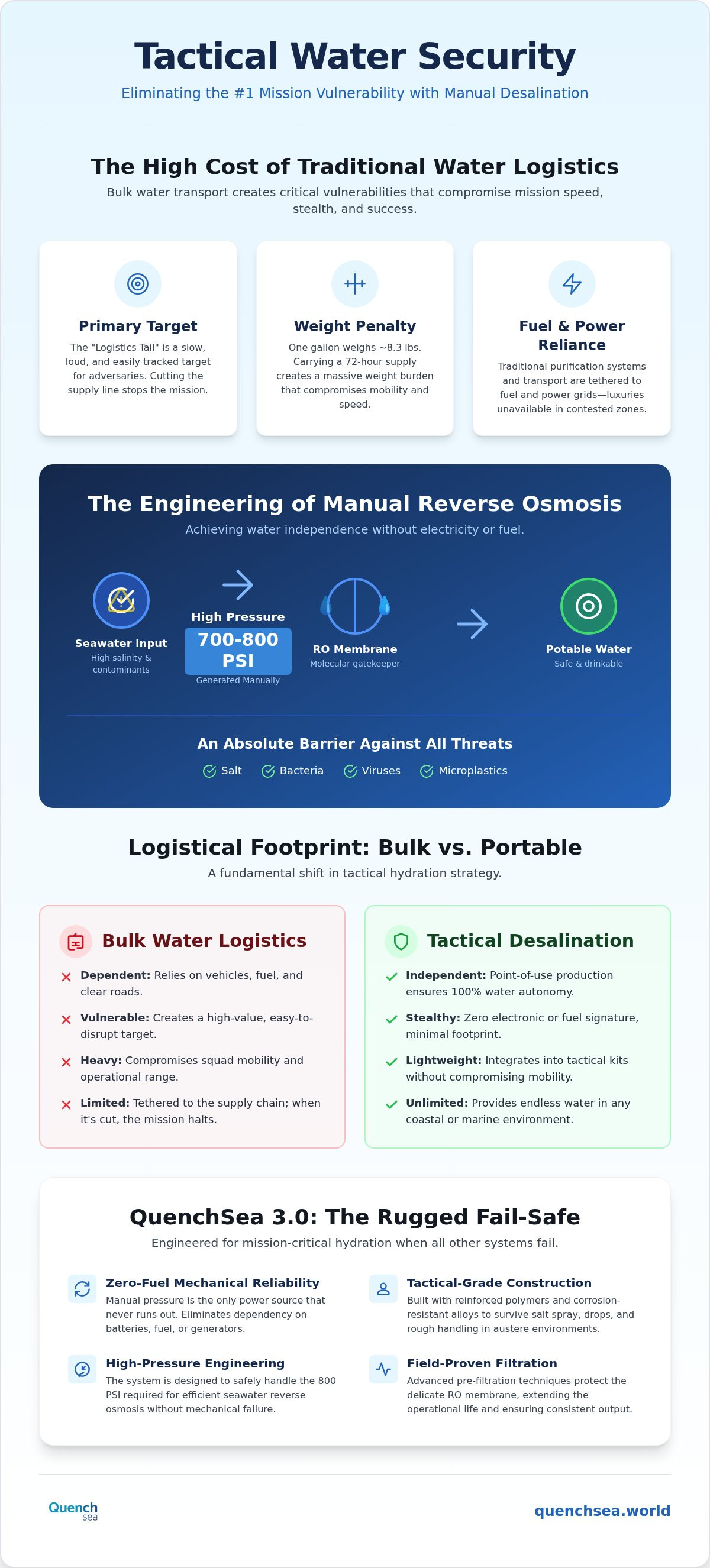
Transport lines become bottlenecks in decisive action or disaster zones. Water is heavy; one gallon weighs approximately 8.3 pounds. Carrying a 72-hour supply creates a massive weight penalty that compromises your mobility and speed. Historical military maneuvers show that units often outpace their own water supply, leading to forced halts and compromised positions. Relying on bulk logistics means your operational range is tethered to a fuel-dependent vehicle. When the fuel runs out or the road is blocked, your water source vanishes.
Mechanical vs. Chemical Failures
Chemical treatments like iodine or chlorine tablets are useless against high salinity. They don't remove salt, and they struggle with high turbidity. Most sophisticated electronic purification systems utilize Reverse Osmosis (RO), but they are prone to mechanical failure. Fragile sensors, complex pumps, and dead batteries turn a $2,000 unit into dead weight.
Tactical Water Security is the ability to source water independently of power. When electronic systems fail in the field, you need a mechanical fail-safe that doesn't require a generator. Manual pressure is the only power source that never runs out. Without a rugged, hand-powered tactical desalination device, you're one mechanical glitch away from a hydration crisis.
The Engineering of Manual Reverse Osmosis (RO)
Standard water filters are designed to trap suspended particles. They use hollow fiber membranes to block bacteria and protozoa. Salt is different. Dissolved sodium and chloride ions are too small for simple physical barriers. To remove them, you need a tactical desalination device capable of reverse osmosis. This process forces water molecules through a semi-permeable membrane while leaving dissolved solids behind. It requires high pressure to overcome the natural osmotic flow.
Desalination Without External Power
Generating high PSI manually is a mechanical feat. Modern manual pumps use leverage and piston efficiency to reach the 700 to 800 PSI required for seawater desalination. Technical assessments of small-scale water treatment show that while large units are more automated, they're tethered to generators. Manual systems eliminate this dependency. In 2026, membrane technology has advanced to allow higher flow rates at lower physical effort. This allows a single operator to produce liters of fresh water without exhausting their own energy reserves.
Removing Biological and Chemical Threats
Reverse osmosis provides protection that chemical tablets can't match. It doesn't just strip salt. It acts as an absolute barrier against viruses, bacteria, and microplastics. The pore size is so small that nearly all contaminants are physically excluded. In a tactical RO system, the semi-permeable membrane acts as a molecular gatekeeper that allows only pure H2O to pass through. Dealing with brackish water requires less pressure than seawater. A well-engineered tactical desalination device allows the user to adjust their pumping rhythm based on the specific source salinity.
Field reliability depends on the housing. Plastic components fail under the 800 PSI internal pressure or when dropped on rocky coastlines. Tactical grade hardware uses reinforced polymers and corrosion-resistant alloys. You need a system that survives salt spray and rough handling. If you're looking for a field-proven solution, the QuenchSea 3.0 offers the mechanical integrity needed for austere environments.
Bulk vs. Portable: Evaluating Tactical Water Logistics
Centralized water purification is efficient until the moment it isn't. Truck-mounted units provide massive volume, often exceeding 1,200 gallons per hour, but they are logistical anchors. They require heavy fuel, specialized technicians, and secure roads for deployment. If the pump fails or the fuel supply is intercepted, you face a Single Point of Failure. One mechanical glitch or a single targeted strike can dehydrate an entire platoon. In high-mobility environments, relying on a centralized system is a calculated risk that often fails when the pressure is highest.
Deploying a portable tactical desalination device shifts the strategy from mass distribution to individual autonomy. Small units operating in coastal or austere zones can't always wait for a supply truck to navigate hostile terrain. They need decentralized solutions that work at the point of use. While bulk systems excel in established base camps, they are a liability in rapid-response scenarios. Portable devices are lighter, faster to deploy, and require zero specialized tools for field maintenance. This independence is the ultimate fail-safe against the collapse of primary supply lines.
Logistics vs. Portability
Industrial systems take hours to set up. You have to lay intake hoses, prime high-pressure pumps, and stabilize a noisy power source. In contrast, a hand-powered tactical desalination device is operational in seconds. You drop the intake hose into the water and start pumping. This speed is the difference between staying mobile and being pinned down. Decentralization also spreads the risk. If one person loses their kit, the rest of the team remains self-sufficient. This model is critical for disaster relief water supply and rapid military maneuvers where speed is the primary defense.
Stealth and Energy Signatures
Covert operations demand a low profile. Fuel-powered purification units are a tactical liability because they generate significant noise and a distinct thermal signature. Modern infrared sensors can pick up the heat from a generator from miles away. Manual RO operation is virtually silent and produces no heat. By using a hand-powered device, you eliminate the energy signature entirely. This allows your team to maintain stealth while securing mission-critical hydration in contested coastal environments. You don't just gain water; you preserve your position.
Field Deployment: Integrating RO into Tactical Kits
Coastal raw water is more than just a brine solution; it's often a slurry of organic debris, sand, and microorganisms. To protect your tactical desalination device, you must source water with precision. Avoid shallow, churning surf where sand concentration is at its peak. Look for calmer tide pools or use a weighted intake to pull from deeper, clearer water. Proper sourcing is the first line of defense for your reverse osmosis membrane.
Sourcing and Pre-Treatment
RO membranes are precision-engineered components. Silt and sand act as abrasives that cause premature failure and clogging. You should always use a multi-stage pre-filtration strategy to extend the life of your gear. First, allow raw water to settle in a collapsible bucket for 20 minutes. This simple step lets heavy particulates drop to the bottom. Next, pass the water through a dedicated sediment filter before it reaches the primary unit. This layered approach is vital for bug out bag water desalination where replacement parts aren't an option.
Hydration logistics for small teams require a disciplined production schedule. Don't wait until your bladders are empty to begin purification. Designate a primary operator for water production during every rest cycle. While one person pulls security, another operates the manual pump to replenish the team's supply. Producing water in consistent batches ensures you maintain a buffer against unforeseen delays or mechanical issues.
Operational Maintenance
High salinity is corrosive and destructive to hardware. After every production cycle, you must flush the system with a small amount of the fresh water you just created. This prevents salt crystals from drying and puncturing the delicate membrane. Use a TDS meter to verify the quality of your output. If the reading begins to climb, it indicates that the membrane is fouled or reaching the end of its service life. For long-term readiness, ensure the device is completely flushed and dried before storage. Biofouling can occur rapidly if stagnant water sits inside the unit for weeks.
Mechanical reliability is the difference between a successful mission and a logistical disaster. If you need a field-proven solution that survives the harshest coastal environments, get the QuenchSea 3.0 for your mission-critical kit.
QuenchSea 3.0: The Rugged Fail-Safe for Mission Criticality
Mission success hinges on hardware that works when every other system breaks. The QuenchSea 3.0 is the definitive tactical desalination device for 2026. It's engineered to solve the "last mile" hydration problem in coastal and marine environments. While bulk systems offer volume, QuenchSea 3.0 offers survival. It utilizes a manual pressure system to drive reverse osmosis without a single watt of electricity. In high-stakes environments, this mechanical simplicity is your greatest asset.
The device is built for professionals who can't afford to wait for a supply chain. Whether you are in defense, disaster relief, or marine safety, the ability to generate potable water at the point of use changes the tactical calculus. It removes the burden of carrying heavy water loads and eliminates the risk of dehydration due to logistical collapse. By focusing on manual reliability, it provides a calculated solution to a life-critical problem.
Engineering for Extreme Environments
Seawater is a harsh medium. It destroys electronics and corrodes standard metals. The QuenchSea 3.0 was built for marine and defense durability. It uses high-grade, corrosion-resistant materials to withstand salt spray and rough field handling. The hand-powered pump is a masterclass in mechanical efficiency. It generates the necessary PSI to strip salt and contaminants while remaining lightweight enough for a rucksack. This makes it an essential survival desalination device for those operating where power grids don't exist. It doesn't just survive the environment; it overcomes it.
The Logical Conclusion of Tactical Prep
True preparedness means eliminating single points of failure. If your water plan requires a generator or a battery, you don't have a plan; you have a hope. Manual power is the only fail-safe that guarantees 100% water independence. Every life raft, bug-out bag, and tactical kit requires a manual RO backup. QuenchSea’s mission is to provide high-reliability solutions at a cost that allows for wide-scale deployment. It’s the calculated choice for professionals who understand that in extreme environments, simplicity equals survival. Don't leave your hydration to chance or a fragile supply line.
Explore the QuenchSea 3.0 for your tactical water needs and secure your water independence today.
Master Your Mission-Critical Hydration
Hydration is a tactical requirement, not an option. Relying on centralized supply lines or fuel-dependent systems creates a vulnerability that modern missions can't afford. By integrating a tactical desalination device into your field kit, you eliminate the risk of logistical collapse and ensure constant access to potable water in coastal zones. True resilience comes from decentralization and mechanical simplicity. You must be able to source and purify water at the point of use without waiting for a delivery that may never arrive.
The QuenchSea 3.0 provides the manual hand-powered RO capability needed for extreme environments. It requires no electricity or fuel, making it the ideal fail-safe for defense and survival. You don't have to worry about battery life or thermal signatures when your survival depends on a rugged, human-powered solution. This technology allows you to operate with absolute autonomy, regardless of the status of the local power grid or primary supply chain. It's a calculated, mechanical answer to the harshness of the natural world.
Secure your mission-critical water supply with QuenchSea 3.0 today. Prepare for the worst-case scenario with a tool engineered for the highest stakes. Stay hydrated and stay mobile.
Frequently Asked Questions
What is a tactical water purification system?
It's a field-ready solution designed to provide potable water in austere environments where infrastructure is absent. Unlike residential filters, these systems prioritize durability, mobility, and the ability to handle high-salinity or contaminated sources. They often utilize advanced technologies like reverse osmosis to ensure mission-critical hydration. A tactical desalination device specifically targets salt removal, allowing operators to source water from coastal areas without relying on vulnerable supply lines or fragile power grids.
Can a tactical desalination device remove salt from seawater?
Yes, these devices are engineered specifically to overcome osmotic pressure and strip dissolved salts from seawater. Standard filters only trap particles, but a tactical desalination device uses reverse osmosis membranes to block sodium and chloride ions. This process converts high-salinity brine into safe, drinkable freshwater. It's the only reliable method for securing hydration from the ocean when you're operating in coastal zones or on life rafts far from land-based supply lines.
How long do reverse osmosis membranes last in tactical environments?
Membrane longevity depends on water quality and maintenance discipline. In 2026, high-quality RO membranes like those in the QuenchSea 3.0 can typically process between 1,000 and 2,000 liters of water before requiring replacement. Heavy sediment or lack of pre-filtration will shorten this lifespan. You must flush the system with freshwater after every use to prevent salt crystallization and biofouling. Regular monitoring with a TDS pen ensures the membrane continues to meet safety standards.
Do manual water makers require a power source or batteries?
No, manual water makers like the QuenchSea 3.0 operate entirely on human power. They use a mechanical lever or pump system to generate the 700 to 800 PSI required for reverse osmosis. This "zero-fuel" design eliminates dependency on batteries, solar panels, or generators. It's a critical advantage for stealth operations and long-term survival where power grids are non-existent. You don't have to worry about electronic failure or finding a charging source in the field.
What is the difference between a water filter and a tactical RO system?
A standard water filter uses physical barriers to remove bacteria, protozoa, and sediment, but it cannot stop dissolved salt. A tactical RO system uses a semi-permeable membrane that functions at a molecular level. It forces water through pores so small that even salt ions and viruses are excluded. While a filter is sufficient for freshwater lakes, only a reverse osmosis system can safely desalinate seawater or handle complex chemical contaminants in austere zones.
How much water can a hand-powered tactical desalination device produce?
Production rates vary by model and operator effort. The QuenchSea 3.0 is engineered to produce between 5 and 8 liters of fresh water per hour under manual operation. This output is sufficient to sustain a small team or an individual in high-stress survival situations. Because the device doesn't rely on external power, you can maintain this production schedule as long as an operator is available to pump, ensuring a steady supply of hydration.
Is manual RO effective against viruses and chemical contaminants?
Yes, reverse osmosis is one of the most effective purification methods available. The pore size of an RO membrane is approximately 0.0001 microns, which is significantly smaller than the smallest known viruses and most chemical molecules. This provides an absolute barrier against biological threats and dissolved solids. While no system is 100% effective against every possible chemical, manual RO offers the highest level of protection for individual operators facing contaminated or saline water sources.
How do I maintain a tactical water maker in the field?
Field maintenance focuses on membrane preservation and mechanical integrity. You must use pre-filters to remove sediment and sand before the water enters the RO chamber. After each production cycle, flush the system with a small amount of freshwater to clear out residual brine. This prevents salt crystallization. Store the unit in a cool, dry place when not in use. Checking the seals and lubricating moving parts ensures the device remains operational for your mission.