

In a mid-ocean emergency, a high-tech electric water maker is nothing more than expensive ballast the moment your battery bank fails. It's a sobering reality every blue-water sailor understands. When systems crash and the horizon is empty, your survival depends on what you can power with your own hands. This is why a hand pump water desalinator isn't just a backup tool. It is a mechanical insurance policy designed for the worst-case scenario.
You likely already know that gear failure isn't a matter of if, but when. Relying on complex electronics in corrosive salt air is a gamble that eventually loses. We promise to help you master the technical reality of manual desalination. You'll learn how to secure a limitless freshwater supply in extreme marine environments without wasting physical energy on inefficient pump designs.
This guide breaks down the essential maintenance of RO membranes and the physical mechanics of manual pressure. We'll explore why survival-grade hardware like the QuenchSea 3.0 has become the modern standard for offshore safety. By the end, you'll have the confidence to face a crossing knowing your hydration isn't tied to a circuit board.
Key Takeaways
- Understand how manual leverage overcomes osmotic pressure to produce freshwater without relying on batteries or fuel.
- Learn why a high-quality hand pump water desalinator serves as the ultimate mechanical insurance policy for life-critical marine situations.
- Discover the "Hydration ROI" and how ergonomic pump designs minimize physical exhaustion during long-term survival scenarios.
- Identify non-negotiable material standards, including the use of corrosion-resistant plastics and metals engineered for the harshest environments.
- Explore why the QuenchSea 3.0 sets the 2026 standard for reliability by stripping away complex failure points to focus on essential performance.
What is a Hand Pump Water Desalinator?
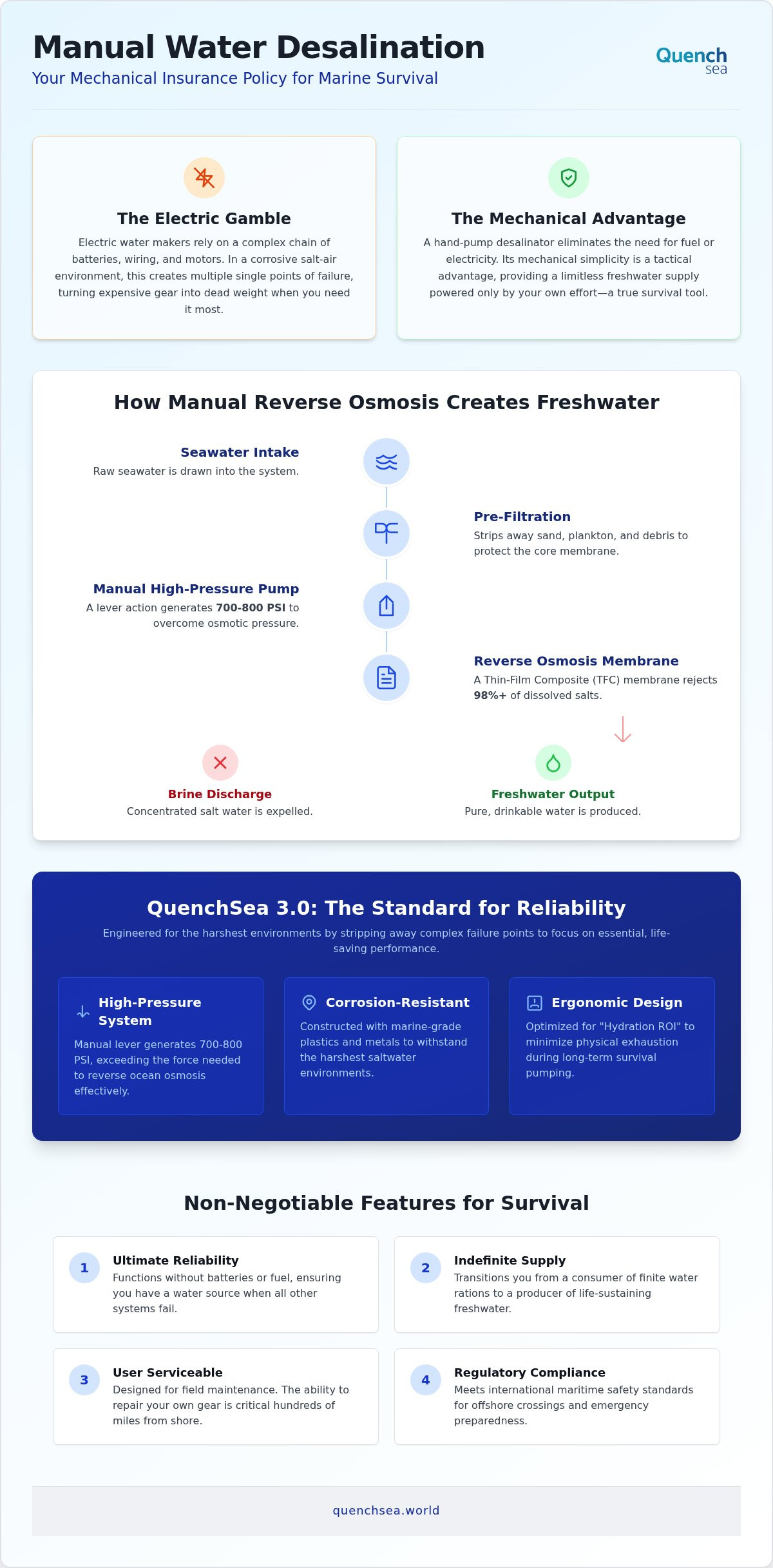
A hand pump water desalinator is a portable, survival-grade device that utilizes manual leverage to convert seawater into drinkable freshwater. Unlike standard gravity filters or ceramic pumps found in hiking kits, these units employ high-pressure reverse osmosis (RO). They force saltwater through a semi-permeable membrane that is fine enough to block dissolved salt ions. It's a mechanical solution to a biological necessity.
Standard filters fail at sea. Carbon and ceramic elements remove bacteria and sediment, but they cannot strip the sodium and chloride that make seawater toxic to humans. A true desalinator requires enough pressure to overcome the natural osmotic flow of the ocean. This demands robust engineering. In the marine world, durability outranks weight. A tool that breaks under pressure is a liability, not an asset.
The Essential Role in Marine Safety
Every life raft has a limit. Stored water rations provide a temporary buffer, but they eventually run dry. A hand-powered desalinator shifts your status from a consumer of finite resources to an active producer of life-sustaining water. This is why non-electric water makers are often mandated by international maritime safety standards. They represent the ultimate "last resort" when power systems go dark and help is days away.
- Transition to production: Move beyond reliance on heavy, space-consuming water cans.
- Indefinite supply: As long as you can pump, you can drink.
- Regulatory compliance: Meet safety requirements for offshore crossings and emergency preparedness.
Manual vs. Electric: The Reliability Gap
Electric water makers are convenient for daily yacht life. However, they rely on a complex chain of batteries, wiring, and high-pressure pumps. In a high-salt environment, this complexity creates multiple "single points of failure." If the electrical system shorts or the motor burns out, the device becomes dead weight.
Mechanical simplicity is a tactical advantage. A hand pump water desalinator eliminates the need for fuel or electricity. Devices like the QuenchSea 3.0 focus on user-serviceability and ruggedness over automated convenience. When you're 500 miles from the nearest coast, you don't need a touch screen. You need a lever that works every time you pull it. The ability to maintain and repair your own gear in a life raft is the difference between a crisis and a manageable situation.
The Engineering of Manual Reverse Osmosis
Reverse osmosis is a mechanical battle against the laws of physics. In a natural environment, water moves from areas of low salt concentration to high concentration to reach equilibrium. To reverse this flow, you must apply significant external force. A hand pump water desalinator uses a high-pressure pump to drive seawater against a Thin-Film Composite (TFC) membrane. These membranes are the industry standard for survival hardware. They utilize multiple microscopic layers to reject 98% or more of dissolved salts and minerals while allowing pure H2O molecules to pass through the molecular barrier.
The core membrane is highly effective but also sensitive. Raw seawater is often loaded with sand, plankton, and organic debris that can shred or clog the TFC layers instantly. This makes pre-filtration a critical engineering requirement. It acts as a sacrificial shield, stripping away physical contaminants before they reach the high-pressure stage. Without robust pre-filtration, the most expensive membrane in the world will fail within hours of deployment.
How Manual Pressure Creates Freshwater
Overcoming the osmotic pressure of the ocean requires immense force. Most manual units employ a lever-action handle to reach internal pressures between 700 and 800 PSI. This mechanical advantage is what allows a human operator to perform a task usually reserved for high-voltage electric motors. Pump speed directly impacts output. A steady, rhythmic stroke maintains the internal pressure required for the RO process to function. Total Dissolved Solids (TDS) is a measure of all inorganic and organic substances dissolved in a liquid, which must remain below 1,000 parts per million (ppm) to be considered safe for human consumption. High-performance tools like the QuenchSea 3.0 are designed to achieve these safe levels through precision engineering.
Membrane Longevity and Maintenance
A desalination membrane is a precision tool that requires specific care to remain functional. If you leave saltwater inside the housing after use, bacteria and algae will grow, leading to bio-fouling. This biological growth creates a slime layer that blocks the membrane pores and ruins the device. To prevent this during long-term storage, operators must "pickle" the unit using a food-grade preservative solution that inhibits growth.
- Freshwater Flushing: Always flush the system with product water after use to remove concentrated brine.
- Scaling Prevention: Regular flushing prevents salt crystals from precipitating and hardening on the membrane surface.
- Storage Protocols: Use chemical preservatives if the unit will sit idle for more than seven days.
Proper maintenance ensures that your mechanical insurance policy is ready when the primary systems fail. Neglecting these steps turns a life-saving tool into a useless piece of plastic.
Evaluating Output: Effort vs. Hydration
Survival at sea is a cold calculation of energy expenditure. When using a hand pump water desalinator, you're trading physical calories for hydration. This is the "Hydration ROI." In high-stress marine environments, every movement costs water through perspiration. If a pump design is inefficient, an operator might sweat out more fluid than the device produces. This makes ergonomics a life-critical feature rather than a luxury. Handle length and stroke volume determine how much leverage you have to reach the 700 to 800 PSI required for reverse osmosis.
Real-world variables drastically alter production rates. Cold seawater is more viscous and harder to push through the membrane than warm tropical water. Similarly, regions with higher salinity require more mechanical work to overcome osmotic pressure. Survivors should adopt a batch pumping strategy. Work for 15 to 20 minutes, then rest. This prevents total muscle failure and allows the membrane to stabilize between sessions. Continuous, frantic pumping is rarely sustainable for a solo survivor.
The Reality of Manual Pumping
Fatigue is the primary enemy in a life raft. A jerky, inconsistent pumping motion doesn't increase water flow; it only accelerates operator exhaustion and risks damaging internal seals. A steady, rhythmic stroke is the most efficient way to maintain the necessary pressure. Don't attempt to force the lever beyond its natural resistance. Pushing a device beyond its rated capacity won't produce water faster. It only increases the likelihood of a mechanical failure when you can least afford it.
Water Quality Standards at Sea
You must verify your output to ensure the system is functioning. A TDS meter is the only objective way to know if your manual desalinator is rejecting salt effectively. Safe drinking water must remain below 1,000 ppm. If the levels spike, the membrane may be compromised or fouled. RO water often tastes "flat" because the process strips away the minerals found in standard bottled water. This is normal. While the RO membrane blocks most biological threats, any contamination in your collection vessel can introduce pathogens. Using purification tablets as a secondary treatment is a sound tactical backup for long-term survival.
Choosing the Best Portable Desalination Device
Selecting a hand pump water desalinator requires a shift in mindset. You aren't buying a luxury accessory; you're investing in a life-support system. While weight is a primary concern for hikers, marine users must prioritize mechanical robustness. A flimsy unit might save a few grams in your ditch bag, but if it flexes or cracks during the 800 PSI stroke, those weight savings are irrelevant. Look for reinforced housings and thick-walled pump cylinders that can withstand the immense internal pressures of reverse osmosis.
Material choice is non-negotiable. The ocean destroys inferior equipment through rapid corrosion and salt crystallization. Metals must be high-grade stainless steel or corrosion-resistant alloys. Plastics should be UV-stabilized and impact-resistant to prevent brittleness after weeks of exposure on a life raft. Cheap components will seize up or degrade, turning your survival tool into a liability.
Ease of service is the final pillar of a reliable device. Can you clear a clog in the middle of the Atlantic? In a survival situation, you won't have a clean workbench or specialized tools. The best designs offer tool-free disassembly, allowing you to inspect the pre-filter, check the O-rings, and access the membrane with your bare hands. Factor in the long-term cost of ownership by checking the price and availability of replacement seals. A device with proprietary parts that are impossible to source in a remote port becomes a burden rather than a solution.
Tactical Features for Emergency Use
In a rescue scenario, visibility is a survival asset. Emergency gear should feature high-visibility colors like international orange to help rescuers spot your position. Tether points are equally vital. If you drop your pump into the swell, it's gone forever. Secure your life raft water supply with heavy-duty lanyards to ensure it stays attached to the craft. Field maintenance must be intuitive. When your hands are cold and the raft is pitching, complex mechanical puzzles lead to failure.
The Coastal Bug-Out Perspective
Survival isn't limited to the open ocean. A manual desalinator is an essential component of bug out bag water desalination for those in coastal regions. Land-based survival often involves brackish water from estuaries or tidal pools. Brackish water has a lower salt concentration than full-strength seawater, which reduces the physical effort required to produce freshwater. However, these sources often contain more sediment and biological matter. Ensure your device has a high-capacity pre-filtration system to handle these varied environments without fouling the core membrane.
If you need a tool built for these exact high-stakes conditions, explore the technical specifications of the QuenchSea 3.0 desalination device.
The QuenchSea 3.0: Survival-Grade Innovation
Reliability in a survival situation isn't about how many features a device has. It's about how many points of failure have been removed. The QuenchSea 3.0 embodies this philosophy. It strips away the fragile electronics and fuel dependencies of traditional systems to focus on pure mechanical performance. As a hand pump water desalinator, it represents a calculated response to the unpredictability of the marine environment. It provides a bridge between total system failure and sustained hydration.
The QuenchSea 3.0 advantage lies in its accessible engineering. High-pressure reverse osmosis is no longer restricted to heavy, expensive yacht installations. By optimizing the leverage and piston design, we've created a unit that delivers survival-grade water production without requiring immense physical strength. This independence is the ultimate tool for the off-grid sailor. Whether you're crossing an ocean or preparing for coastal emergencies, zero-fuel operation ensures that your water supply is never tied to a battery bank or a diesel tank.
Beyond individual survival, this technology addresses the global water crisis. Clean water is a human right, yet millions lack access to reliable sources. QuenchSea is mission-driven. We provide a low-cost, high-durability solution that works in the most remote corners of the planet. By refining the hardware for the harshest marine conditions, we've built a tool capable of serving humanitarian needs worldwide.
Engineered for the Extremes
The 2026 standards for marine hardware demand more than just waterproofing. The QuenchSea 3.0 features an impact-resistant housing designed to survive the toss into a life raft and the subsequent battering of the sea. High-pressure seals ensure that internal force remains focused on the membrane, not on leaking joints. Every component is built for high-stress, low-energy states. When you're exhausted and dehydrated, you need a device that is intuitive to operate. Learn more in our QuenchSea 3.0 Desalination Device guide.
Securing Your Water Independence
A Grab Bag is incomplete without a reliable way to produce water. Rations run out. Batteries die. Solar panels break. The 3.0 is your mechanical insurance policy. Getting started is simple. Secure the unit to your craft, deploy the intake hose into clean seawater, and begin a steady pumping rhythm. It's a direct, physical solution to the threat of dehydration. Don't wait for a system failure to realize the value of manual backup. Secure your QuenchSea 3.0 and never worry about ocean hydration again.
Mastering Your Mechanical Water Security
The ocean is an unforgiving environment where complexity often leads to failure. Relying on a hand pump water desalinator ensures that your hydration is never dependent on a battery bank or a circuit board. You now understand the technical reality; manual reverse osmosis is the only reliable way to strip salts and TDS when power systems vanish. By prioritizing rugged material science and ergonomic design, you transform a potential crisis into a manageable tactical challenge.
Survival-grade reliability requires hardware that works every time you pull the lever. The QuenchSea 3.0 delivers this through proven manual RO technology that requires zero batteries or fuel. We provide global shipping for the marine and defense sectors, ensuring that professional-grade water security is accessible regardless of your location. This isn't just gear; it's a mission-driven commitment to safety in the most extreme conditions on Earth.
Don't leave your survival to chance. Take command of your vessel's safety and ensure you have an indefinite freshwater supply. It's time to equip your craft with the mechanical insurance you need for peace of mind during any crossing. You have the knowledge and the tools to stay hydrated and empowered.
Order the QuenchSea 3.0 Desalination Device Today
Manual Desalination: Frequently Asked Questions
Is it physically difficult to use a hand pump desalinator?
Operating a hand pump water desalinator requires consistent physical effort but remains manageable through ergonomic engineering. The device uses a lever-action handle to create the 700 to 800 PSI needed for reverse osmosis. While it demands more work than an electric system, it's designed for survivors in weakened states. Success depends on maintaining a steady, rhythmic pace rather than using explosive strength. This prevents premature fatigue during long survival sessions.
Can I use a hand pump water desalinator on fresh water or river water?
You can use the device on fresh or brackish water, but it's engineered specifically for seawater. While it will remove contaminants, river water often contains high levels of sediment and organic silt that can clog the membrane faster than salt. If you're using it in estuaries or coastal rivers, always use the pre-filtration system. This protects the core RO element from bio-fouling and ensures the hardware remains functional.
How long does the RO membrane last in a manual desalinator?
Membrane lifespan varies based on water quality and maintenance discipline. In ideal conditions with regular freshwater flushing, a survival-grade membrane can last for several years of intermittent use. However, allowing salt to crystallize or bacteria to grow inside the housing will destroy the TFC layers in days. Using a preservative or "pickling" solution during storage is non-negotiable for long-term reliability. Always inspect the seals and membrane before any offshore passage.
Does the water from a manual desalinator taste like salt?
Drinkable water produced by a functioning RO system shouldn't taste like salt. The Thin-Film Composite membrane rejects over 98% of dissolved solids, including sodium and chloride. The resulting water often tastes "flat" or "distilled" because it lacks the minerals found in tap or bottled water. If you detect a salty flavor, it indicates a membrane breach or a seal failure. Use a TDS meter to verify the output remains below 1,000 ppm.
What happens if the membrane gets clogged with sand or algae?
A clogged membrane leads to increased resistance and a total loss of freshwater production. This is why pre-filtration is a critical tactical feature. If the core RO element becomes fouled by algae or silt, it's often impossible to clean in the field and must be replaced. Survival hardware like the QuenchSea 3.0 allows for tool-free disassembly, enabling you to clean the pre-filters and inspect the intake line to prevent permanent damage.
Is a hand pump desalinator better than solar distillation for survival?
Manual reverse osmosis is significantly more efficient than solar distillation. Solar stills rely on evaporation, which is slow and depends entirely on direct sunlight and calm conditions. A hand pump device works 24 hours a day in any weather condition. It produces larger volumes of water in a fraction of the time. While solar stills are a passive backup, a mechanical pump is the primary tool for active survival and reliable hydration.
Can I drink the water immediately after pumping?
You can drink the water immediately as it leaves the product hose. Reverse osmosis is a physical barrier that blocks salt, bacteria, and most viruses at the molecular level. However, if your collection container is contaminated, the water becomes unsafe. In high-risk environments, many professionals use purification tablets as a secondary treatment. This ensures that any pathogens introduced after the desalination process are neutralized before you consume the water.
How much water can a person realistically produce in one day?
Realistic output depends on the operator’s physical condition and the sea's temperature. While specific hourly volumes vary, a manual desalinator is designed to provide enough freshwater to sustain multiple people on emergency rations. Production is a trade-off between calories burned and fluid gained. Most survivors find that pumping in 20-minute intervals throughout the day provides a sustainable supply without causing total physical collapse. It's about maintaining life, not luxury.