

Your primary electric water maker is a luxury appliance, not a survival tool. True safety requires a yacht safety water maker that functions when your batteries are dead and your engine won't start. If you are mid-passage and the power grid fails, your reliance on high-tech desalination becomes a liability. We understand the high stakes of offshore travel and the fear of being stranded without a reliable source of hydration. You need a solution that ignores the electrical grid and fits in a standard ditch bag.
This 2026 emergency preparedness checklist ensures your vessel's survival readiness by helping you choose and deploy the ultimate manual backup system. You will learn how to integrate survival-grade technology like the QuenchSea 3.0 into your safety protocols while maintaining compliance with offshore standards. We provide a clear, technical path to total water independence. This guide eliminates the complexity of traditional marine systems to focus on what truly works when lives are on the line. Prepare for a foolproof strategy that delivers peace of mind during your longest passages.
Key Takeaways
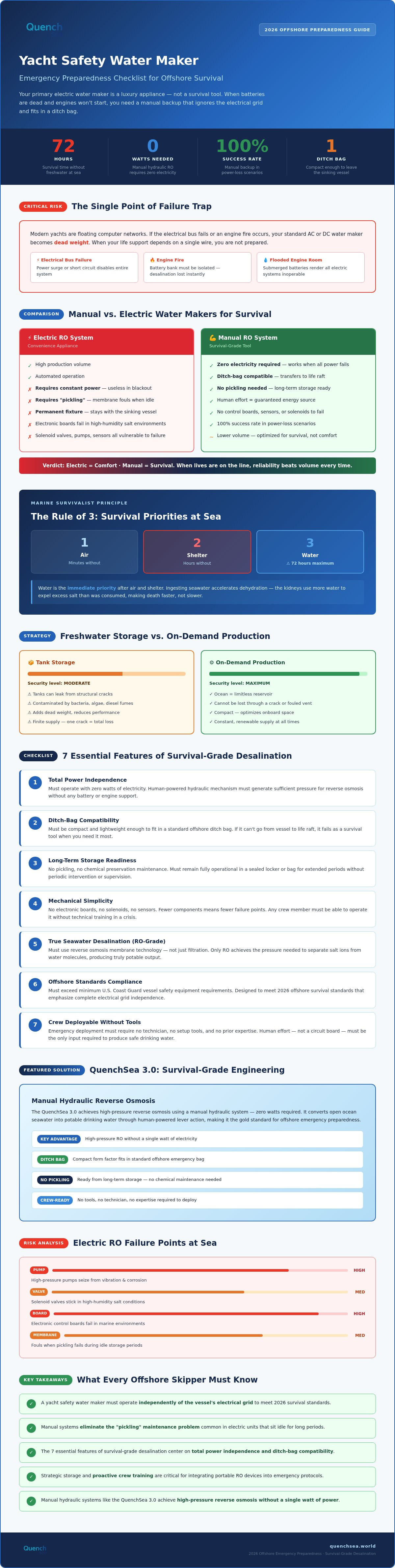
- Understand why a yacht safety water maker must operate independently of your vessel's electrical grid to meet 2026 survival standards.
- Learn why manual systems eliminate the "pickling" maintenance issues common in electric units that sit idle for long periods.
- Identify the seven essential features of survival-grade desalination, emphasizing total power independence and ditch-bag compatibility.
- Master the integration of portable RO devices into your emergency protocols through strategic storage and proactive crew training.
- Discover how manual hydraulic systems like the QuenchSea 3.0 achieve high-pressure reverse osmosis without requiring a single watt of power.
Why a Water Maker is Critical for Yacht Safety in 2026
A yacht safety water maker is not a luxury upgrade for showers and laundry. It is a critical redundancy designed to prevent fatalities when primary systems fail. In 2026, offshore safety standards increasingly emphasize total independence from a vessel's power grid. This shift recognizes a harsh reality: modern yachts are floating computer networks. If the electrical bus fails or an engine fire occurs, your standard AC or DC water maker becomes dead weight. This "Single Point of Failure" trap is the greatest risk to modern blue-water cruisers. When your life support depends on a single wire, you aren't prepared. True safety requires a mechanical solution that ignores the yacht's internal failures.
The biological consequences of thirst at sea are unforgiving. Understanding why is drinking sea water dangerous is fundamental to ocean survival. Ingesting salt water accelerates dehydration by forcing the kidneys to use more water to expel the excess salt than was consumed. Without a functional desalination method, survival time drops to roughly 72 hours. Relying on a single electrical source for this life-critical resource is a strategic error. You must be able to convert seawater into potable water even if your batteries are submerged or your engine is disabled.
The Role of Redundancy in Ocean Crossings
Mechanical failure is a statistical certainty on long passages. High-pressure pumps, sensors, and control boards in primary electric water makers are vulnerable to vibration, corrosion, and power surges. Marine survivalists follow the "Rule of 3," which dictates that water is the immediate priority after air and shelter. If an electrical fire forces you to isolate the battery bank, you lose your ability to produce freshwater instantly. A manual backup ensures that human effort, not a circuit board, dictates your survival. It turns a potential catastrophe into a manageable technical challenge. You don't need a technician; you need a lever.
Freshwater Production vs. Freshwater Storage
Storing hundreds of liters in tanks creates a false sense of security. Tanks can leak. They can become contaminated by bacteria, algae, or diesel fumes. They also add significant dead weight that reduces vessel performance and fuel efficiency. A compact survival desalination device provides production on demand. This approach utilizes reverse osmosis desalination technology to turn the surrounding ocean into a limitless reservoir. By focusing on production over storage, you optimize space and ensure that your water supply cannot be lost through a single structural crack or a fouled vent line. It's about maintaining a constant, renewable supply rather than a finite, vulnerable stockpile.
Manual vs. Electric: Choosing a Water Maker for Survival
Choosing between manual and electric systems is a choice between production volume and survival reliability. Electric RO units are designed for the convenience market. They serve staterooms and laundry needs. But when the power grid fails, these systems offer zero utility. A dedicated yacht safety water maker must prioritize energy independence. Human power is the only energy source guaranteed to be available when the engine room is flooded or the battery bank is depleted. Survival requires a shift in mindset: move from high-volume appliances to high-reliability tools.
The maintenance profile of electric systems creates a hidden risk. These units require "pickling", a chemical preservation process, whenever they sit idle. If the preservation fails, the membrane fouls, rendering the device inoperable during a crisis. Manual survival units are engineered for long-term storage. They are hardware-focused tools that remain ready in a locker or ditch bag without constant supervision. This reliability is why manual desalination remains the gold standard for offshore preparedness.
Portability is the ultimate differentiator. An electric unit is a permanent fixture. If you are forced into a life raft, that investment stays with the sinking vessel. A survival-grade manual device is compact enough for a ditch bag. While following U.S. Coast Guard vessel safety equipment requirements, savvy mariners look beyond the minimum standards. They invest in gear that transitions from the deck to the raft seamlessly. The cost-to-safety ratio favors manual backups because they provide a 100% success rate in power-loss scenarios.
The Vulnerability of Electric RO Systems
Electric water makers are vulnerable to the harsh marine environment. High-pressure pumps can seize. Solenoid valves can stick. Most importantly, electronic control boards often fail in high-humidity, high-salt conditions. These are "Single Point of Failure" components. If a single capacitor blows, the system stops. In a survival situation, you need hardware that you can troubleshoot with a basic toolkit, not a specialized technician. Manual systems provide this mechanical transparency and eliminate the risk of an electrical short circuit during a flood.
The Advantage of Hand-Powered Desalination
Hand-powered desalination relies on mechanical leverage rather than electrical current. This simplicity translates to durability. These units require no fuel and no external power, making them effective even if your diesel is contaminated by seawater. Crew members can operate the device under extreme stress with minimal training. It's a utilitarian approach to a life-critical need. For offshore travelers, the QuenchSea 3.0 offers a survival-grade backup that ensures you are never more than a few strokes away from potable water.
The Yacht Safety Water Maker Checklist: 7 Essential Features
Evaluating a yacht safety water maker requires a shift from comfort metrics to survival benchmarks. This checklist identifies the mechanical and technical requirements for a device that must perform when all other systems fail. In an emergency, your equipment is either a tool or a burden. There is no middle ground. Use these seven features to audit your vessel's current preparedness level.
- Total Power Independence: Manual operation is the only guarantee. Your water supply must not be tied to a battery bank, solar array, or an engine's alternator.
- Ditch Bag Compatibility: Compact dimensions are mandatory. If the device cannot be grabbed in a single motion during an evacuation, it is a liability.
- Tool-Free Maintenance: Field serviceability must be intuitive. You won't have a workbench or a specialized kit in a life raft.
- High Salt Rejection Rate: The system must achieve significant TDS (Total Dissolved Solids) reduction. Produced water must meet WHO safe drinking water standards to prevent renal stress and ensure long-term health during recovery.
- Corrosion-Resistant Materials: Survival-grade builds utilize reinforced polymers and high-grade stainless steel to withstand constant exposure to salt spray.
Technical Specifications for Emergency Use
Weight is a critical safety factor. A survival water maker must weigh under 5kg to ensure it remains manageable during a high-speed evacuation. Heavy equipment slows down the crew and takes up valuable displacement in a life raft. Output benchmarks should target at least 3 to 4 liters per hour. This volume is sufficient to sustain a small crew and provide a margin for physical exertion. Membrane longevity is equally important. Replacing the RO element should be a simple, sequential process that can be performed in a moving vessel or raft without losing small parts.
Durability in Extreme Marine Environments
Impact resistance is non-negotiable. Emergency gear must survive a 2-meter drop onto a fiberglass deck without losing mechanical integrity. UV stability is another priority. Plastics must not become brittle after years of storage in emergency lockers where heat and sunlight fluctuate. Effective pre-filtration is the final essential feature. It protects the primary membrane from surface oils, silt, and micro-debris that often accumulate near a disabled vessel. Reliability is built into the engineering, not added as an afterthought. Ensure your yacht safety water maker is ready for the worst-case scenario.
Emergency Deployment: Integrating Portable RO into Your Safety Protocol
Deployment is the point where engineering meets execution. A yacht safety water maker is a paperweight if it remains buried under fenders during a hull breach or electrical fire. You must treat your manual desalination tool as a mission-critical component of your primary safety gear. Integration begins with accessibility. Store the device in a dedicated, high-visibility location near the companionway or inside your primary ditch bag. Seconds matter when a vessel is taking on water. If your backup system isn't reachable in one motion, your preparedness plan is incomplete.
Crew training is the next pillar of your protocol. Muscle memory saves lives. Every person on board must know how to operate the manual pump before you leave the dock. Conduct a "dry run" where each crew member produces at least 500ml of water. This exercise demonstrates the physical effort required and the cadence of the hydraulic system. It also ensures that everyone understands how to deploy the intake and discharge hoses without tangling lines in high-stress conditions. Formalize this by adding the desalination device to your official "Abandon Ship" checklist.
Maintenance for a manual backup is simpler than for electric systems, but it's not non-existent. While these units don't require the complex "pickling" mentioned in previous sections, they do require annual inspections. Check all seals for elasticity. Verify that pre-filters are clear of debris and that the pump handle moves through its full range of motion without resistance. Equip your vessel with the QuenchSea 3.0 to bridge the gap between mechanical failure and rescue.
Ditch Bag Optimization
Your ditch bag should be a self-contained survival ecosystem. Pack the water maker alongside a minimum of three spare pre-filters and a basic seal replacement kit. Secure the device to the life raft using a dedicated lanyard. In heavy seas, a loose tool is a lost tool. Combine your manual production capability with emergency water rations. Use the rations for the first 24 hours to allow the crew to stabilize before beginning the physical labor of manual desalination. This staggered approach preserves energy and psychological morale.
Protocol for Power Failure at Sea
Establish a clear transition point for switching to manual production. If your primary electric system is inoperable and house battery voltage drops below 11.5V, deploy the manual backup immediately. Don't wait for your stored tanks to run dry. Assign "pumping shifts" to manage crew fatigue. Twenty-minute intervals are generally effective for maintaining steady output without causing physical exhaustion. This rotation ensures a constant supply of freshwater while allowing off-duty crew members to rest and focus on other survival tasks.
QuenchSea 3.0: The Engineering of Survival-Grade Desalination
The QuenchSea 3.0 is a portable seawater desalination device that replaces electrical complexity with hydraulic efficiency. It utilizes a manual lever to generate the extreme pressures required for reverse osmosis without a single watt of power. This isn't a scaled-down version of a domestic appliance. It is a survival-grade tool. Every internal component is optimized for the high-salinity marine environment. It provides a yacht safety water maker solution that functions in the dark, in the cold, and in the absence of fuel. When your primary system fails, this device becomes your most valuable asset.
Portability is a core design requirement, not a secondary feature. The unit fits within the strict volume constraints of a standard emergency kit. Its rugged construction withstands the physical shocks of a rapid evacuation or a rough life raft boarding. This durability is why the technology is a staple for disaster relief water supply globally. If it's trusted by tactical teams in the world's most hostile environments, it's reliable enough for your offshore passage. It's engineered to work when everything else breaks.
Key Advantages of the 3.0 Model
The 3.0 model features enhanced ergonomics to reduce operator fatigue during sustained manual pumping. We've refined the hydraulic circuit to improve flow rates, ensuring faster emergency hydration when every minute counts. Advanced multi-stage filtration protects the RO membrane from suspended solids and silt. This ensures that the produced water is safe and palatable, even in coastal waters with higher turbidity. The system is designed for high-stress environments where simplicity equals speed.
Investing in Peace of Mind
The return on investment for a manual backup is measured in safety, not just dollars. Repairing a proprietary electric RO system mid-ocean is often impossible. Replacing a fried control board or a seized high-pressure pump costs significantly more than a dedicated manual unit. In 2026, every blue-water cruiser must carry a manual yacht safety water maker to complete their emergency checklist. It's the only way to guarantee hydration when the ship goes dark. Secure your vessel's water supply with QuenchSea 3.0 and ensure your crew's survival readiness.
Secure Your Water Independence for 2026 and Beyond
Survival at sea is a matter of mechanical reliability, not electrical capacity. You've seen why a true yacht safety water maker must bypass the vessel's power grid to provide a foolproof backup during total system failure. By prioritizing manual operation and integrating portable RO into your official ditch bag protocol, you eliminate the single point of failure that compromises most modern yachts. It's time to move beyond luxury appliances and invest in survival-grade tools that prioritize life over convenience.
The QuenchSea 3.0 is a hardware solution designed specifically for high-stakes marine survival. It requires no electricity, no fuel, and no batteries to produce potable water from the raw ocean. This technology is already trusted by marine professionals and disaster relief teams worldwide to deliver results in the most extreme environments. Don't leave your crew's hydration to a circuit board that might fail when the cabin is flooding or the batteries are dead.
Equip your yacht with the QuenchSea 3.0 Safety Water Maker today.
Take control of your vessel's readiness and sail with the confidence that comes from total water independence. Your next passage deserves the security of a proven mechanical backup. Stay prepared, stay hydrated, and stay safe.
Frequently Asked Questions
Is a manual water maker actually effective for survival?
Manual desalination is the most reliable method for long-term survival because it functions independently of a vessel's power grid. Unlike emergency water rations, which are finite and heavy, a manual device provides a renewable source of hydration. It ensures that as long as you have the physical capacity to pump, you have potable water. This technical independence is critical when batteries are dead or the engine room is flooded.
How much water can the QuenchSea 3.0 produce per hour?
The QuenchSea 3.0 is engineered to produce approximately 4 liters of potable water per hour through manual operation. This output volume is sufficient to sustain multiple crew members and meet the hydration requirements set by international safety standards. Actual production rates may vary slightly based on the operator's pumping cadence and the temperature of the raw seawater, but the device remains a high-capacity survival tool.
Does a yacht safety water maker require regular maintenance?
A manual yacht safety water maker requires significantly less maintenance than complex electric systems. You don't need to perform chemical pickling or manage electronic control boards. Annual inspections of the internal seals and pre-filters are recommended to ensure the unit is ready for immediate deployment. This low-maintenance profile makes it the ideal "Plan B" for offshore cruisers who need a system that stays ready without constant supervision.
Can I use a manual water maker while in a life raft?
Yes, the QuenchSea 3.0 is designed specifically for use in life rafts and emergency ditch bags. Its compact, lightweight construction allows for operation in the confined spaces of an inflatable raft. The device includes dedicated intake and discharge hoses that you can deploy over the side to access seawater and expel brine. It's a self-contained system that transitions seamlessly from the yacht to the survival craft.
What is the shelf life of the reverse osmosis membrane in a backup device?
Reverse osmosis membranes in survival-grade devices are built for long-term storage. When kept in a cool, dry environment within a sealed ditch bag, these membranes remain viable for several years. Unlike electric systems that can foul or grow bacteria when left idle without pickling, these manual units are engineered to stay dormant. They are ready to be pressurized and used the moment a crisis occurs at sea.
Do I need any tools to operate the QuenchSea 3.0 in an emergency?
No tools are required for the standard operation or deployment of the QuenchSea 3.0. The system is designed for rapid, tool-free assembly in high-stress environments. All hose connections are intuitive and can be secured by hand. This ensures that any crew member can begin producing water immediately, even in low-light conditions or while wearing foul weather gear. Simplicity is a core requirement for survival engineering.
Can this device remove bacteria and viruses as well as salt?
Yes, the reverse osmosis process naturally filters out biological contaminants along with dissolved salts. The membrane pore size is small enough to block bacteria, viruses, and microplastics from the final product water. This ensures the water produced meets high safety standards and protects the crew from waterborne illnesses. It provides a clean, safe source of hydration from raw seawater in any ocean environment.
How does the QuenchSea 3.0 compare to emergency water rations?
The QuenchSea 3.0 provides a limitless supply of water, whereas rations are a finite resource that eventually runs out. Rations are bulky and occupy significant space and weight in a ditch bag. By utilizing a manual desalination device, you gain a renewable source of hydration that doesn't run dry. This allows you to extend your survival window indefinitely, regardless of how long it takes for rescue teams to arrive.