

A survival desalination pump can produce freshwater without electricity or fuel, but it isn’t a set-and-forget safety net. Manual reverse osmosis forces seawater through a membrane that rejects salt. An ordinary water filter can’t do that. To judge whether a pump fits your plan, compare its documented output, the effort needed to operate it, and the instructions for preparing and maintaining it.
It’s reasonable to wonder whether a hand-powered device can deliver enough water when conditions are difficult. It can help in a marine or coastal emergency, but portable units produce limited volumes and require sustained physical effort. Practice and realistic water planning matter as much as the equipment itself.
This guide explains reverse osmosis in plain language, then walks through what to assess before choosing a manual seawater desalination pump. You’ll also learn how to store, test, operate, and maintain one so you’re prepared to use it when power and fuel aren’t available.
Key Takeaways
- A survival desalination pump removes dissolved salt from seawater; ordinary particle filters can’t make seawater drinkable.
- Manual reverse osmosis uses human effort to create pressure, so assess operating demands alongside freshwater output.
- Compare devices by power source, suitable water source, operating method, and intended use. Base your plan on documented specifications, not assumptions.
- Build readiness through a clear routine: plan, inspect, practise, store, and review, following the manufacturer’s instructions throughout.
- QuenchSea 3.0 uses hand-powered reverse osmosis to desalinate seawater without electricity, batteries, or fuel.
What Is a Survival Desalination Pump, and What Can It Do?
A survival desalination pump is a manually operated device that uses pressure and a selective membrane to remove dissolved salts from seawater and produce freshwater. Unlike a basic filter, which traps particles such as sediment, desalination targets salts dissolved in the water. A standard camping or household filter cannot make seawater drinkable.
The manual design matters when electricity, batteries, or fuel aren’t available. Instead of relying on a motor, the user supplies the effort needed to pressurize seawater. Powered watermakers use an external power source to drive the process; manual pumps use human effort. Both can rely on reverse osmosis, but their operating demands differ.
Treat this equipment as an emergency freshwater-making tool, not a complete water-supply plan. Its practical value depends on access to seawater, a ready-to-use device, and enough capacity for the situation. Plan how you’ll store water, account for the people relying on the supply, and follow the manufacturer’s directions for handling the output.
How does a hand-powered desalination pump make freshwater?
The process follows a simple sequence. The device draws in seawater, and the user operates its pump to build pressure. That pressure pushes water against a selective membrane. The membrane allows water molecules to pass while rejecting much of the dissolved salt; the separated freshwater then collects for use. Learn more about the underlying reverse osmosis process. This overview covers the essentials; membrane design and pressure control involve more engineering detail.
When can a survival desalination pump be useful?
A survival desalination pump may help during marine emergencies, aboard yachts, on life rafts, in disaster response, or at off-grid coastal locations. In each case, it offers a way to make freshwater from seawater when powered equipment isn’t practical. It won’t help without a usable seawater source, and its output and operating demands must match the need. Use documented capabilities to plan realistically, and practise before an emergency rather than relying on unfamiliar equipment under pressure.
For a broader look at planning drinking water after abandoning a vessel, read this life raft water supply guide. A pump can add an important option to that plan, but readiness still depends on knowing how to operate and care for it.
How Manual Reverse Osmosis Works Without Power
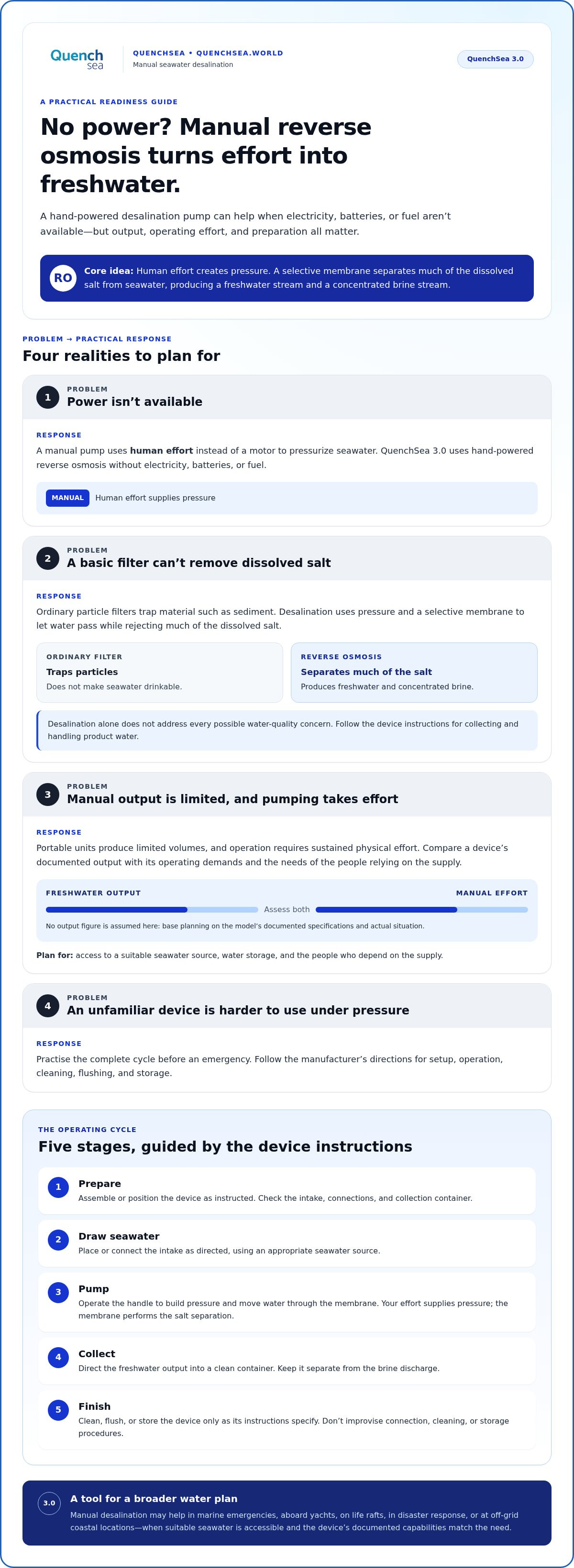
A manual reverse osmosis system uses human effort in place of an electric motor. The user pumps seawater through a pressurized membrane system. The membrane separates much of the dissolved salt from the water, producing a freshwater stream and a more concentrated brine stream. This is the core operating principle of the QuenchSea 3.0, which works without electricity, batteries, or fuel. For an overview of desalination methods, see the U.S. Department of Energy’s Desalination basics.
Pressure pushes seawater against a selective membrane, which separates freshwater from concentrated brine.
What happens inside a manual reverse osmosis system?
The membrane acts as a selective barrier. Under pressure, water passes through it while much of the dissolved salt remains behind and leaves in the brine stream. That separation doesn’t mean the membrane removes every possible contaminant, so don’t assume desalination alone addresses every water-quality concern. Keep the freshwater and brine outlets distinct, and follow the device instructions for collecting and handling the product water.
What does operating a hand pump involve?
The exact setup varies by model, so prepare and operate each survival desalination pump as its manufacturer directs. The basic stages are:
- Prepare: Assemble or position the device as instructed, and check the intake, connections, and collection container.
- Draw seawater: Place or connect the intake as directed, using an appropriate seawater source.
- Pump: Operate the handle to build pressure and move water through the membrane. Manual effort supplies the pressure; the membrane performs the salt separation.
- Collect: Direct the freshwater output into a clean container and keep it separate from the brine discharge.
- Finish: Clean, flush, or store the device only as its instructions specify.
Setup, effort, and shutdown steps can differ across designs. Don’t improvise connection, cleaning, or storage procedures. Practise the full cycle before an emergency so you understand how the device behaves and can spot problems without rushing. For the engineering behind the process, read this manual reverse osmosis engineering explainer.
For a hand-powered option for marine or emergency readiness, explore the QuenchSea 3.0 desalination device as one part of a broader water plan.
How to Compare Survival Desalination Pumps Realistically
Compare equipment against the situation you need it to handle, not just its advertised category. A survival desalination pump may provide freshwater when powered equipment is unavailable, but manual operation takes effort and output varies by model and conditions. Treat both as practical limits. Build your plan around documented capabilities, not assumptions.
| Option | Power source | Water source | Operating method | Intended role |
|---|---|---|---|---|
| Manual desalination pump | Human effort | Seawater | User operates a hand pump | Emergency or off-grid water production when suitable seawater is accessible |
| Powered watermaker | Electricity or another specified power source | Seawater | Motorized system runs the desalination process | Situations with reliable power and a need for ongoing production |
| Stored water | None during use | Water collected in advance | Access and dispense the reserve | Immediate supply when water production isn’t practical |
Manual pump, powered watermaker, or stored water?
Each option solves a different problem. Stored water gives you a reserve without requiring setup or pumping, but it depends on how much you can safely store and carry. A powered watermaker can reduce manual work, yet it depends on its specified power source. A manual unit avoids dependence on electricity, batteries, or fuel, but transfers the work to the operator. A layered plan can use stored water for immediate needs and desalination to produce more from seawater. Choose based on your access, power supply, space, and likely operating conditions, not on a claim that one method suits every emergency.
Which specifications matter for emergency use?
Start with the manufacturer’s stated use and confirm that it matches your seawater source and emergency context. Then review the operating instructions, documented output, required effort, maintenance needs, and storage requirements. Use the stated production rate to estimate what the device can contribute, and consider whether the expected pumping effort is realistic for the people who may need to operate it. Don’t build a daily water plan around an assumed output rate or assume that a pump will be easy to operate for extended periods.
QuenchSea 3.0 uses hand-powered reverse osmosis and operates without electricity, batteries, or fuel. When comparing it with other options, weigh those features against the specific needs of your water plan, including output, operating effort, and maintenance. Use the product documentation for model-specific figures and requirements, and base your expectations on those details rather than on estimates.
How to Prepare and Operate a Survival Desalination Pump
A survival desalination pump is only useful if it’s accessible, maintained, and familiar to the people who may need it. Build readiness into your emergency plan before you depend on the device. Follow the manufacturer’s instructions for preparation, operation, cleaning, and storage. Don’t improvise procedures based on another model’s design.
Use this five-part routine:
- Plan: Decide who may operate the device, where seawater will be collected, and where freshwater will go. Include realistic limits on output and manual effort in your broader water plan.
- Inspect: Confirm the pump and its required components are present, accessible, and in usable condition. Review the model’s instructions for checks before operation.
- Practise: Run through setup, seawater intake, pumping, freshwater collection, and shutdown in suitable conditions. Make sure each likely user understands the sequence.
- Store: Put the device where you can reach it in an emergency, and store it as the manufacturer directs. Keep its operating instructions accessible.
- Review: Revisit the setup periodically and follow the model-specific guidance for cleaning and maintenance. Update your plan if the device, storage location, or intended users change.
What should be in a seawater desalination readiness check?
Start with access: can you find the device quickly, and can you reach it without unpacking unrelated gear? Then mentally walk through the setup. Identify the seawater collection point, the device’s position, and a clean container for freshwater. Check that the arrangement keeps the freshwater collection separate from the brine discharge, following the device instructions. For wider emergency-planning context, read this survival desalination device guide.
How should users build confidence before an emergency?
Practise calmly before conditions become stressful. Use the manufacturer’s directions and suitable conditions to rehearse the entire cycle, not just the pumping motion. Notice where to position the intake and collection container, how to handle the device, and what the instructions say to do after use. A practice run builds familiarity, but it doesn’t remove physical demands or guarantee a particular water output.
Keep the pump as one part of a larger emergency water plan, alongside stored water and a realistic assessment of need. The QuenchSea 3.0 desalination device is a hand-powered option to consider for that plan.
Where QuenchSea 3.0 Fits in a Survival Water Plan
QuenchSea 3.0 is a portable, hand-powered reverse osmosis device designed to desalinate seawater. Its operating principle doesn’t depend on electricity, batteries, or fuel. That makes it relevant to marine safety, life rafts, yachts, emergency preparedness, disaster relief, defence, and off-grid coastal use, where powered equipment may not be practical.
Power independence is one part of readiness, not the whole plan. A survival desalination pump still needs an accessible seawater source, an operator who understands the process, and a plan for collecting and storing the freshwater. Manual operation also requires physical effort. Keep a suitable water reserve for immediate needs, and treat desalination as another way to produce water rather than a replacement for broader emergency planning.
What role can QuenchSea 3.0 play in preparedness?
Think of the device as a contingency option for situations where seawater is available but powered watermaking isn’t dependable or accessible. For a yacht, that could mean having a manual option alongside stored supplies. In a coastal emergency, it could add a way to make freshwater if users can safely access the shoreline and operate the device as directed. The right role depends on your use case, the water source, and realistic expectations for manual work and output.
Prepare before you need it. Review the operating instructions, practise the operating cycle, and follow the model’s guidance for cleaning and storage. Build your plan around the product’s documented output and maintenance requirements. For more detail on features and evaluation, see the QuenchSea 3.0 buyer’s guide.
What is the next step toward a manual seawater solution?
Before choosing a manual desalination device, make four checks: Does it match your intended use? Can you operate it without relying on electricity or fuel? Are the instructions clear to its intended users? Can you keep it accessible, practise with it, and maintain it as directed? These questions connect product choice to actual readiness. They also help prevent a device from becoming an emergency tool that’s unfamiliar when pressure rises.
Review the QuenchSea 3.0 product information, compare its documented capabilities with your water plan, and decide how it fits alongside stored supplies. Explore QuenchSea 3.0 as a manual seawater desalination option for marine, emergency, and off-grid preparedness.
Make Your Water Plan Ready Before You Need It
A survival desalination pump can help produce freshwater when seawater is accessible and powered equipment isn’t available. But the pump is only one part of readiness. Understand its documented capabilities, account for the effort manual operation takes, and practise the full setup and collection process before an emergency.
QuenchSea 3.0 uses hand-powered reverse osmosis and is designed to operate without electricity, batteries, or fuel. Its intended uses include marine safety, emergency preparedness, and off-grid coastal situations. Pair it with suitable stored water, clear operating instructions, and a realistic plan for the people relying on your supplies.
Preparedness starts with choosing equipment that fits your conditions, then learning how to use and care for it. Explore QuenchSea 3.0 and consider how a manual seawater desalination device could fit into your water plan. A little preparation now can help you act with greater confidence when conditions change.
Frequently Asked Questions
Can a survival desalination pump make seawater safe to drink?
A survival desalination pump is designed to remove salt from seawater and produce freshwater through reverse osmosis. Whether the output is suitable to drink depends on correct operation and the device’s documented capabilities. The membrane separates much of the dissolved salt, but desalination shouldn’t be assumed to remove every possible contaminant. Follow the manufacturer’s instructions for collecting and handling water, and use any testing guidance specified for the device.
How does a hand-powered desalination pump work?
A hand-powered desalination pump uses manual effort to create pressure and push seawater through a selective membrane. The membrane allows water to pass while rejecting much of the dissolved salt. The system directs the resulting freshwater and concentrated brine into separate streams. Setup and operating steps differ by model, so practise the complete cycle and follow the device instructions rather than relying on general guidance alone.
Can a manual desalination pump work without electricity or fuel?
Yes. A manual system uses the operator’s effort to supply pressure rather than relying on an electric motor or fuel-powered equipment. QuenchSea 3.0 is designed to operate without electricity, batteries, or fuel. That independence can be useful in marine or off-grid situations, but it doesn’t remove the need to prepare the device, understand its operating instructions, and account for the physical effort involved.
How much drinking water can a survival desalination pump produce?
Output depends on the specific model and its operating conditions. Use the manufacturer’s documented production rate to estimate how much water the pump can provide for your situation. Don’t assume that a rate advertised for one device applies to another, or that you can sustain a stated rate for an extended period. Plan around documented figures, operating effort, and the water needs of everyone relying on the supply.
Is a survival desalination pump better than stored emergency water?
Neither option is universally better. Stored water is ready to use without setup or pumping, while a desalination pump can produce water from seawater when the source and device are accessible. A practical emergency plan can include both: reserves for immediate needs and desalination as another supply option. Consider how much water you can store, where seawater is available, and whether someone can operate the pump.
What should I check before storing a survival desalination pump?
Confirm that the device and its required components are present, accessible, and stored according to the manufacturer’s instructions. Keep the operating directions available, and know where you’ll collect seawater and store the freshwater output. Follow model-specific guidance for cleaning and maintenance before putting the unit away. Avoid assuming that another pump’s storage method or maintenance schedule applies to your device.
Can I use a survival desalination pump with freshwater?
These devices are designed to desalinate seawater, so freshwater isn’t their primary use. Desalination removes dissolved salts, which freshwater generally doesn’t need. Don’t assume a unit can be used as a general freshwater filter or purifier; it may not be designed to remove other contaminants. Follow the manufacturer’s directions about suitable water sources and never use the device outside its stated operating guidance.
Is a manual desalination pump suitable for a life raft?
A manual desalination pump can be relevant to a life-raft water plan if the device is intended for marine use and can be safely stored, accessed, and operated in that setting. QuenchSea 3.0 is designed for marine safety and life-raft applications. Before relying on any device, review its instructions and documented capabilities, practise its operating cycle, and plan for water reserves alongside desalination.