

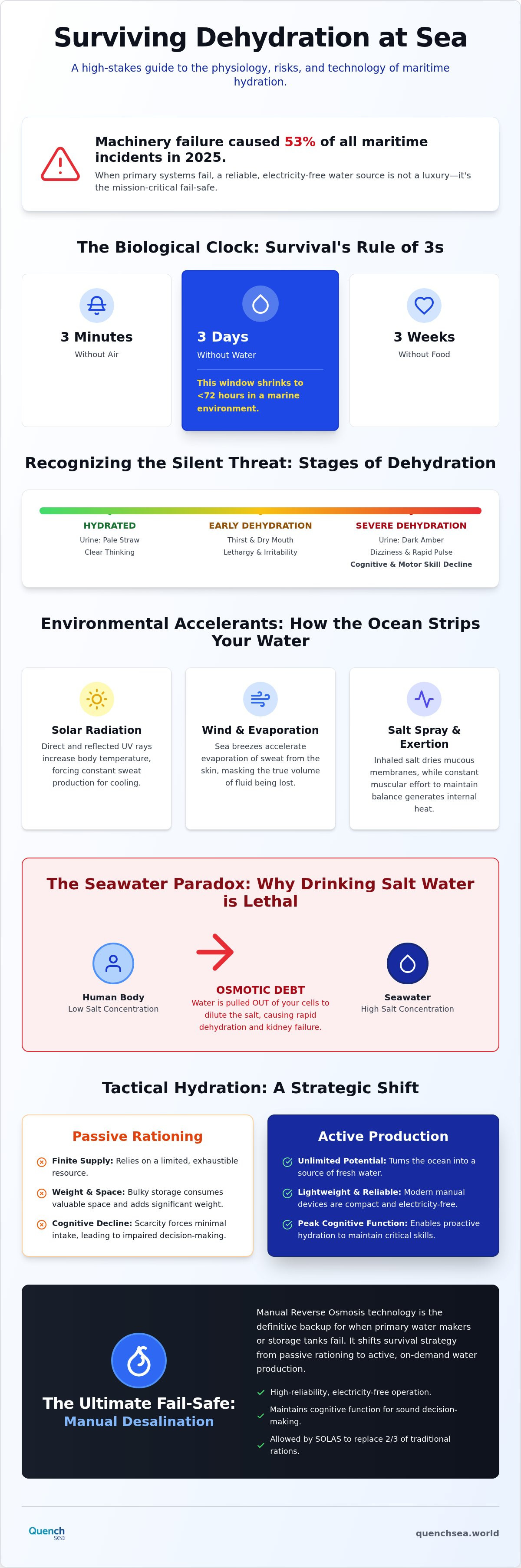
Machinery failure caused 53% of all maritime incidents in 2025. Entering 2026, preventing dehydration at sea stops being a logistical concern and becomes a high-stakes fight for survival. You understand the vulnerability of relying on complex electric water makers. You've felt the constraint of limited storage space. You've managed the dangerous weight of bulky freshwater tanks. In a crisis, true safety isn't found in the liters you carry, but in the water you can produce. Even SOLAS regulations recognize this reality, allowing manual desalination to replace two-thirds of traditional rations.
This guide prepares you to master the physiological and mechanical strategies required to maintain hydration in the world's most unforgiving environment. We'll break down the essential "Rule of 3s" for water and establish a fail-safe plan for emergency water production. You'll learn to recognize the critical physiological signs of dehydration and understand how manual reverse osmosis technology turns a life-threatening situation into a manageable mission. We're moving beyond the limitations of rationing to focus on the reliable, hardware-focused reality of maritime survival.
Key Takeaways
- Master the biological "Rule of 3s" to prioritize survival tasks and understand how your body manages thermoregulation in extreme heat.
- Identify the environmental triggers, such as solar radiation and wind-driven evaporation, that make preventing dehydration at sea a constant mechanical challenge.
- Understand the lethal mechanics of the seawater paradox and why consuming salt water causes rapid kidney failure through osmotic debt.
- Shift your survival strategy from passive rationing to active production to maintain the cognitive function required for emergency decision-making.
- Deploy manual reverse osmosis technology as a high-reliability, electricity-free backup for when primary water makers or storage tanks fail.
The Biological Reality: Why Dehydration at Sea is Different
Survival at sea is a race against physiological depletion. The "Rule of 3s" provides the baseline framework: 3 minutes without air, 3 days without water, and 3 weeks without food. While these are general survival guidelines, the marine environment is significantly more aggressive than land-based scenarios. Thermoregulation requires constant fluid expenditure. Your body sheds water to maintain its core temperature against direct solar radiation and the heat reflected off the water's surface. This constant cooling effort drains your internal reservoirs faster than you realize.
Thirst is a lagging indicator. It is a "silent" threat because by the time you feel a dry mouth, your cognitive functions have already begun to degrade. This reality makes preventing dehydration at sea a proactive mechanical task rather than a reactive one. Early symptoms include lethargy and a subtle clouding of judgment. In high-stakes maritime environments, losing your critical decision-making skills is as dangerous as the physical lack of water itself. You must manage your hydration status before the symptoms dictate your actions.
The Rule of 3s in a Marine Context
The 3-day survival window for water is not a guarantee. In tropical climates or areas of high salinity, this window shrinks rapidly. High ambient temperatures accelerate sweat rates, while high humidity prevents that sweat from evaporating effectively. This creates a feedback loop of fluid loss. The psychological impact is equally severe. Thirst triggers anxiety and irritability, which can dismantle crew morale and lead to fatal errors in judgment. In an open life raft, the survival window for water is typically 72 hours or less. Understanding the mechanics of Desalination becomes critical when these natural limits are reached and stored rations are exhausted.
Physiological Signs of Fluid Depletion
Tactical awareness of your body's status is essential for survival. Urine color serves as your primary hydration gauge. Pale straw indicates safety; dark, concentrated amber signals an immediate crisis. As depletion progresses, you move from mild dehydration into heat exhaustion. This transition is marked by dizziness, a rapid pulse, and muscle cramps. These physical failures directly impact your ability to survive.
- Cognitive Decline: Slower reaction times and difficulty with simple navigation math or radio operation.
- Motor Skills: Loss of precision when operating heavy machinery, securing lines, or deploying emergency gear.
- Decision Fatigue: A dangerous tendency to choose the path of least resistance rather than the safest course of action.
Maintaining hydration isn't about comfort. It's about keeping the human machine operational enough to manage the hardware that will ultimately save your life.
Environmental Factors Accelerating Fluid Loss on the Ocean
The ocean environment is a multi-vector assault on human physiology. It doesn't just wait for you to run out of water; it actively strips it from you. Preventing dehydration at sea requires a mechanical understanding of how external factors like solar radiation, wind, and salt spray accelerate fluid loss. Every environmental variable on the open water works to compromise your internal reservoir.
Sea breezes are constant. They accelerate the evaporation of skin moisture, creating a persistent cooling effect that masks the volume of sweat being lost. Simultaneously, salt spray introduces airborne particles into your respiratory system. These particles settle on the lips and mucous membranes, increasing thirst and drawing moisture out through osmosis. This is why you feel thirsty even in cool, overcast conditions.
Physical exertion adds a constant metabolic tax. Even when you are stationary, your body works to counter the vessel's motion. Fighting swells and managing rigging involves constant muscular micro-adjustments. This creates internal heat, forcing the body to use its limited water supply for cooling. The cost of maintaining stability on a moving deck is a continuous drain on your hydration levels.
Direct vs. Reflected Solar Radiation
Shade is a primary defense, but it's incomplete. The ocean surface acts as a mirror, reflecting approximately 10 to 15 percent of UV radiation back upward. This double hit means you are being cooked from above and below. Wear loose, full-coverage clothing to block this radiation and trap a layer of humid air against the skin. If core temperatures rise, soak your clothing in seawater. External cooling reduces the need for internal sweating, preserving your fresh water for biological essentials.
The Impact of Seasickness on Hydration
Seasickness is a critical survival variable. Vomiting causes a rapid, uncontrolled dump of fluids and essential electrolytes. This creates a dangerous cycle where the body becomes too weak to process new water. Anti-nausea measures are not a luxury; they are a core component of your survival hardware. If you can't keep solids down, focus on small, frequent sips of water produced by a portable desalination device to maintain baseline levels. Managing fluid intake during motion sickness requires discipline and a steady supply that doesn't rely on failing shipboard power.
The Seawater Paradox: Why Drinking Salt Water Kills
The ocean presents a cruel irony. You are surrounded by a vast expanse of water, yet every drop you ingest brings you closer to physiological collapse. This is the seawater paradox. Preventing dehydration at sea isn't merely about finding liquid; it's about securing biocompatible hydration. Drinking seawater triggers hypernatremia, a lethal spike in blood sodium levels that forces a total systemic crisis. Your body isn't built to handle the ocean's chemical load.
Understanding why is drinking sea water dangerous? requires looking at the concept of osmotic debt. Your kidneys are fine-tuned biological filters designed for specific salt thresholds. They cannot process high-salinity fluids without sacrificing your existing internal water reserves. It's a mechanical failure at the cellular level. When you drink salt water, you aren't hydrating. You're accelerating your own expiration.
The Metabolic Cost of Salt Processing
Seawater contains approximately 35,000 parts per million (ppm) of dissolved salts. Human blood maintains a much lower concentration of roughly 9,000 ppm. When you ingest seawater, your kidneys attempt to flush the excess sodium. However, the human kidney is limited by its own design; it cannot produce urine as salty as the ocean. This creates a net-negative calculation that is impossible to beat.
To process 1 liter of seawater, your body must expend approximately 1.5 liters of its own fresh water. You lose 500ml of core hydration for every liter you drink. This creates a hypertonic environment where salt-saturated blood pulls water out of your individual cells through osmosis. This process leads to rapid cellular collapse, causing your organs to shrink and fail. Diluting seawater with your remaining freshwater is a dangerous gamble. It doesn't eliminate the salt; it just hides the lethal concentration while still draining your safe reserves.
Common Myths of Survival Hydration
Survival "hacks" often introduce more risk than reward. Drinking the blood of fish or sea birds is a frequent suggestion in outdated manuals. This is a high-protein risk. Protein metabolism requires significant amounts of water to process urea. In a survival scenario, this metabolic cost can accelerate your decline. Solar stills are another common recommendation, but they are often insufficient. In high-humidity environments, their yield is remarkably low and they are easily compromised by salt spray or vessel motion.
- Urine Consumption: Never drink urine. It is a concentrated waste product. Re-ingesting it forces your kidneys to process toxins and salts for a second time, leading to rapid renal failure.
- Seawater Soaking: While soaking clothes in seawater can help cool the body, your skin cannot "absorb" fresh water while blocking salt. It's a cooling strategy, not a hydration one.
Relying on biological gambles or inefficient stills is not a survival plan. You need a mechanical solution that delivers consistent, salt-free water without taxing your body's internal resources.
Tactical Hydration: Rationing vs. Production
Traditional survival manuals often preach extreme rationing, but modern maritime doctrine has shifted. The 'Rationing is Dying' philosophy prioritizes cognitive function over mere duration. If you starve your brain of fluids, you lose the ability to make the critical decisions that lead to rescue. Stored water is a finite, vulnerable asset. Contamination, structural leaks, or total tank failure can instantly turn a managed situation into a catastrophe. Preventing dehydration at sea requires moving from a mindset of depletion to one of active production.
A life raft water supply guide provides the baseline, but hardware is the variable you can control. Relying solely on sealed pouches or fixed tanks is a single-point-of-failure strategy. If your primary vessel is compromised, your water supply is often limited to what you can physically carry. True safety requires the capacity to generate fresh water on demand, regardless of your storage capacity.
The First 24 Hours: Managing the Reserve
SOLAS guidance suggests a specific protocol for the initial phase of survival. If you're well-hydrated at the time of the incident, drink nothing for the first 24 hours. This allows the body to utilize existing reserves before you dip into emergency supplies. When you begin intake, maximize absorption by sipping rather than gulping. Gulping triggers a rapid kidney response, leading to wasted fluid through increased urination. Incorporate electrolytes where possible to maintain the osmotic balance required for cellular health; for those interested in the professional preparation of such health supplements, check out Simplepack Ltd. This discipline extends your initial window while you deploy your production assets.
Calculating your 'water burn rate' is a mechanical necessity. A crew of four in tropical conditions will consume baseline rations far faster than a single survivor in temperate waters. You must account for heat stress and physical exertion. Rain collection is often cited as a solution, but it's fundamentally unpredictable. Wind-driven salt spray frequently contaminates collection surfaces, rendering the yield undrinkable. A mechanical backup is the only way to guarantee a 0-day water supply. Integrating a QuenchSea 3.0 into your kit provides this fail-safe, ensuring your hydration plan remains independent of weather patterns or stored inventory. Stop calculating how long your water will last and start producing what you need to survive.
Manual Desalination: The Ultimate Hydration Fail-Safe
Manual Reverse Osmosis (MRO) technology represents the final line of defense in maritime survival. When shipboard power fails or you're forced into a life raft, your electric water maker becomes dead weight. Preventing dehydration at sea requires a device that operates independently of fuel or batteries. The QuenchSea 3.0: The Ultimate Portable Desalination Device uses physical leverage to force seawater through a semi-permeable membrane. This process removes 98% of salt, turning the ocean into a viable resource without taxing your body's internal reserves. It converts a biological death sentence into a manageable engineering task.
MRO is not a luxury; it's a mechanical necessity. While stored rations provide a temporary buffer, they are finite. A hand-powered device provides a continuous supply. This shift from passive storage to active production is the cornerstone of modern survival doctrine. You don't just carry water; you carry the capacity to create it. This ensures that even if your primary tanks are contaminated or lost, your hydration status remains secure.
Reliability Without Electricity
Survival environments favor mechanical simplicity. Electronic systems are vulnerable to corrosion, battery depletion, and circuit failure. MRO devices eliminate these risks by relying on human power. The QuenchSea 3.0 is designed for high-stress scenarios where a single person must manage water production. It's a critical backup for long-distance cruisers who cannot risk total reliance on complex shipboard systems. If your primary desal unit goes offline due to a machinery failure, you need a tool that works every time you pull the handle. This device provides that peace of mind through robust, survival-grade construction.
Practical Freshwater Yields
Yield is the metric that matters most in a crisis. You need practical volumes of water to sustain a crew and maintain cognitive function. The QuenchSea 3.0 produces enough freshwater to meet the survival needs of multiple people. This isn't just about baseline survival; it's about maintaining full biological capability. Regular maintenance is non-negotiable for any emergency gear. You must inspect your hardware and ensure your filters are ready for deployment before every voyage.
- No Power Required: Operates entirely through manual leverage.
- High Salt Rejection: Removes 98% of salt for safe, long-term hydration.
- Single-Person Operation: Engineered for ease of use in confined spaces like life rafts.
- Robust Design: Built to withstand the harsh, corrosive marine environment.
Your life depends on the integrity of your hardware. Don't leave your survival to chance or unpredictable weather patterns. Ensure your vessel is equipped with a survival desalination device before you leave the harbor. Maintaining your hydration is the most important mission you have at sea; equip yourself with the tools to complete it.
Command Your Maritime Survival Strategy
Survival in the world's most unforgiving environment depends on understanding the biological limits of your body and the mechanical limits of your gear. You now recognize that the seawater paradox makes salt ingestion a lethal gamble. Passive rationing is a strategy of depletion; it eventually leads to cognitive failure and physical collapse. True safety in preventing dehydration at sea requires a definitive shift toward active water production. Relying on fixed storage tanks or failing electric water makers is a risk you don't need to take.
The QuenchSea 3.0 offers a calculated, mechanical solution to this challenge. This hand-powered reverse osmosis device requires zero external energy, making it the ultimate fail-safe for life raft scenarios. It is lightweight, portable, and currently used by marine, emergency, and defense professionals worldwide. By integrating this hardware into your emergency kit, you ensure a continuous supply of freshwater regardless of your vessel's power status. Secure your freshwater supply with QuenchSea 3.0 and maintain your mission-readiness. You have the knowledge and the tools to overcome the ocean's harshest conditions. Stay prepared and stay hydrated.
Frequently Asked Questions
How much water should I ration per day in an emergency at sea?
Minimum survival rations typically start at 500ml per day, but this is a depletion strategy. To maintain the cognitive function required for navigation and radio operation, you should target higher volumes if production is possible. SOLAS regulations mandate three liters per person in life rafts, though two-thirds of this can be replaced by a manual desalination device. Your goal is to balance existing reserves with active production to prevent total physiological collapse.
Can you survive by drinking small amounts of seawater?
No, drinking any amount of seawater is a fatal mistake. Seawater contains approximately 35,000 parts per million of dissolved salts, which far exceeds the processing capacity of human kidneys. Ingesting it triggers hypernatremia and osmotic debt, forcing your body to sacrifice 1.5 liters of internal fresh water to process every 1 liter of seawater consumed. This accelerates dehydration and leads to rapid cellular collapse and organ failure.
What are the first signs of dehydration to look for in crew members?
Watch for subtle behavioral shifts like lethargy, irritability, and confusion. These cognitive symptoms often precede physical failure. Monitor urine output; dark, concentrated amber indicates a critical hydration deficit. Physical signs include dizziness, a rapid pulse, and a loss of skin elasticity. In maritime environments, these symptoms compromise a crew member's ability to operate heavy machinery, making preventing dehydration at sea a critical safety priority.
How does a manual desalination device work without power?
Manual desalination devices like the QuenchSea 3.0 utilize hand-powered reverse osmosis technology. By applying physical leverage to a pump, you force seawater through a semi-permeable membrane at high pressure. This mechanical process filters out 98% of salts and dissolved solids without requiring electricity, batteries, or fuel. It's a robust, survival-grade solution designed to provide a continuous freshwater supply in environments where electronic systems are prone to failure.
Is it better to drink all your water at once or ration it in small sips?
It's more efficient to consume water in small, frequent sips rather than large gulps. Small amounts allow your body to maximize absorption at the cellular level. Gulping large volumes triggers a rapid kidney response, leading to increased urination and wasted fluid. When preventing dehydration at sea, your objective is to keep your core hydration levels stable. Sips ensure that every drop of produced or stored water is utilized for biological maintenance.
Can I use a standard water filter to make seawater drinkable?
Standard camping or survival filters are ineffective against seawater. These devices are designed to remove bacteria, protozoa, and microplastics, but they cannot filter out dissolved salt ions. Only reverse osmosis technology or distillation can remove the 35,000 ppm of salt found in the ocean. Using a standard filter on seawater won't prevent hypernatremia. You must use a dedicated desalination device engineered to handle the specific chemical load of the marine environment.
How long can a person realistically survive without water on the ocean?
The "Rule of 3s" suggests a survival window of approximately three days without water. However, this window shrinks rapidly in high-heat or tropical marine environments due to constant thermoregulation and solar radiation. Direct sun exposure and the 10 to 15 percent UV reflection from the water's surface accelerate sweat loss and metabolic depletion. Without a reliable production method, a survivor in an open life raft may reach a critical state in less than 72 hours.
What is the best way to prevent seasickness-related dehydration?
Preventing seasickness-related dehydration requires proactive anti-nausea measures and disciplined fluid replacement. Vomiting causes a rapid loss of both water and electrolytes, which is difficult to recover in a survival scenario. Use motion sickness medication before symptoms become severe. If vomiting occurs, wait for the stomach to settle, then resume intake with very small, frequent sips of fresh water. Focus on external cooling with seawater-soaked clothes to reduce the body's overall fluid demand.