

What if your vessel is surrounded by seawater but has no power to run its watermaker? Choosing a naval survival kit seawater desalinator means looking beyond the promise of fresh water. A manual device can add a useful layer of backup, but it does not replace stored supplies or automatically meet every crew’s needs.
The practical question is what role a hand-powered desalinator can fill when conditions become difficult. The answer depends on crew size, mission duration, available storage, and how much operating effort the crew can sustain. Account for those limits when planning, not during an emergency.
This guide compares desalination equipment, stored water, and mission requirements to help you choose gear for its intended role. It also explains what non-electric reverse osmosis offers. QuenchSea 3.0 uses manual pressure to desalinate seawater without electricity, batteries, or fuel. It adds a power-independent production option to a broader maritime water plan. Use the criteria below to weigh that capability alongside stored water and other supplies, rather than relying on a single device.
Key Takeaways
- Build your naval survival kit seawater desalinator plan around the mission, crew needs, and conditions of use.
- Manual reverse osmosis can produce freshwater without onboard electricity, batteries, or fuel.
- Compare desalination with stored water as complementary layers, not interchangeable solutions.
- Plan water reserves, pack equipment for access, and prepare it according to the device manual.
- Assess whether QuenchSea 3.0’s portable, hand-powered design fits your marine safety or emergency preparedness role.
Why a naval survival kit needs a seawater desalinator strategy
At sea, water is everywhere, but seawater cannot serve as drinking water without treatment. A seawater desalinator separates salt from seawater to produce freshwater. Desalination includes several methods, including reverse osmosis, as explained in this Desalination overview.
For a maritime kit, the decision is not simply whether to carry a device. Decide what job it must do, who will use it, and under what conditions. A naval survival kit seawater desalinator can provide a way to produce water when stored supplies run low or powered equipment is unavailable. Its usefulness depends on the mission, the crew’s ability to operate it, and the rest of the water plan.
What job should the desalinator perform in a maritime kit?
Separate emergency production from routine onboard supply. A manually operated device is best treated as a reserve production option, not an automatic replacement for the vessel’s normal water system. In a life raft, it can provide a way to make water from the surrounding seawater. On a yacht, it can serve as a backup if normal systems are unavailable. Define the role based on the scenario and the people expected to use it.
Consider who will operate the device, whether it will be accessible when needed, and whether the crew can use it in the expected conditions. One item cannot cover every need: it produces water only when someone operates it, and it does not replace planning for stored supplies or equipment care. Desalination equipment complements a complete water plan; it does not replace one.
Why stored water and production equipment serve different roles
Stored water is ready to use, but the reserve is finite and takes up space. A desalinator can produce water from seawater, but it requires the device, a seawater source, and user effort. These options solve different problems. Stored water can cover immediate needs while the crew organizes or begins using production equipment. A desalinator adds another layer when stored reserves are limited, but it is not an unlimited or effortless supply.
Plan the layers together. A life raft plan should account for the water already packed and the role any production device is intended to fill. A yacht plan should also account for whether the device can be reached during an emergency. The life raft water supply guide offers broader context for reserve planning.
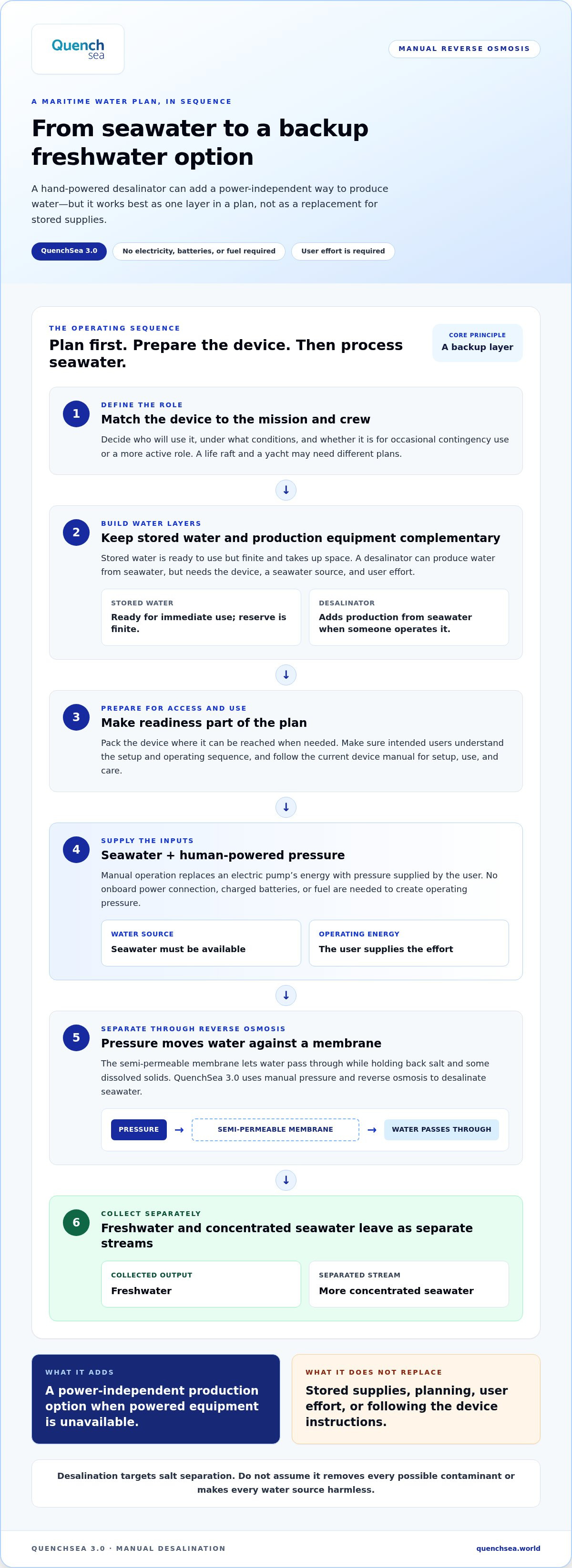
Before choosing equipment, define the mission, crew, likely operating conditions, and backup layers. Then decide whether the desalinator is for occasional contingency use or a more active role. This makes expectations clear and helps ensure the device supports the plan rather than standing in for it.
How a manual seawater desalinator works without onboard power
A hand-powered desalinator replaces an electric pump’s energy with pressure supplied by the user. In reverse osmosis, pressure pushes seawater against a semi-permeable membrane. Water passes through while much of the salt is separated, and the resulting freshwater is collected separately from the more concentrated seawater.
Manual reverse osmosis uses human-powered pressure to move water through a membrane that separates much of the salt from seawater. This makes a naval survival kit seawater desalinator relevant when electrical power or fuel may be unavailable. It does not make operation effortless: the device still requires user effort, a seawater source, and correct setup.
What reverse osmosis does to seawater
In a reverse osmosis device, the membrane is the separation element. Pressure moves water through it while salt and some dissolved solids are held back. QuenchSea 3.0 uses manual pressure and reverse osmosis to remove salt and reduce dissolved solids from seawater. This describes the desalination process; it does not mean that every possible contaminant in every source is removed or made harmless.
That distinction matters in an emergency. Desalination targets salt separation, so follow the device instructions for operation and water handling rather than assuming the process addresses every water-quality concern. The manual reverse osmosis engineering guide provides a deeper look at how this approach works.
What hand-powered operation means during an emergency
A manual unit does not depend on onboard electricity, charged batteries, or fuel to create operating pressure. QuenchSea 3.0 is designed to work without those inputs. That independence matters if a vessel loses power or the crew needs a water-production option that does not rely on an energy supply. The trade-off is straightforward: a person must operate the device.
Before an emergency, make sure intended users understand the setup and operating sequence. During use, the crew needs access to seawater and must follow the current device manual. Conditions can affect how practical manual operation is, so consider who will be available to operate it and how the task fits the situation. No power connection is required, but readiness still depends on preparation.
- Energy source: The user supplies the operating effort instead of electricity, batteries, or fuel.
- Water source: The device needs seawater available for processing.
- Operating method: Follow the product instructions for setup, use, and care.
QuenchSea 3.0 is a portable, hand-powered option for marine and emergency planning. Learn more about the QuenchSea 3.0 desalination device and how its fuel-free operation can fit into a maritime kit.
How to compare naval survival kit seawater desalinators
Compare equipment against the mission, not an abstract “best” label. A yacht preparing for a power failure, a life raft, and a vessel supporting a larger crew may have different priorities. Start with the device’s intended role, then compare its power source, operating method, intended setting, and support needs. A naval survival kit seawater desalinator can serve as a contingency layer, but assess the mission and product documentation before treating it as the sole planned supply.
Which specifications matter for a marine survival kit?
Start with how the unit operates and whether it depends on external power or fuel. Then compare its documented water output with expected crew needs and the time available for operation. Do not rely on a headline rate alone. Physical effort, operating conditions, and setup instructions all affect whether a device is suitable for its intended role.
- Power source: A hand-powered device uses manual effort; powered models depend on their specified energy source.
- Operating method: Identify the steps and user input required to produce water.
- Intended setting: Match the design and documented use to your vessel, raft, or emergency kit.
- Support requirements: Review documented maintenance, replacement components, storage, and care instructions.
- Practical handling: Compare verified dimensions, weight, and storage needs with the space available.
Use current product documentation to confirm figures such as production rate, operating effort, weight, and maintenance interval. These details vary by device and cannot be inferred from the general category. For example, a device that produces water may still be a poor fit if its documented output or operating demands do not match the crew’s needs. QuenchSea 3.0 uses manual pressure and reverse osmosis and operates without electricity, batteries, or fuel.
Manual desalinator or stored water: how to think about the trade-off
Stored water is immediately available, but the quantity is finite and must be allocated to the mission. A desalinator provides a way to produce water from seawater, but it requires access to seawater, user operation, and correct use. Treat the two as layers in one plan, not interchangeable choices.
Ask directly: is the device intended as a backup, or is it the only planned water supply? A backup role adds redundancy alongside stored reserves. Relying on a device alone puts greater weight on its operating requirements, verified output, and readiness. Make the decision against crew needs and mission duration instead of assuming that water production automatically means a sufficient supply.
The QuenchSea 3.0 buyer’s guide offers a product-focused assessment. QuenchSea 3.0 is a manual, fuel-free option for a backup layer in a maritime water plan. Explore the QuenchSea 3.0 desalination device.
How to plan, pack, and prepare a seawater desalinator
A reliable setup starts before equipment goes into a bag. Define what the water plan must support, decide how the desalinator fits alongside stored reserves, and make sure the people responsible know where it is and how to use it. Pack a naval survival kit seawater desalinator for a specific role, not as a complete water plan by itself.
Define the mission, calculate water needs, assign reserve layers, then pack and prepare equipment.
A four-step water-planning checklist for maritime use
- Identify the scenario. Consider the vessel or survival setting, who the plan must support, and what conditions could affect access to supplies and equipment.
- Set reserve needs. Use guidance applicable to the mission and crew rather than assuming one water quantity suits every situation.
- Assign water layers. Decide what stored water covers immediately and what role production equipment may serve if reserves are limited.
- Pack for access. Place the device and its instructions where intended users can reach them and operate it in the planned scenario.
This sequence turns a general preparedness goal into a clear equipment decision. A raft, a yacht, and other marine settings may call for different reserve arrangements. Keep intended users in mind: a device contributes only if the crew can access and operate it when needed.
Operating readiness, storage, and supporting supplies
Before deployment, familiarise intended users with the device and its instructions. Follow the current manual for setup, operation, cleaning, inspection, and storage. Use the manufacturer’s guidance for practice and maintenance rather than inventing a schedule or interval. Keep the instructions with the equipment or somewhere readily accessible to the people expected to operate it.
Plan the whole task, not just where the device fits. The crew needs access to seawater, a practical way to collect it, and a place to operate the unit and handle the water produced. Check that the packed arrangement leaves the equipment reachable. The survival desalination device guide adds wider context for emergency use.
QuenchSea 3.0 is a portable, hand-powered reverse osmosis device designed to operate without electricity, batteries, or fuel. Include it as a defined production layer, then build the rest of the plan around mission needs and stored reserves. Read more about QuenchSea 3.0 for your maritime water plan.
Is QuenchSea 3.0 the right manual desalinator for your kit?
QuenchSea 3.0 is a portable, hand-powered way to desalinate seawater without relying on onboard electricity, batteries, or fuel. It is designed for marine safety, life rafts, yachts, and emergency preparedness, including situations where a power-independent water-production option has a defined role.
Assess the fit against what your plan requires the device to do. Consider who will operate it, how it will be accessed, and whether its documented capabilities suit the scenario. A device’s operating method may fit the mission while other needs still depend on stored supplies and established procedures.
Where QuenchSea 3.0 fits, and where the wider plan matters
QuenchSea 3.0 uses manual pressure and reverse osmosis to remove salt and reduce dissolved solids from seawater. Because it is hand-powered, it does not need electricity, batteries, or fuel. These features make it a production layer for situations where those power sources are limited, not a complete water supply by itself.
Stored reserves, mission-specific water planning, and user readiness still matter. The device requires seawater and operation by a person, so account for those practical needs alongside the intended setting. Do not assume one portable unit will meet every crew’s requirements or replace the broader water plan. Use current product documentation to review specifications relevant to your use, including output and operating instructions.
For a life raft, yacht, or emergency kit, consider whether manual operation suits the conditions and the people the device must support. If intended users can access it, understand its operation, and integrate it with reserve supplies, QuenchSea 3.0 can serve as a defined backup or contingency layer. If you plan to rely on it as the only source, assess that decision carefully against mission needs and documented capabilities.
Next steps for choosing a maritime water solution
Before selecting equipment, review the scenario, crew needs, reserve supplies, and current product documentation. Compare power source, operating method, intended setting, and support requirements. Assign the device a realistic role, and make sure intended users know where it is and how to follow its instructions.
A practical choice fits the mission and strengthens the whole plan. Learn more about QuenchSea 3.0 for your maritime water plan.
Make water readiness part of the mission
A water plan is useful when the crew can act on it without guesswork. Turn the equipment choice into a shared onboard procedure: make sure the people responsible know the role of each supply, where to find the relevant instructions, and how the plan changes if the crew or mission changes. Keep that procedure aligned with the vessel’s actual operating conditions.
That is the practical test for any naval survival kit seawater desalinator. It should have a defined role in maritime readiness, with expectations based on the mission rather than assumptions about what one device can cover. Reviewing the plan before departure can reveal gaps while there is still time to address them.
Explore QuenchSea 3.0 for your maritime water plan as a manual, power-independent desalination option. Build a plan your crew understands, can access, and is ready to put into action.
Frequently Asked Questions
What is a naval survival kit seawater desalinator?
A naval survival kit seawater desalinator is equipment intended to turn seawater into freshwater for maritime emergency use. Manual models use a person’s effort to drive the desalination process, while other systems may depend on an external power source. Treat it as a water-production tool with a defined role, not a self-sufficient supply. Its usefulness depends on the mission, device instructions, and crew readiness.
Can a manual seawater desalinator work without electricity or fuel?
Yes. A hand-powered model can operate without electricity or fuel by using manual pressure. QuenchSea 3.0 also requires no batteries. This removes dependence on charging or carrying fuel, but the user must still operate the device and have seawater available. Consider who will handle the task in the intended situation and make sure they can follow the current operating instructions.
Is a seawater desalinator enough water for a life raft?
Not automatically. Whether a desalinator can meet a life raft’s water needs depends on the device’s verified output, the number of people, how long the raft must support them, and whether someone can operate it. Do not assume the device alone covers the requirement. Plan reserves and production equipment together, using applicable life raft guidance and current product documentation to assess the setup.
How does reverse osmosis turn seawater into freshwater?
Reverse osmosis uses pressure to push seawater against a semi-permeable membrane. Water passes through while much of the salt is separated, producing a freshwater stream and a more concentrated seawater stream. In a manual unit, the user supplies the pressure through its operating mechanism. The process reduces salt and dissolved solids, but do not assume it addresses every possible contaminant in every source.
What should I compare when choosing a marine desalinator?
Compare the power source, operating method, documented output, intended setting, and care requirements. Then match those details to the crew and likely conditions. A device intended as a backup, for example, has a different role from one expected to support regular production. Review current specifications for output, handling, storage, and maintenance rather than relying on assumptions based on the product category or a general description.
Does a seawater desalinator replace emergency water storage?
No. Stored water is ready to use but limited to the amount carried. A desalinator adds a way to produce water, but it requires seawater, an operable device, and user effort. Give the options distinct roles in the plan: reserves support immediate needs, while production equipment adds another option. Plan each layer around the mission rather than treating either as a complete solution.
How should I prepare a manual desalinator for emergency use?
Read the current device manual and familiarise intended users with its setup and operation before deployment. Keep the unit and instructions accessible, and plan where users can collect seawater and operate the equipment. Follow the manufacturer’s directions for inspection, cleaning, and storage. Do not create an arbitrary maintenance schedule or assume the device is ready simply because it is packed; preparation includes knowing how to use and care for it.