

Could a hand-powered device keep a life raft supplied with drinking water, or does it only shift the problem? A life raft desalinator can turn seawater into freshwater, but it is not a complete water plan. Its usefulness depends on its specified output, operating demands, condition, and suitability for your raft.
A reassuring product label is not enough. Manual desalination differs from ordinary filtration: reverse osmosis separates dissolved salts from seawater, while many filters are designed for other contaminants and may not remove salt. The device also needs to suit the conditions and procedures you could realistically manage in an emergency.
This guide explains what a life raft desalinator can and cannot do, which operating details to compare, and how desalination differs from filtration and purification. It also explains how a hand-powered option such as QuenchSea 3.0 might fit into planning, without assuming raft approval or guaranteed production. Before relying on an emergency water maker, check its specifications and instructions, and confirm compatibility and backup water provisions.
Key Takeaways
- A life raft desalinator removes dissolved salt from seawater; ordinary filters may target particles or some microorganisms without removing salt.
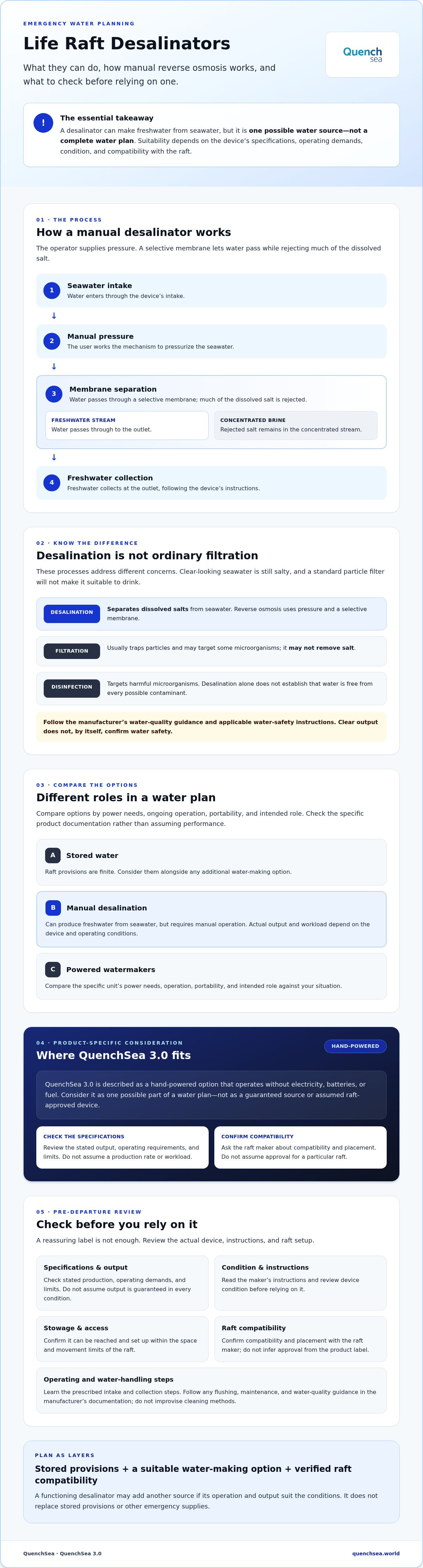
- Understand the reverse-osmosis sequence: seawater intake, manual pressure, membrane separation, and freshwater collection.
- Compare stored water, manual desalination, and powered watermakers by power needs, ongoing operation, portability, and intended role.
- Before departure, review the device instructions, condition, stowage, and access, then confirm compatibility and placement with the raft maker.
- Assess QuenchSea 3.0 as a hand-powered option that operates without electricity, batteries, or fuel, and check its specifications before relying on it.
What Is a Life Raft Desalinator, and What Problem Does It Solve?
A desalinator removes dissolved salts from seawater to produce freshwater. A life raft desalinator is an emergency water-making device intended to help people aboard a raft when they cannot resupply. It offers a possible additional source of water, but does not replace the raft’s stored provisions or other emergency supplies.
Desalination separates dissolved salts from seawater, while ordinary water filtration usually traps particles and may target some microorganisms without removing salt. That distinction matters: clear-looking seawater is still salty, and a standard particle filter will not make it suitable to drink.
How is a desalinator different from a water filter?
A reverse-osmosis desalinator uses pressure to move water through a selective membrane while rejecting much of the dissolved salt. A filter generally captures material as water passes through it; disinfection, in turn, targets harmful microorganisms. These processes address different concerns. Desalination alone does not establish that water is free from every possible contaminant or that it needs no further handling. Follow the device maker’s instructions and applicable water-safety guidance.
Why consider freshwater production in a life raft?
Raft provisions are finite. If rescue or resupply takes longer than expected, a functioning water-production device may provide another option, provided its operation and output suit the conditions. Treat it as one layer in a plan, not an unlimited supply. The device must be accessible, usable, and compatible with the raft.
For broader planning, see a life raft water supply guide alongside the raft maker’s instructions. A hand-pumped reverse-osmosis desalinator is also among examples of equipment that may be included in some over-water survival kits. That reference does not confirm that a particular device is approved for, or supplied with, your raft. Check directly with the raft maker before relying on one.
How Does a Manual Life Raft Desalinator Turn Seawater into Freshwater?
A manual reverse-osmosis desalinator uses pressure supplied by the operator to move water through a selective membrane while rejecting much of the dissolved salt. The basic sequence is straightforward, although each device has its own procedure: seawater enters through an intake, the user works the manual mechanism to pressurize it, the membrane separates a freshwater stream from concentrated brine, and freshwater collects at the outlet.
The process depends on the membrane and pressure system working as designed. It does not mean every possible contaminant is removed or that output is guaranteed in every condition. Actual production and the effort required to operate a life raft desalinator depend on the specific device and operating conditions. Check the manufacturer’s specifications rather than assuming a production rate or workload.
What does reverse osmosis do inside a hand-powered unit?
A semipermeable membrane allows water molecules to pass through while blocking much of the dissolved salt. In a hand-powered unit, the operator creates pressure using the device’s manual mechanism. Follow the official QuenchSea 3.0 instructions for its exact setup and operating sequence; do not substitute a generic procedure for the maker’s directions. Where raft approval matters, check the applicable U.S. Coast Guard approval standards and confirm requirements with the raft maker.
What can affect water output and usability?
Operating conditions and the person’s ability to work the mechanism can affect practical output and usability. The specific factors, their effects, and any operating limits should be stated in the manufacturer’s documentation. This is particularly relevant in a raft, where space, movement, and user capacity may constrain how a device can be set up and operated.
Before an emergency, learn the prescribed intake and collection steps, and follow any flushing or maintenance instructions from the manufacturer. These steps help protect the device and keep its use aligned with the intended procedure. Do not improvise cleaning methods or assume that clear output confirms water safety. Check the product documentation for water-quality guidance or additional handling steps.
If you are considering a hand-powered option designed to make freshwater from seawater without electricity, batteries, or fuel, review the QuenchSea 3.0 device information and official instructions. Confirm current specifications and suitability with the raft maker before including it in your emergency plan.
Manual, Stored, or Powered: Which Life Raft Water Option Fits?
No single water source covers every emergency. Stored water is ready to use but finite. A manual desalinator can make freshwater without an external power source, but someone must operate it. Powered marine watermakers can produce water while their energy source and system remain available, though their installation and power needs may make them unsuitable for a life raft. Treat these options as possible layers, not interchangeable solutions.
| Option | Power dependence | Ongoing operation | Portability and role |
|---|---|---|---|
| Stored water | None required to use it | Available for drinking until the supply is used | Provision to keep accessible; finite and dependent on what is carried |
| Manual desalination | Can operate without electricity, batteries, or fuel, depending on the device | Requires a person to operate it according to the instructions | Potential emergency backup; check stowage, usability, and raft compatibility |
| Powered marine watermaker | Depends on its specified energy source | Requires the system and its power supply to remain available | May involve installation and space requirements; assess whether it suits the intended craft and emergency conditions |
Manual water production requires user operation; it is not an automatic supply. In a life raft, consider who can use the device, whether they can follow its instructions, and whether it can be operated in the raft’s conditions. The table is a starting point, not a substitute for raft-maker guidance or equipment requirements.
When is a manual desalinator a practical backup?
A hand-powered device may be relevant when electricity, batteries, or fuel are unavailable. For example, QuenchSea 3.0 uses manual pressure and reverse osmosis, and operates without those external power sources. That may be useful to consider in emergency planning, but it does not establish the device’s output in your conditions, its raft compatibility, or its approval status. Check the manufacturer’s specifications and confirm suitability with the raft maker.
How does it compare with stored water and powered systems?
Stored water requires no water-making operation, which can matter when people are tired or conditions make equipment difficult to use. Its limit is simple: once consumed, it is gone. Manual desalination may add another source, but depends on the device functioning and someone being able to operate it. Powered systems rely on their energy source and may require equipment or installation that a life raft cannot accommodate.
Build the plan around the raft’s provisions and instructions first. Then assess whether another method is appropriate and practical, rather than assuming one choice is universally best. For broader selection criteria beyond raft use, consult a portable desalination buyer’s guide.
How to Check a Life Raft Desalinator Before You Rely on It
A device belongs in an emergency plan only if you can find it, understand it, and confirm it suits the raft. Before departure, check the desalinator against the manufacturer’s current instructions, then review its storage location and any raft-specific restrictions. A product’s advertised purpose does not establish approval or compatibility.
What should the pre-departure readiness check include?
- Condition: Inspect the device and supplied components for visible damage or missing parts. Use the manufacturer’s instructions to determine which condition checks apply.
- Operating instructions: Make sure the crew can locate and understand the correct instructions before an emergency. Do not rely on memory or assume different models operate the same way.
- Stowage: Confirm the device is secured where planned and remains accessible. Its placement must not obstruct raft access, deployment, or other required equipment.
- Maintenance: Follow the maker’s documented inspection, flushing, and maintenance guidance. Do not add procedures or replacement parts based on guesswork.
Keep the check practical. If the device is buried under gear or no one aboard knows how to use it, its theoretical capability will not help when needed.
How can you verify raft compatibility and requirements?
Ask the life-raft manufacturer whether the specific device is compatible, where it may be stowed, and whether approval restrictions apply. Check the raft’s documentation as well. Requirements can depend on the raft and applicable jurisdiction, so confirm them with the relevant flag state or maritime authority rather than assuming one rule applies everywhere.
Separate product information from compliance evidence. A manufacturer may describe an emergency use case, but that alone does not prove a device is certified, approved, included with a raft, or permitted in a particular setup. Treat those points as unconfirmed until you check official documentation from the product maker, raft maker, or relevant authority.
Untreated seawater is not a safe fallback for drinking. For more context, consult the guide on drinking seawater dangers, and follow recognized water-safety guidance rather than judging water by appearance or taste.
Considering a hand-powered option for your plan? Review the QuenchSea 3.0 device details, then verify its specifications and raft compatibility with the relevant manufacturers before relying on it.
Where QuenchSea 3.0 Fits in a Life Raft Water Plan
QuenchSea 3.0 is a portable, hand-powered reverse-osmosis device designed to make freshwater from seawater. The operator supplies manual pressure, and the device works without electricity, batteries, or fuel. That makes it an option to assess for marine emergency planning where external power may not be available. It does not, by itself, provide a complete water plan or confirm that it can be carried or used in a particular life raft.
Which confirmed QuenchSea 3.0 attributes matter at sea?
Its manual operation and independence from electrical power and fuel are relevant attributes when planning beyond a vessel’s powered systems. They do not remove the need for a person to operate the device according to its instructions. Nor do they confirm how much water it will produce in specific conditions. Check current product specifications and operating guidance before using any output expectation in your plan.
Think of it as a possible additional water-making layer, not a replacement for the raft’s required provisions or equipment. A life raft desalinator must also be accessible and practical to operate in the intended setup. Confirm those points rather than assuming that portability alone means the device fits a raft.
What should you verify before choosing a device?
Before relying on QuenchSea 3.0, check its current official documentation and confirm:
- Specifications and operation: Review the latest product details and follow the stated operating sequence.
- Water-quality guidance: Check the manufacturer’s instructions for handling the produced water and any additional steps.
- Raft compatibility and stowage: Ask the raft manufacturer whether the device is suitable, where it may be stored, and whether it could interfere with access, deployment, or other equipment.
- Approval and carriage requirements: Verify any applicable requirements with the relevant maritime authority. Do not treat a product description as proof of certification or raft approval.
Confirm the practical details before adding a device to an emergency plan. Compare its verified specifications and instructions with the raft maker’s guidance, then decide whether it complements the raft’s provisions and can be safely stowed and accessed. For product information to review as part of that assessment, review QuenchSea 3.0.
Build a Water Plan You Can Rely On
A life raft desalinator can add a freshwater-making option, but it is not a complete water plan. Stored provisions remain important, and manual production depends on someone operating the device. Before relying on any model, review its instructions and verified specifications, then confirm stowage, compatibility, and any approval requirements with the raft maker and relevant authority.
QuenchSea 3.0 is a hand-powered reverse-osmosis device that operates without electricity, batteries, or fuel. Those attributes may make it worth evaluating for marine emergency planning, but they do not establish output, raft approval, or suitability for your specific raft. Check the details against your needs and the raft maker’s guidance.
Review QuenchSea 3.0 and use its product information as one input in a carefully checked emergency water plan. Prepare by confirming the details before you need to make decisions in difficult conditions.
Frequently Asked Questions
Can a life raft desalinator make seawater safe to drink?
A life raft desalinator can remove salt from seawater, but desalination alone does not confirm that water is safe in every respect. Reverse osmosis separates water from much of the dissolved salt, while other contaminants may require separate treatment. Follow the device maker’s water-quality instructions and applicable guidance. Do not use appearance or taste as proof of safety, and do not drink untreated seawater as a substitute.
How does a hand-powered life raft desalinator work?
A hand-powered life raft desalinator uses manual pressure to push seawater through a selective reverse-osmosis membrane. The membrane allows water to pass while rejecting much of the dissolved salt. The general process involves drawing in seawater, operating the manual mechanism, and collecting the freshwater stream. Exact setup, operation, and maintenance steps vary by device, so learn and follow the manufacturer’s instructions before an emergency.
How much water can a life raft desalinator produce?
Output depends on the specific device and its operating conditions. Check the current manufacturer specifications for the stated production rate, how it is measured, and any conditions or limitations. Do not assume a rate from another model applies to yours, or that the device will meet a group’s needs in every situation. Include stored water and other provisions in your plan rather than relying on an unverified output estimate.
Is a manual desalinator better than carrying emergency water?
Neither option universally replaces the other. Stored emergency water is immediately available, but the supply is finite. A manual desalinator may provide another source without relying on external power, but someone must operate it, and actual output depends on the device and conditions. Consider both as possible layers in a water plan. Follow the raft maker’s guidance and do not remove or reduce supplied provisions based on an unverified device claim.
Can QuenchSea 3.0 be carried in a life raft?
Do not assume QuenchSea 3.0 is approved for or compatible with a particular life raft. It is a portable, hand-powered reverse-osmosis desalination device that operates without electricity, batteries, or fuel, but those features do not establish raft approval, stowage fit, or carriage requirements. Check the current product documentation, then ask the raft manufacturer and relevant maritime authority whether the device can be carried and where it may be stored.
Does a life raft desalinator replace the water supplied with a raft?
No. Treat a life raft desalinator as a possible additional water-making option, not an automatic substitute for water supplied with the raft. Stored water is available without operating equipment; a manual device requires someone to use it and may not produce water in every condition. Keep the raft’s provisions intact and follow its documentation. Confirm any equipment or carriage requirements with the raft maker and relevant authority.
What should I check before storing a desalinator in a life raft?
Check the device’s condition and supplied components against the manufacturer’s instructions. Make sure the crew can access and understand those instructions, and confirm the chosen stowage location will not obstruct raft access, deployment, or other equipment. Ask the raft manufacturer about compatibility, placement limits, and approval restrictions. Verify applicable requirements with the relevant maritime authority, and follow the product maker’s maintenance and water-quality guidance.