

If your vessel's electrical system fails 50 miles offshore, how long will your bottled water reserves actually last? It's a question that keeps even experienced mariners awake at night. You already know that thirst is the most immediate threat in a survival situation. However, many sailors avoid backup gear because traditional manual desalinators are often heavy, expensive, or physically exhausting to operate. You need a solution that works when everything else breaks.
This guide shows you how to choose a portable hand powered desalination device that delivers high-volume output without draining your remaining physical energy. We'll explore the 2026 landscape of manual reverse osmosis technology, focusing on units that provide 98% salt rejection and reliable output of 4 to 6 liters per hour. You'll learn how to evaluate mechanical integrity, manage membrane maintenance, and ensure your emergency kit is ready for the reality of the open sea. It's time to replace fear with a calculated, mechanical advantage. This is about more than just gear. It's about ensuring your survival when the horizon is all you can see.
Key Takeaways
- Learn why relying solely on stored water is a critical risk and how the "Rule of 3" makes a manual desalinator a tactical necessity for offshore safety.
- Understand how a portable hand powered desalination device utilizes high-pressure reverse osmosis to convert seawater into drinkable water without batteries or fuel.
- Compare manual, electric, and solar-powered units to identify why human-powered systems offer the highest reliability in extreme equipment failure scenarios.
- Identify critical selection criteria, including a minimum 2-liter-per-hour output and the use of corrosion-resistant, survival-grade materials for long-term durability.
- Discover the engineering behind the QuenchSea 3.0, which produces up to 6 liters of fresh water per hour with a 98% salt rejection rate.
Why an Emergency Water Maker is Non-Negotiable for Offshore Safety
Survival at sea is governed by the Rule of 3. You can survive three minutes without air, three weeks without food, but only three days without water. Once you're adrift, fresh water becomes your primary mission. Relying solely on stored reserves is a tactical error. Water is heavy, weighing approximately one kilogram per liter. It consumes vital space in a life raft and remains vulnerable to container leakage or bacterial contamination. A portable hand powered desalination device transforms the surrounding ocean from a life-threatening barrier into an infinite resource.
Integrating a manual water maker into your life raft water supply provides a critical psychological advantage. Survival experts recognize that moving from a mindset of rationing to one of sustainable production reduces panic. When you control your hydration, you maintain the cognitive function necessary to manage other survival tasks and signal for rescue.
Rationing vs. Production: A Tactical Shift
Drinking seawater is never an option. The high salinity forces your kidneys to use more water to flush out the salt than you actually ingested. This process accelerates dehydration and leads to rapid organ failure. Under high heat stress, a human requires a minimum of two liters of water daily to maintain basic physiological function. Rationing a few liters of stored water merely delays the inevitable. In contrast, active production acts as a force multiplier. By generating 4 to 6 liters per hour, you extend your rescue window indefinitely. You aren't just waiting to be found; you're maintaining the physical strength required to assist in your own recovery.
The Failure Points of Electric Systems
Electronic systems are inherently fragile in marine environments. Saltwater is highly conductive and corrosive. It targets circuit boards, battery terminals, and wiring harnesses. Even the most robust electric desalinators eventually face battery depletion or electrical shorts. This is why manual backups remain the gold standard for emergency drinking water at sea. Mechanical simplicity is your greatest ally when systems fail. By understanding How Manual Reverse Osmosis Technology Works, you realize that your own physical effort is the only power source that won't short-circuit. A portable hand powered desalination device relies on durable seals and high-pressure pumps rather than complex microchips. In a high-stakes environment, the tool with the fewest points of failure is the one that saves lives.
How Manual Reverse Osmosis Technology Works Without Power
A portable hand powered desalination device operates on a precise mechanical principle: the application of extreme pressure. Reverse osmosis (RO) works by forcing seawater through a semi-permeable membrane. This membrane features microscopic pores that allow water molecules to pass while blocking salt, minerals, and pathogens. In an emergency, your physical effort replaces the electric motor. This process is not just about filtering; it is a molecular-level separation that turns undrinkable brine into life-saving hydration.
The efficiency of this process depends on achieving a high salt rejection rate. High-performance manual units aim for 98% rejection. This ensures the output water falls below 1,000 parts per million (PPM) of Total Dissolved Solids (TDS). This 98% threshold is the benchmark for safety, aligning with World Health Organization standards for potable water in emergency situations. Without this level of precision, the resulting water could still contribute to long-term dehydration due to residual salt content.
The Physics of Hand-Powered Pressure
Building the pressure required to desalinate seawater is a significant engineering challenge. A manual desalinator uses a reinforced lever to drive a high-pressure piston. This mechanical advantage is what allows a human operator to perform a task usually reserved for 12V or 24V electric motors. To overcome the osmotic pressure of seawater, the system must generate a consistent 60 bar of pressure to force water molecules through the membrane. Older manual designs were often inefficient, requiring exhausting levels of physical output. Modern survival-grade devices solve this by integrating an energy recovery device. This mechanism captures the leftover pressure from the concentrated brine stream and redirects it to assist the next pump stroke. It significantly lowers the physical barrier to hydration.
Membrane Protection and Maintenance
The RO membrane is highly sensitive to physical damage. Seawater is a complex soup of sediment, algae, microplastics, and parasites like Giardia or Cryptosporidium. If these contaminants reach the membrane, they cause "fouling," which reduces water flow and eventually destroys the unit. A portable hand powered desalination device must include a triple filtration sequence. Ultra-filtration and micro-filtration stages act as the first line of defense, trapping suspended solids before they can impact the RO membrane. This protective layer is essential for longevity in the field. To keep the system operational, users must perform basic maintenance. Rinsing the device with fresh water after use prevents biological growth and salt crystallization. For those prioritizing mechanical integrity in harsh environments, the QuenchSea manual desalination unit offers a streamlined, durable solution.
Comparing Portable Desalination: Manual vs. Electric vs. Solar
Selecting a survival water source requires a ruthless evaluation of failure points. In a maritime crisis, you cannot rely on systems that depend on external power. Electric portable RO units offer high volume but remain tethered to batteries that short-circuit in saltwater environments. Solar stills are passive and require zero effort, yet they are entirely weather-dependent and produce negligible volumes, often less than 0.5 liters per day. Chemical or single-use kits are compact for a ditch bag, but they provide a finite, non-renewable supply. A portable hand powered desalination device represents the tactical middle ground. It provides the high output of reverse osmosis without the vulnerability of electronic components.
Reliability in Extreme Conditions
Mechanical simplicity is the ultimate fail-safe for a yacht safety water maker. While electric units provide convenience during routine use, they introduce high-risk failure points like corroded terminals and motor burnouts. In the cramped environment of a life raft, stowage volume and weight are primary concerns. A manual unit typically weighs under 3 kilograms. This is significantly lighter than the combined weight of an electric pump and the battery packs or solar arrays required to power it. When analyzing long-term value, consider the cost-per-liter over an extended survival scenario. Manual devices provide a renewable supply as long as you can operate the lever. In contrast, chemical reagents eventually run out, leaving you with no options once the initial supply is exhausted.
Output Efficiency: Liters per Hour
The engineering landscape of 2026 has fundamentally changed the physical cost of hydration. Legacy manual desalinators were notoriously inefficient, often producing only 0.8 liters per hour. This created a dangerous "Exhaustion Threshold." In high-heat environments, the metabolic heat and sweat loss generated by the effort of pumping could nearly offset the water produced. Modern portable hand powered desalination device designs have solved this through improved piston geometry and better membrane flux. Current survival-grade units deliver 4 to 6 liters per hour. This leap in efficiency allows a survivor to secure their daily water requirement in under 30 minutes of exertion. By minimizing the physical toll, modern engineering ensures that manual pumping is a sustainable daily task rather than an exhausting struggle for survival.
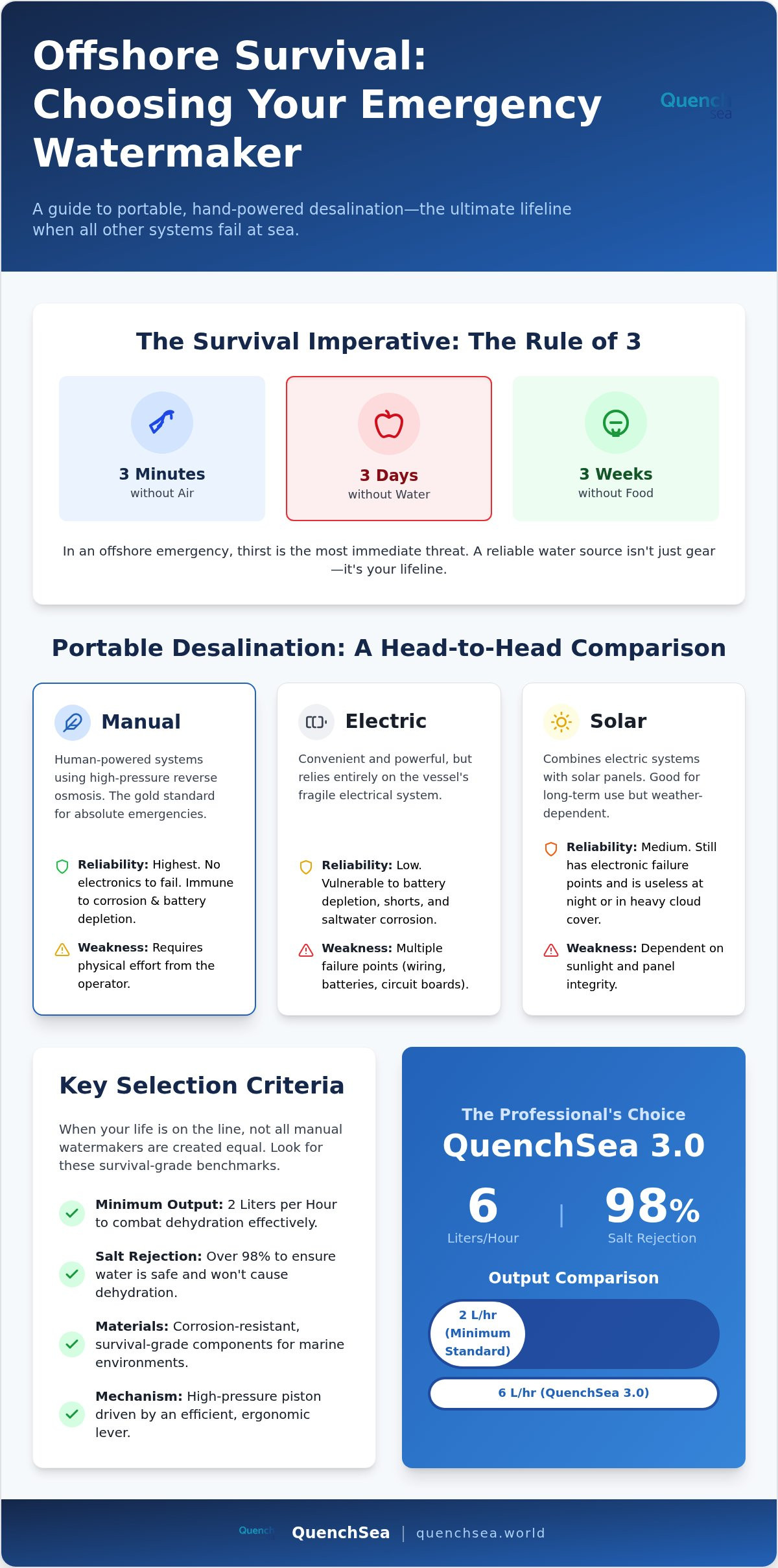
Key Selection Criteria for Your Survival Desalination Device
Selecting a survival tool requires a cold, analytical approach. You cannot afford to carry equipment that fails under stress. When evaluating a portable hand powered desalination device, prioritize mechanical integrity over aesthetics. A unit that produces less than 2 liters per hour is insufficient for multi-person survival or high-heat scenarios. Look for hardware constructed from 316-grade stainless steel and reinforced polymers. These materials withstand the relentless corrosive force of concentrated brine. High-quality materials ensure the pump maintains its seal even after hundreds of hours of operation.
Ease of operation is equally critical. In a crisis, fine motor skills degrade and cognitive load increases. Complex manuals are useless in a tossing life raft. Survival-grade devices feature pictorial instructions engraved directly onto the housing. This ensures that any user, regardless of technical background or language, can produce water immediately. Portability must not compromise the hydraulic system. You need a device that fits into a standard ditch bag while maintaining the robust pump geometry required for 60-bar pressure. Every gram of weight should contribute directly to mechanical output.
Evaluating Build Quality
High-stress environments punish complexity. A "no extra parts to lose" design is a non-negotiable requirement for offshore safety. Detachable handles or loose intake valves are liabilities that can render a device useless if dropped overboard. Every component should be integrated or tethered. Materials science plays a decisive role here. High-salinity water destroys inferior plastics and low-grade metals within days. Professional units use advanced composites that resist UV degradation and chemical pitting. Compactness is the final hurdle. The device must be small enough to fit inside a life raft canister yet powerful enough to sustain life indefinitely.
The Importance of Salt Rejection Rates
The quality of the output is as important as the volume. A 98% salt rejection rate is the professional benchmark for long-term health. If a device only achieves 90% or 95% rejection, the remaining salt puts significant stress on your kidneys. This leads to increased thirst and eventual dehydration despite drinking. For safe consumption, Total Dissolved Solids must remain below 1,000 parts per million to prevent physiological stress. High-TDS water tastes brackish and fails to hydrate the body effectively. Maintaining this standard is what separates a survival tool from a gadget.
To ensure you have the most reliable hardware for your emergency kit, order the QuenchSea 3.0 desalination device today. It combines survival-grade durability with the high output necessary for maritime emergencies.
QuenchSea 3.0: The Professional Choice for Emergency Hydration
The QuenchSea 3.0 represents a significant advancement in survival hardware. It's the world’s only low-cost, high-output manual RO solution designed for the most punishing environments. While legacy devices often struggled to meet basic physiological needs, this unit delivers 4 to 6 liters of drinkable water per hour. It requires no batteries, fuel, or external power. Your own physical effort is the only input required to secure your hydration. This portable hand powered desalination device bridges the gap between expensive fixed systems and ineffective emergency kits. It provides professional-grade reverse osmosis to sailors, coastal preppers, and defense professionals who demand absolute reliability.
Engineering for the Extreme
The core of the QuenchSea 3.0 is a unique hydraulic system engineered to maximize pressure with minimal physical exertion. It overcomes the high-pressure thresholds required for desalination through superior mechanical advantage, allowing for sustained use without rapid fatigue. Protecting the advanced industrial RO membrane is a triple filtration system. This sequence traps sediment, microplastics, and biological contaminants before they can cause fouling or membrane damage. The design is intentionally streamlined with no extra parts to lose. It fits easily into standard ditch bags, ensuring you have a lifeline ready the moment you abandon ship. Mechanical integrity is the priority here. The unit is built to withstand the corrosive nature of high-salinity water over long durations in the field.
Global Impact and Mission
QuenchSea is more than a hardware manufacturer; it's a mission-driven innovator. The brand actively supports humanitarian relief and disaster response efforts where clean water is a critical scarcity. With nearly 2.3 billion people living in water-scarce conditions globally, the company's goal is ambitious yet focused. The vision is to distribute 100 million devices to make clean water accessible in every corner of the planet. This spirit of global responsibility is grounded in practical, survival-grade technology. By choosing this portable hand powered desalination device, you're investing in a tool proven by defense and humanitarian professionals alike. Don't leave your offshore safety to chance. Secure your vessel with the QuenchSea 3.0 Desalination Device and ensure a sustainable freshwater supply in any emergency.
Secure Your Water Independence Offshore
Preparation is the definitive line between a survival story and a maritime tragedy. You now understand why a portable hand powered desalination device is the ultimate fail-safe for offshore voyaging. By prioritizing mechanical simplicity over electronic complexity, you eliminate the most common failure points in harsh saltwater environments. Reliable hydration is no longer a variable; it's a mechanical certainty that you control through physical effort.
Modern engineering ensures that you can produce 4 to 6 liters of fresh water per hour with 98% salt rejection, fully meeting WHO standards for safety. This level of efficiency allows you to maintain vital hydration without depleting your physical reserves. These systems are already trusted by defense and humanitarian organizations worldwide because they deliver results when power grids and batteries fail. Don't wait for an equipment malfunction to secure your supply. Take a proactive step toward complete vessel safety today. Equip your life raft with the QuenchSea 3.0 and ensure your crew has a sustainable freshwater source. Stay prepared and master your environment.
Frequently Asked Questions
How much physical effort is required to operate an emergency water maker?
Operating a manual desalinator requires physical exertion, but modern engineering minimizes the toll. Units like the QuenchSea 3.0 use a high-leverage handle and a specialized hydraulic system to reduce the force needed per stroke. While older models were exhausting, current designs allow an average adult to produce 4 to 6 liters per hour without reaching a state of total fatigue. It's a manageable, sustainable task for survival in high-stress environments.
Can a manual desalinator remove viruses and bacteria from seawater?
Yes, the reverse osmosis membrane acts as a physical barrier against biological threats. The pores in an RO membrane are approximately 0.0001 microns, which is significantly smaller than viruses and bacteria. This process effectively removes pathogens like Giardia, Cryptosporidium, and E. coli. However, you must maintain the integrity of the seals and pre-filters to ensure that no contaminated water bypasses the membrane during operation. Reliability depends on proper hardware maintenance.
How long does the RO membrane last in a portable desalination device?
An RO membrane in a portable hand powered desalination device typically lasts for several hundred liters of water production. Longevity depends on seawater quality and consistent maintenance. If the water is clear and the triple filtration system is intact, the membrane remains efficient for long durations. Biological fouling and salt crystallization are the primary threats. Rinsing the system with fresh water after each use is essential to prevent permanent damage.
What is the difference between a water purifier and a desalinator?
A water purifier removes biological contaminants like bacteria and viruses but cannot remove dissolved salts. In contrast, a desalinator uses reverse osmosis to strip salt molecules from seawater at a molecular level. While all desalinators effectively purify water, most standard purifiers will fail or clog instantly if used with seawater. For marine survival, a desalinator is the only tool that produces potable water from the ocean. It's a critical distinction for safety.
Is the water produced by a hand-powered desalinator safe for long-term drinking?
Water produced by a survival-grade desalinator is safe for long-term consumption if it meets the 98% salt rejection benchmark. This keeps the Total Dissolved Solids (TDS) below 1,000 parts per million, which is the safety standard for potable water. While the water is demineralized, it provides the essential hydration required to sustain life. In a survival scenario, maintaining hydration is the absolute priority over mineral balance. It's engineered to keep you alive and functional.
What happens if the intake of the emergency water maker gets clogged with sand?
If sand or heavy sediment enters the intake, the pre-filtration system traps it to protect the RO membrane. You'll notice increased resistance while pumping, indicating that the filters need cleaning or replacement. To prevent this, always deploy the intake buoy in clear water away from the seabed or surf zone. Operating the device in heavily silted water without functional pre-filters will lead to rapid mechanical failure and potentially destroy the expensive RO membrane.
Do I need to add minerals back into the water produced by reverse osmosis?
You don't need to add minerals back into the water during an emergency survival situation. Your body gets necessary electrolytes from food or stored nutrients. While RO water has a flat taste due to the lack of minerals, it's perfectly safe for hydration. If using the device for long-term off-grid living rather than a crisis, you can use mineral drops to improve the flavor and nutritional profile. In survival, focus on volume and purity first.
Can I use a portable desalinator on brackish water or just seawater?
You can use a portable hand powered desalination device on both brackish water and seawater. Brackish water has a lower salt concentration, which puts less stress on the RO membrane and requires less physical effort to pump. The device will produce fresh water more efficiently in these environments. However, ensure the water source is free from chemical pollutants or oils, as RO membranes cannot filter out certain industrial chemicals or petroleum-based contaminants.