

What makes a durable manual marine water desalinator dependable at sea? It needs to suit saltwater use, be practical to operate, and fit the demands of your vessel or emergency kit. Output matters, but so do pumping effort, care requirements, and whether the device is intended as a backup or a main water source.
Compared with an installed watermaker, a manual desalinator works without onboard electricity or fuel, while an installed system is designed for higher-volume water needs. Neither suits every situation. Use this guide to assess durability and operating demands, then match those factors to your crew and vessel.
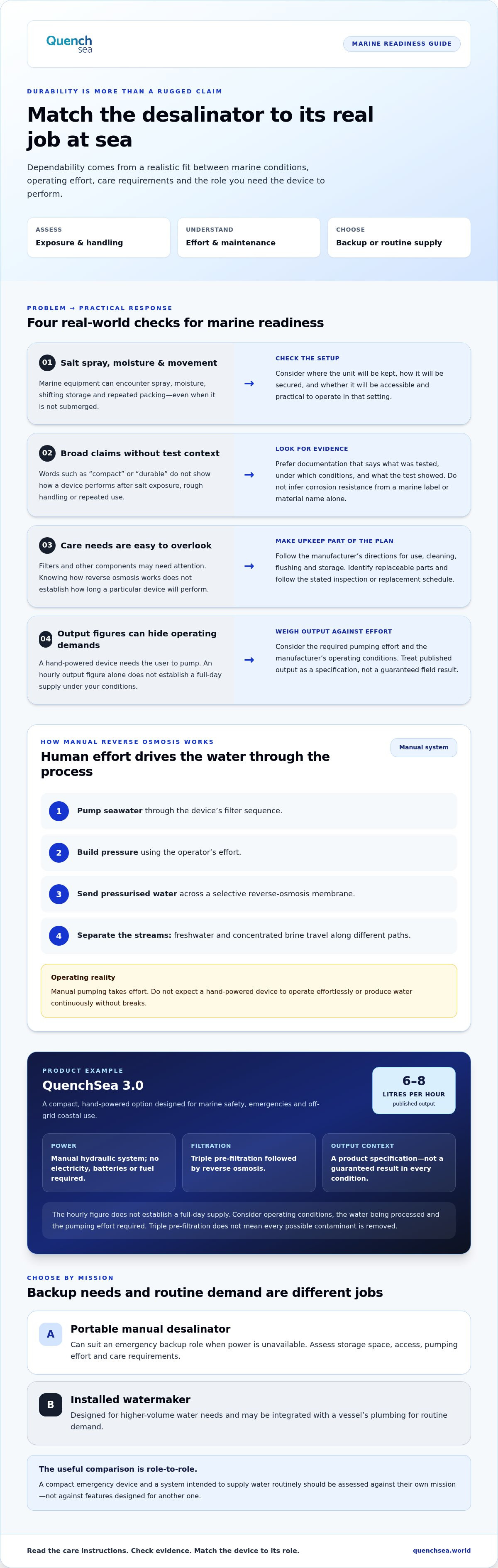
Product claims can help you compare devices, but they need context. QuenchSea 3.0 uses a manual hydraulic system, triple pre-filtration, and reverse osmosis, without requiring electricity, batteries, or fuel. Its published output is 6-8 litres per hour. Treat that as a product figure, not a guaranteed result in every condition, and consider whether a portable manual unit belongs in your onboard safety plan.
Key Takeaways
- Assess a durable manual marine water desalinator by how its operation, care requirements, and intended role match your conditions, not by rugged claims alone.
- Understand the reverse-osmosis process, including why manual pumping takes effort and how pre-filtration supports the system.
- Compare portable manual devices with installed watermakers to decide whether you need an emergency backup or higher-volume onboard production.
- Prepare the device for storage and inspection using a practical checklist, and follow its manufacturer’s operating and care instructions.
- Consider where QuenchSea 3.0, a portable, hand-powered option, fits into marine preparedness and off-grid coastal use.
What makes a manual marine water desalinator durable in real use?
A durable manual marine water desalinator continues to serve its intended role under expected conditions, can be cared for with realistic effort, and can be stored and handled appropriately. Durability doesn’t mean “indestructible.” A compact emergency device has a different job from a system designed to supply water continuously aboard a vessel.
That difference should guide your comparison. A portable unit may spend long periods in storage and be used when power is unavailable. A fixed watermaker may be integrated into a vessel’s plumbing and used to meet routine demand. Assess each against its intended role, not features designed for another mission. QuenchSea 3.0 is a compact, hand-powered option designed for marine safety, emergencies, and off-grid coastal use. Its design intent doesn’t establish a particular service life or guarantee performance in every environment.
Which marine conditions should buyers consider?
Salt spray and moisture can reach equipment even when it isn’t submerged. Movement may shift a device in storage or during handling, and repeated packing and unpacking can put stress on its components. Consider where the unit will be kept, how it will be secured, and whether it will be accessible and practical to operate in the intended setting.
Storage needs vary. A life raft has tight space limits; a tender may expose equipment to spray and movement; a yacht may offer protected storage; and a shore kit may be handled and stored differently. Don’t infer corrosion resistance from a marine label or a material name alone. Look for documentation describing the exposure tested and the result.
What does a durability claim actually tell you?
Separate stated construction, design intent, and demonstrated performance. A product page might describe a device as compact or durable, but those words alone don’t show how it performs after prolonged salt exposure, rough handling, or repeated use. More useful evidence identifies what was tested, under which conditions, and what the test showed.
The same distinction applies to the desalination mechanism. Reverse osmosis uses a membrane to separate water from dissolved substances, but knowing how the process works doesn’t show how long a particular device will perform. Operating instructions, care guidance, and replacement requirements help you understand what keeping it ready involves.
- Read the care instructions. Follow the manufacturer’s directions for use, cleaning, flushing, and storage. Don’t assume one device’s routine applies to another.
- Identify replaceable parts. Find out which components need inspection or replacement, and follow the stated schedule.
- Look for relevant test evidence. Prefer specific results to broad adjectives, and check whether the testing reflects your intended environment.
The word “durable” alone doesn’t establish service life. Suitability depends on documented performance, appropriate care, and a realistic match between the device and its marine role.
How manual reverse osmosis turns seawater into freshwater
A manual desalinator uses human effort to power the process. The operator pumps seawater through a sequence of filters, builds pressure, and sends the pressurised water to a reverse-osmosis membrane. The membrane separates some of the water from dissolved salts, sending freshwater and concentrated brine along separate paths through the device.
Reverse osmosis separates dissolved salts from water by applying pressure to seawater across a selective membrane. The principle is shared across reverse-osmosis systems, but a portable hand-powered device has its own design and operating limits. QuenchSea 3.0 uses a manual hydraulic system, triple pre-filtration, and reverse osmosis. These are product-specific details, not a description of every manual unit.
What role do pressure and pre-filtration play?
Pressure moves water through the membrane against its natural movement. In a manual unit, the user supplies the operating energy by pumping. That effort is part of the process, so don’t expect a hand-powered device to operate effortlessly or produce water continuously without breaks.
Pre-filtration comes first and helps reduce suspended material reaching the reverse-osmosis membrane. That makes filter condition and the manufacturer’s care instructions important. QuenchSea 3.0 has triple pre-filtration. This doesn’t mean the filters remove every possible contaminant, or that all manual desalinators have three filter stages.
For a general overview of reverse-osmosis systems, the EPA’s guidance on reverse-osmosis systems explains the technology and considerations for point-of-use systems. It provides useful background, but isn’t a test or performance assessment of a specific marine device.
What should buyers understand about output figures?
QuenchSea 3.0’s product page states an output of 6-8 litres per hour. Treat this as a published product specification, not a guaranteed result in the field. Suitability depends on the manufacturer’s stated operating conditions, the water being processed, and the user’s ability to maintain the required pumping effort.
An hourly figure doesn’t tell you how much water you’ll collect over a full day. Don’t convert it into a daily supply estimate unless there’s evidence that the unit can operate continuously at that rate under your conditions. When assessing a durable manual marine water desalinator, weigh the stated output against the effort required and the task you need it to perform.
For a product-specific example of a hand-powered system, explore the QuenchSea 3.0 desalination device and its stated process details.
Manual desalinator or installed marine watermaker: which fits your mission?
Choose equipment by its role rather than assuming one system can cover every need. A portable manual unit provides a power-independent option for emergencies or off-grid use. An installed powered watermaker is designed to integrate with the vessel and support regular onboard water production. Some crews may need both: one for routine supply and another as backup.
| Factor | Manual portable desalinator | Installed powered watermaker |
|---|---|---|
| Power dependence | Hand-powered; doesn’t rely on vessel electricity, batteries, or fuel. | Depends on the system’s power source and configuration. |
| Portability | Designed to be carried and stored as portable equipment. | Installed aboard and connected to vessel systems. |
| Intended role | Emergency preparedness, backup, or off-grid use. | Regular water production for onboard needs. |
| Operating effort | Requires the user to pump and manage the operating process. | Uses powered equipment, though the operator still manages system operation and care. |
| Integration needs | Portable use, with storage and operation guided by the manufacturer. | Requires a suitable installation and fit with the vessel’s power and plumbing arrangements. |
When does a manual unit make practical sense?
A manual unit may suit an emergency kit, life-raft plan, remote sailing, or off-grid coastal use, where vessel power or fuel may be limited. Because it operates without electricity, batteries, or fuel, it can provide another option when powered equipment isn’t available. But manual operation takes time and effort. Plan where you’ll use the device, and don’t assume its published output represents effortless or uninterrupted production.
QuenchSea 3.0 is a portable, hand-powered option designed for marine safety, emergencies, and off-grid coastal use. For more product-specific selection considerations, see the QuenchSea 3.0 buyer’s guide.
When is an installed watermaker the better fit?
If you need routine onboard water production, compare an installed system with your crew’s needs and the vessel’s capacity to accommodate it. Consider where it will fit and how its power supply and water connections will integrate with the boat. These requirements differ from those for a portable backup. A durable manual marine water desalinator can complement an installed system, but it isn’t a universal replacement.
For broader context on non-electric marine equipment and manual options, explore the guide to manual boat water makers. Choose according to your mission: routine supply, emergency resilience, or a layered plan that accounts for both.
How to assess a marine desalinator before relying on it
A device is useful only if it fits your plan and you can operate it in the conditions you expect. Distinguish the manufacturer’s instructions from your general preparedness steps: the instructions govern operation and care, while your plan determines where the unit is stored and who may need to use it. A durable manual marine water desalinator still needs to be understood, accessible, and suited to its assigned role.
What should a buyer check before deployment?
Read the supplied instructions before an emergency. Learn the operating sequence, setup requirements, care directions, and any stated replacement requirements. Don’t create a test or maintenance schedule that conflicts with the manufacturer’s guidance, or assume another model’s instructions apply.
- Define its role. Decide whether it’s a vessel backup, part of a life-raft plan, or equipment for off-grid use.
- Plan storage and access. Choose a location that suits the device’s instructions and allows the intended operator to reach it when needed.
- Review the parts and care guidance. Know what the instructions say to inspect, clean, flush, or replace, and keep required components accounted for.
- Consider the operating setting. Think through where the user can position the unit and manage its operation safely and practically.
These are general readiness prompts, not manufacturer-prescribed steps or intervals. For life-raft planning context, consult this guide to life-raft water supply.
How should buyers assess output and effort?
Start with the water task. Identify who needs drinking water, what role the desalinator will play, and whether another source is part of the plan. Don’t assume it will supply water for cooking, washing, or every onboard use. A manual emergency device and a routine vessel water system serve different needs.
QuenchSea 3.0’s product page states an output of 6-8 litres per hour. Treat this as a published specification, not a guaranteed result. Consider it alongside the stated operating guidance and the effort required from the person pumping. Don’t turn an hourly figure into a daily supply estimate unless the product documentation supports that use under relevant conditions.
Before relying on any unit, consider whether the intended operator can manage its manual process in the setting where it may be needed. If you’re assessing a portable option for marine preparedness, explore the QuenchSea 3.0 desalination device and its product information.
Why QuenchSea 3.0 is a portable manual option for marine preparedness
QuenchSea 3.0 is a portable, hand-powered desalinator designed for marine safety, emergencies, and off-grid coastal use. It operates without electricity, batteries, or fuel. That independence can matter when vessel power isn’t available, but you still need to plan for pumping effort, water needs, storage, and care.
Consider it as one layer in a preparedness plan, not a universal replacement for an installed watermaker. A compact manual option may suit backup needs, while regular onboard production calls for a system matched to the vessel’s ongoing requirements.
Which QuenchSea 3.0 features matter for marine use?
QuenchSea 3.0 uses a manual hydraulic system, triple pre-filtration, and reverse osmosis. Together, these describe its approach: the user powers the process, pre-filtration helps reduce suspended material reaching the membrane, and the membrane separates freshwater from seawater. Operating without electricity, batteries, or fuel is a practical feature for off-grid and emergency situations.
QuenchSea publishes an output figure of 6-8 litres per hour. Treat it as a stated product specification, not a guaranteed field result. Compare it with the device’s operating guidance and the effort required, and don’t assume it will meet every crew’s water needs. Product details describe the design; they don’t establish a universal result or guarantee safe water in every situation.
How can readers decide if it fits their preparedness plan?
Assess the device against your actual plan before assigning it a role. Consider who will operate it, where it will be stored, how it will be accessed, and whether it’s intended for emergency backup or off-grid water supply. Read the operating and care instructions so the person responsible understands the process before relying on the equipment. Keep those manufacturer directions distinct from your general preparedness arrangements.
- For emergency backup: Consider whether a portable, hand-powered device belongs in your vessel’s safety equipment and whether its operation suits the expected situation.
- For routine onboard production: Compare your ongoing water needs with the purpose and integration of an installed system. A manual device may complement it, but it isn’t automatically a substitute.
- For off-grid coastal use: Account for the required user effort and the product’s stated operating guidance as part of your water plan.
A durable manual marine water desalinator earns its place through a clear fit with its intended role, not through a broad claim alone. To review QuenchSea 3.0’s product and operating information, explore QuenchSea 3.0.
Make your preparedness plan practical
Give any desalinator a clear job before you need it. Decide who will operate it, where it will be kept, and what water need it is meant to support. Then use the manufacturer’s instructions to understand the operating process and care requirements. This preparation helps you plan around the equipment realistically.
A durable manual marine water desalinator should fit the people, storage space, and conditions on your vessel or in your emergency kit. If you need regular onboard water production, keep that need distinct from the role of a portable backup. That distinction helps set realistic expectations when choosing equipment.
Ready to assess a portable option for your setup? Explore the QuenchSea 3.0 manual desalination device and review its product and operating information as you shape your plan. Preparedness starts with a considered choice and a clear role for each piece of equipment.
Frequently Asked Questions
Is a manual marine water desalinator durable enough for regular use?
Durability depends on construction, care, storage, and intended duty. A durable manual marine water desalinator used periodically as emergency equipment has a different workload from a system expected to produce water routinely. With frequent use, filter care and replacement requirements become especially relevant. Follow the device’s instructions and look for documented testing. Don’t infer service life or a saltwater rating from the word “durable” alone.
Can a manual desalinator make seawater drinkable without electricity?
Yes. A hand-powered reverse-osmosis device can operate without electrical power. QuenchSea 3.0 requires no electricity, batteries, or fuel, so its operation doesn’t depend on those onboard supplies. However, power independence alone doesn’t establish the quality of water produced in every situation. Follow the product’s operating instructions and documented water-quality guidance. Don’t treat a general desalination claim as a guarantee for every source or condition.
How much water can a manual marine desalinator produce?
Output varies by device and operating conditions, so use the product’s stated figure as a starting point, not a promise. QuenchSea’s product page publishes a rate of 6-8 litres per hour. Review the product information for the conditions and qualifications behind that rate, then consider whether it suits the task, such as emergency drinking-water support. An hourly specification doesn’t guarantee daily production or account for continuous operating effort.
What is the difference between a manual desalinator and a boat watermaker?
A manual desalinator is portable and requires human effort, making it a possible choice for emergency backup or off-grid use. An installed boat watermaker is integrated with the vessel and serves its onboard water-production needs. Compare power requirements, storage or installation needs, and who must operate the system. A cruising boat with routine demand may need a different arrangement from a small craft carrying emergency equipment.
Do manual seawater desalinators remove salt and other contaminants?
Reverse osmosis uses pressure and a membrane to separate water from dissolved salts. A specific unit may also use pre-filtration, but that doesn’t mean it removes every contaminant. QuenchSea 3.0 uses triple pre-filtration and reverse osmosis; those process details aren’t proof of universal contaminant removal or guaranteed potability. Check the product’s documented water-quality guidance and follow its instructions for the water source and intended use.
What should I check before storing a desalinator for marine emergencies?
Read the product instructions, learn the operating sequence, and choose storage that lets the intended user access the device. Follow the manufacturer’s guidance for care, component replacement, and storage conditions; don’t assume a universal inspection interval or shelf life. For example, equipment packed deep beneath other gear may be difficult to retrieve in an emergency. Readiness depends on the device-specific instructions and whether your storage plan makes it practical to use.
Is a manual desalinator a substitute for a yacht’s installed watermaker?
Not in every case. The right role depends on the yacht’s water needs and the manual device’s intended use. A portable unit can provide an emergency or backup option, particularly if the installed system isn’t available, but pumping effort and stated output may not suit routine onboard demand. Assess the crew’s plan and distinguish regular water production from emergency preparedness. A manual device can complement an installed system rather than replace it.