

What if your primary watermaker fails halfway across an ocean? A blue water cruising backup watermaker can add resilience, but it shouldn’t be expected to replace the vessel’s main system. Stored water buys time; a manual unit offers another way to make freshwater when powered production stops.
Plan for that failure before departure. This guide covers how to build a practical water-contingency plan, compare stored reserves with backup production, and weigh output against manual effort, space, and weight. It also explains where QuenchSea 3.0 may fit: a portable, hand-lever-powered option that produces 6-8 L/hr in suitable conditions, with lower output possible in colder or saltier water.
Test produced water with a TDS meter before drinking. Do not assume filtered water is safe based on appearance alone - test a small amount first, and only drink when TDS reading is below 1 000 ppm. If the water tastes salty or unusual, do not drink it. The goal is a realistic backup plan, not false confidence.
Key Takeaways
- Build your blue water cruising backup watermaker plan around layers: stored drinking water, onboard production, and a contingency method.
- Compare backup systems by power dependence, space, production approach, and the effort required to operate them.
- Understand how manual reverse osmosis uses pre-filtration and a membrane to separate much of the salt from seawater.
- Before departure, plan reserves, review the pictorial instructions, and prepare to test produced water with a TDS meter.
- Assess whether QuenchSea 3.0’s hand-lever operation, 6-8 L/hr output, and 6 kg weight suit your vessel and backup needs.
Why Blue-Water Cruising Needs a Backup Watermaker Plan
Offshore, freshwater can become unavailable faster than expected. Stored reserves may run low, while a production system can stop working or become unusable if its power supply or components fail. On a blue-water cruising passage, there may be no quick way to replenish supplies. Plan for that uncertainty before departure rather than relying on a single system to remain available.
Separate essential drinking and cooking water from the vessel’s broader water plan. Estimate what the crew needs for drinking and food preparation, then consider other onboard uses independently. The reserve you need depends on crew size, passage length, storage capacity, and conditions that could delay arrival. Don’t count a watermaker’s rated production as water already available to the crew.
What can make an offshore water plan vulnerable?
A plan that depends on one production method has a single point of failure. Even a maintained primary watermaker can be affected by equipment problems, power interruption, or water conditions. Passage duration matters too: a short delay and a prolonged diversion place different demands on the same reserves.
Redundancy and stored freshwater solve different problems. A second production method adds another way to make water; stored water provides a supply that doesn’t depend on operating equipment. Plan for both where vessel capacity allows. Consider who can operate backup equipment, how often it may need to be used, and where it can be stowed without displacing other essential gear.
What should a backup watermaker contribute?
A backup watermaker is a contingency source, not necessarily a match for an installed system’s output. A compact manual device can help bridge a disruption, but it takes hands-on effort and time. QuenchSea 3.0 produces 6-8 L/hr in suitable conditions; colder or saltier water may reduce output. Account for that variability and the crew’s ability to operate the lever.
Use a TDS meter to test output, and drink only when the reading is below 1,000 ppm. Do not assume filtered water is safe based on appearance alone - test a small amount first, and only drink when TDS reading is below 1 000 ppm. If the water tastes salty or unusual, do not drink it.
Before departure, map your plan in layers: stored drinking and cooking reserves, the primary production system, and a separate backup option. Decide how the crew will access, operate, and test the backup if normal supply is disrupted. A manual unit supports resilience, but it isn’t a high-output primary system. For a wider view of emergency reserves, connect your passage plan with this life raft water supply guide.
How a Manual Backup Watermaker Produces Freshwater
A manual reverse-osmosis watermaker uses hand-applied pressure to push seawater through a membrane. The membrane separates much of the salt from the water, producing freshwater without a powered pump. In QuenchSea 3.0, seawater passes through fitted ceramic-and-stone and mesh pre-filters before reaching the industrial reverse-osmosis membrane. An optional ultrafiltration pre-filter is available separately for very murky or high-turbidity water. Pre-filtration prepares the feed water; it doesn’t replace testing the finished output.
This process makes a hand-powered unit a distinct option in a blue water cruising backup watermaker plan. QuenchSea 3.0 operates without batteries, fuel, solar panels, or external electricity. It isn’t automatic, though. The user must work the hand lever, so production depends on operating conditions and the crew’s ability to keep pumping.
What are the operating limits of a hand-powered desalinator?
QuenchSea 3.0 produces 6-8 L/hr in suitable conditions, not at a guaranteed rate in every sea or operating condition. Colder or saltier feed water may lower production. The maximum feed-water temperature is 45°C (113°F). Plan around the stated range and possible reduction rather than counting on the upper figure as a fixed supply.
Manual operation takes time and effort. Consider who can work the lever and when, alongside the crew’s other duties. A hand-powered unit isn’t a continuous, unattended source. It produces water through active operation when needed, rather than matching the convenience or high output of a vessel’s primary watermaker.
The device runs on its hand lever only. Independence from external power can matter if onboard electricity or fuel is unavailable, but it doesn’t remove the need for hands-on operation. Pictorial instructions are included to support operation without reading. Keep them accessible and use them to guide operation and care.
How should crews assess the output water?
The output is designed to stay below 1,000 ppm TDS. In suitable conditions, typical output is 400-500 ppm, but readings can vary. Test the water with a TDS meter or TDS pen, and drink it only when the reading is below 1,000 ppm. Appearance and taste alone can’t establish that it’s safe.
If the water tastes salty or unusual, do not drink it.
Membrane compatibility matters for maintenance and replacement: These RO membranes only work with QuenchSea version 3.0. For a closer look at the manual desalination device and its operating approach, see the QuenchSea 3.0 desalination device.
Manual, Installed, or Stored: Compare Blue-Water Backup Options
A robust backup plan uses different layers, not just a second version of the same system. Stored freshwater is ready to use without producing anything. An installed watermaker can generate more water during normal operation, but depends on its equipment and power source. A hand-powered desalinator offers another production method, with output limited by operating conditions and crew effort.
| Option | Power dependence | Production approach | Space and effort |
|---|---|---|---|
| Stored freshwater | None to access stored water | Immediate reserve, limited to the quantity carried | Requires tank or stowage capacity; no production effort |
| Secondary installed system | Depends on its design and power source | Produces water through a separate installed system | Needs installation space and operation; workload depends on the system |
| Hand-powered desalinator | No external power for QuenchSea 3.0 | Produces freshwater through manual operation | Portable, but requires stowage and a crew member to operate it |
Stored water and production equipment cover different risks. Reserves provide water immediately, but only until the carried supply runs down. A production device can replenish supply only if it operates successfully and someone can run it. Equipment redundancy doesn’t replace adequate stored freshwater, and storage alone may not provide the same ongoing production potential.
When does a hand-powered backup make sense?
A hand-powered backup can suit a contingency plan where independence from external power and portability matter. Its value is another production option, not meeting routine, high-volume demand without effort. QuenchSea 3.0 produces 6-8 L/hr in suitable conditions, with lower output possible in colder or saltier water. For a wider marine comparison, explore manual boat water makers.
What trade-offs should a crew compare?
Start with the vessel. How much room can you dedicate to stored reserves, installed equipment, or a portable unit? Then weigh expected production against crew size, passage needs, and who can take on manual operation. A portable device still takes up space, and its water output isn’t automatic. The right mix depends on the vessel’s layout and passage plan.
The main limitation is clear: manual output is limited compared with a high-output primary system. Treat a hand-powered device as a complement, not a replacement for primary capacity. A practical blue water cruising backup watermaker decision weighs the consequences of losing production against available storage, alternative systems, and the crew’s ability to operate the backup. No single arrangement fits every boat.
Build a Practical Backup Watermaker Checklist Before Departure
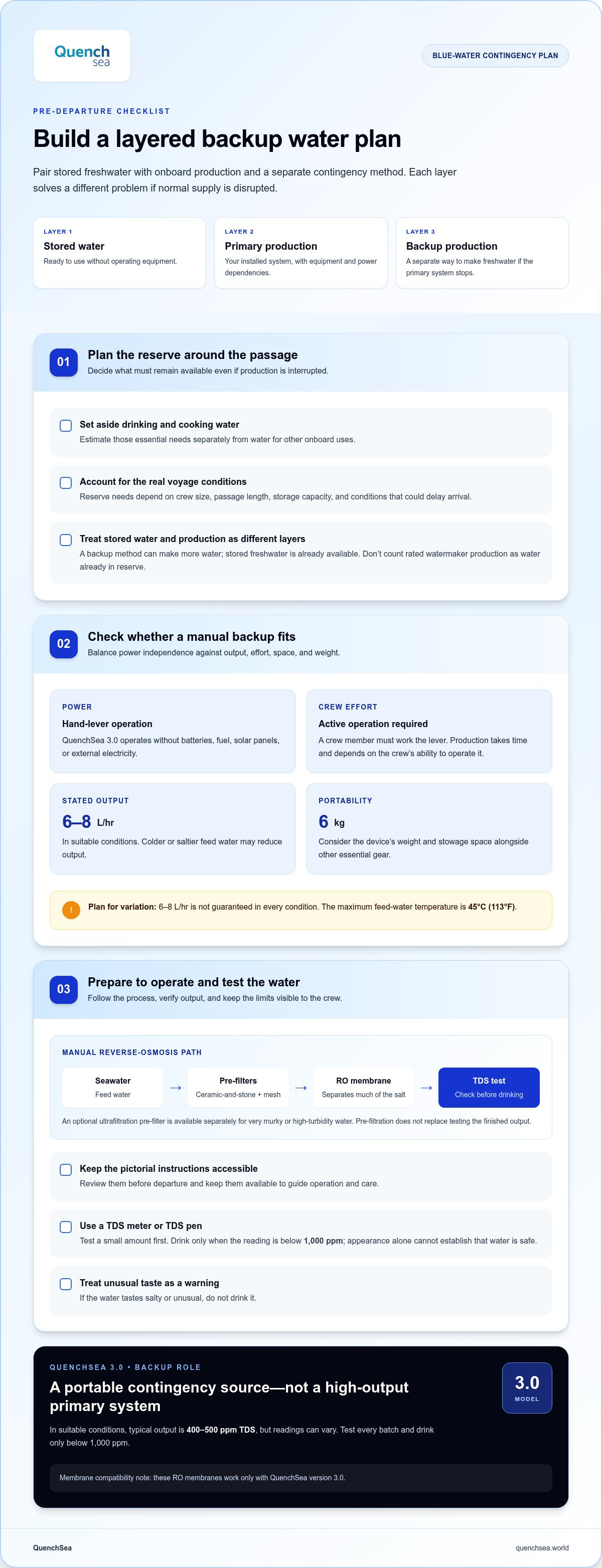
A backup device helps only if the crew can find it, operate it, and assess its output. Use this pre-departure sequence to make your blue water cruising backup watermaker part of a planned contingency, not unfamiliar gear brought out for the first time offshore.
- Set the water plan. Record the crew’s drinking and cooking reserves, primary production method, and backup option. Decide who can operate the manual device and how its output would fit into the plan if normal production stops.
- Inventory the equipment. Confirm the device and its fitted filters are present, and keep a compatible QuenchSea 3.0 RO membrane with the equipment if you carry a spare. These RO membranes only work with QuenchSea version 3.0. Keep a TDS meter or TDS pen with the unit so it’s ready to test output.
- Check storage and access. The unit weighs 6 kg. Choose a stowage location that accounts for its weight and lets the crew retrieve it without shifting critical equipment. Make sure the person expected to operate it knows where it is kept.
- Review operation and care. Read the supplied pictorial instructions before departure, then keep them with the device. Use them to guide operation and care rather than relying on memory or assumptions. Brief the crew on hand-lever operation and the need for active effort.
- Match filtration to the water. Confirm the fitted ceramic-and-stone and mesh pre-filters are ready for use. The optional ultrafiltration pre-filter is sold separately and is intended only for very murky or high-turbidity water. It isn’t a routine add-on for every source.
- Practise output testing. Make sure the crew can use a TDS meter or TDS pen to assess produced water. Drink output only when the reading is below 1,000 ppm. The device is designed to stay below that threshold, but readings can vary with conditions.
How should crews verify water before drinking?
Test each batch with a TDS meter or TDS pen. Don’t use clear appearance or familiar taste as a safety test; neither replaces a reading. If the crew can’t test the output, don’t treat it as verified drinking water.
If the water tastes salty or unusual, do not drink it.
Make the checklist part of the crew’s departure briefing, then keep the testing tool and instructions accessible with the device. Explore the QuenchSea 3.0 desalination device as you prepare your backup equipment.
Where QuenchSea 3.0 Fits in a Blue-Water Backup Plan
QuenchSea 3.0 is a portable contingency option, not a replacement for a yacht’s primary watermaker. It offers another way to produce freshwater if normal supply is disrupted, but a crew member must operate the hand lever. Its output is 6-8 L/hr in suitable conditions and may be lower in colder or saltier water. The device weighs 6 kg, so include its stowage needs and the time and effort of manual operation in your passage plan.
Power independence is one practical consideration: QuenchSea 3.0 uses its hand lever only, with no batteries, fuel, solar panels, or external electricity. That makes it a distinct layer in a blue water cruising backup watermaker plan, not an effortless or high-output source. Keep stored freshwater and primary production in the plan, and assess the manual device according to the crew’s realistic capacity to use it.
Which confirmed features matter for offshore backup use?
The portable reverse-osmosis device uses fitted ceramic-and-stone and mesh pre-filters before the RO membrane. An ultrafiltration pre-filter is optional, sold separately, and intended only for very murky or high-turbidity water. QuenchSea 3.0 has a 3-month limited warranty.
QuenchSea also makes a one-for-one donation pledge toward delivering 100 million devices by 2035. For sailors comparing product details, the QuenchSea 3.0 portable desalination buyer’s guide offers a closer look at the device.
How can sailors take the next step?
Assess the specifications against your vessel: available storage space, reserve water, crew size, and who could operate the lever if the primary system were unavailable. Account for the stated output range rather than treating 8 L/hr as guaranteed. Colder or saltier feed water can reduce production, and each batch must be tested with a TDS meter or TDS pen. Drink only when the reading is below 1,000 ppm. The output is designed to stay below that level; typical readings are 400-500 ppm in suitable conditions, but test rather than assume.
If the water tastes salty or unusual, do not drink it.
Review the product details and specifications, then compare them with your backup plan. If the fit makes sense for your vessel, Explore QuenchSea 3.0.
Make Your Backup Plan Ready Before Departure
A dependable blue water cruising backup watermaker plan is more than equipment aboard. It’s a decision the crew has discussed, a device they can access, and a clear process for checking water before drinking. Use your next passage-preparation session to review who will take responsibility and how the backup fits the vessel’s wider contingency plan.
QuenchSea 3.0 has undergone Applus-certified independent inspection, certification, and testing. Its hand-lever design avoids dependence on batteries, fuel, solar panels, or external electricity, while still requiring a crew member to operate it. The brand also makes a one-for-one donation pledge toward delivering 100 million devices by 2035. Consider whether the device’s role and operating demands suit your boat.
Review the specifications, consider your crew’s practical needs, and decide whether this manual option belongs in your onboard plan. Explore QuenchSea 3.0, then set out with a contingency plan your crew understands and can put into practice.
Frequently Asked Questions
Is a manual watermaker a reliable backup for blue-water cruising?
It can provide a useful contingency source, but no manual device should be treated as a guaranteed supply. Its value is greatest when the crew understands how to operate it, can set aside time and effort to use it, and carries stored water as another layer. Before departure, practise the process and keep the testing tool accessible. That makes a blue water cruising backup watermaker part of a prepared plan, not an untested assumption.
Can a manual backup watermaker replace an installed yacht watermaker?
No. QuenchSea 3.0 is a portable backup, not a replacement for an installed system designed to meet routine onboard demand. Its manual output requires a person to operate the lever, so production also depends on crew availability. For example, consider whether someone could operate it while other crew members handle watch duties. Keep primary production and stored reserves in your plan rather than relying on the manual unit alone.
How much freshwater should a blue-water crew carry for a passage?
There isn’t one suitable amount for every crew or route. Estimate drinking and cooking needs using your crew’s actual habits, then account for passage length, storage capacity, and possible delays. Decide what reserve you want available if production stops, and keep essential drinking water distinct from water intended for other onboard uses. Don’t count backup-device output as guaranteed supply when setting your minimum reserve.
What should I do if a TDS meter reads 1,000 ppm or higher?
Don’t drink that batch. Only drink produced water when a TDS meter or TDS pen reads below 1,000 ppm. Check that you’re using the tester according to its instructions, then test again. Until the reading is below the threshold, treat the water as unsuitable for drinking. If the water tastes salty or unusual, do not drink it.
Can QuenchSea 3.0 operate without batteries, fuel, or electricity?
Yes. QuenchSea 3.0 is powered by its hand lever only, so it uses no batteries, fuel, solar panels, or external electricity. That can be useful if a vessel’s power supply is unavailable, but the unit still needs active operation by a crew member. Include the person-power requirement in your contingency plan, and keep the pictorial instructions with the device for reference.
How should a QuenchSea 3.0 RO membrane be stored between passages?
Follow the supplied pictorial instructions for membrane care and storage. Keep the instructions with the device and follow them when preparing the unit between passages. Remember the compatibility limit: These RO membranes only work with QuenchSea version 3.0.
Does QuenchSea 3.0 include an ultrafiltration pre-filter?
No. The ultrafiltration pre-filter is optional, sold separately, and intended only for very murky or high-turbidity water. QuenchSea 3.0 has fitted ceramic-and-stone and mesh pre-filters, so don’t treat the optional ultrafiltration filter as standard equipment. Consider whether your expected source water is especially turbid, and use the supplied instructions for the correct setup. Regardless of filtration, test output with a TDS meter before drinking.