

Can you make seawater drinkable without electricity? Yes, but “no power” doesn’t mean “no energy.” Seawater desalination without power can use human effort to drive reverse osmosis or sunlight to evaporate and condense water. These methods work differently, and neither should be confused with an off-grid electric system that still depends on batteries, panels, or another power source.
A compact, dependable option can be useful in an emergency or remote coastal setting. But a small device may not produce enough water for every need, while passive solar methods depend on suitable conditions and take time. The energy source, effort required, and realistic water needs all matter.
This guide compares manual desalination, solar-thermal distillation, and off-grid electric systems, including their practical limits. You’ll learn what to consider for a life raft, yacht, emergency kit, or off-grid coastal site, and how a hand-powered reverse-osmosis device such as QuenchSea 3.0 fits when electricity, batteries, and fuel aren’t available.
Key Takeaways
- Identify the energy source behind a desalination method before deciding whether it truly works without electricity.
- Compare solar stills, solar-powered reverse osmosis, and manual reverse osmosis by their operating conditions and effort requirements.
- Match your method to local daylight, portability needs, and the amount of water you may need.
- Plan how you’ll select a source, operate the device, and safely store the water.
- Understand how seawater desalination without power can use hand-powered reverse osmosis, including the role of QuenchSea 3.0.
What Does Seawater Desalination Without Power Actually Mean?
Desalination separates dissolved salts from seawater to produce freshwater. The phrase “without power” can describe very different systems. One may operate independently of the electrical grid but still use electricity from solar panels. Another may use sunlight as heat, while a manual device relies on a person’s effort. To compare methods accurately, identify the energy source and how the system uses it.
Electricity-free desalination uses no grid electricity, batteries, or fuel, but it still needs an energy input, such as sunlight as heat or human effort to create pressure. The distinction matters in an emergency: a device can be off-grid yet still depend on electrical components and a reliable source of power.
Off-grid desalination versus desalination without electricity
“Off-grid” means a system doesn’t rely on a connection to the utility grid. It doesn’t mean the system uses no electricity. Photovoltaic panels can generate electricity to run a pump, including in a setup without battery storage. By contrast, a solar still uses sunlight as heat, and manual pumping uses a person’s effort to create pressure for reverse osmosis.
Generation and storage are separate considerations. A battery stores electricity for later use, while a solar panel generates it. A battery-free system may still use electricity while sunlight is available. Solar-thermal distillation and hand-powered desalination don’t require electricity for their core processes.
Why seawater needs desalination before drinking
Clear-looking water isn’t necessarily fresh water. A basic filter can trap visible particles, such as sediment, but dissolved salt passes through many ordinary filters. Desalination targets dissolved salts; filtration addresses particles and other contaminants, depending on the filter. They solve different water-quality problems, and one shouldn’t be assumed to replace the other.
Removing debris from seawater doesn’t make it safe to drink. Consuming seawater can worsen dehydration, a risk explored in a guide to why drinking seawater is dangerous. Choose a method designed to desalinate seawater, then follow its operating instructions and applicable water-quality guidance.
The main categories are easier to distinguish by what drives the process:
- Solar-electric: Photovoltaic panels convert sunlight into electricity for equipment. This can operate off-grid, but it isn’t electricity-free.
- Solar-thermal: Sunlight supplies heat to evaporate water, and condensation is collected separately from much of the salt. A Solar Still is one example.
- Human-powered: Manual pumping supplies the effort needed to create pressure for reverse osmosis, without electricity, batteries, or fuel.
In short, “off-grid” describes a system’s relationship to infrastructure, while “electricity-free” describes how it operates. For seawater desalination without power, consider whether the available energy source, operating conditions, and human effort suit the situation.
How Solar, Thermal, and Hand-Powered Desalination Work
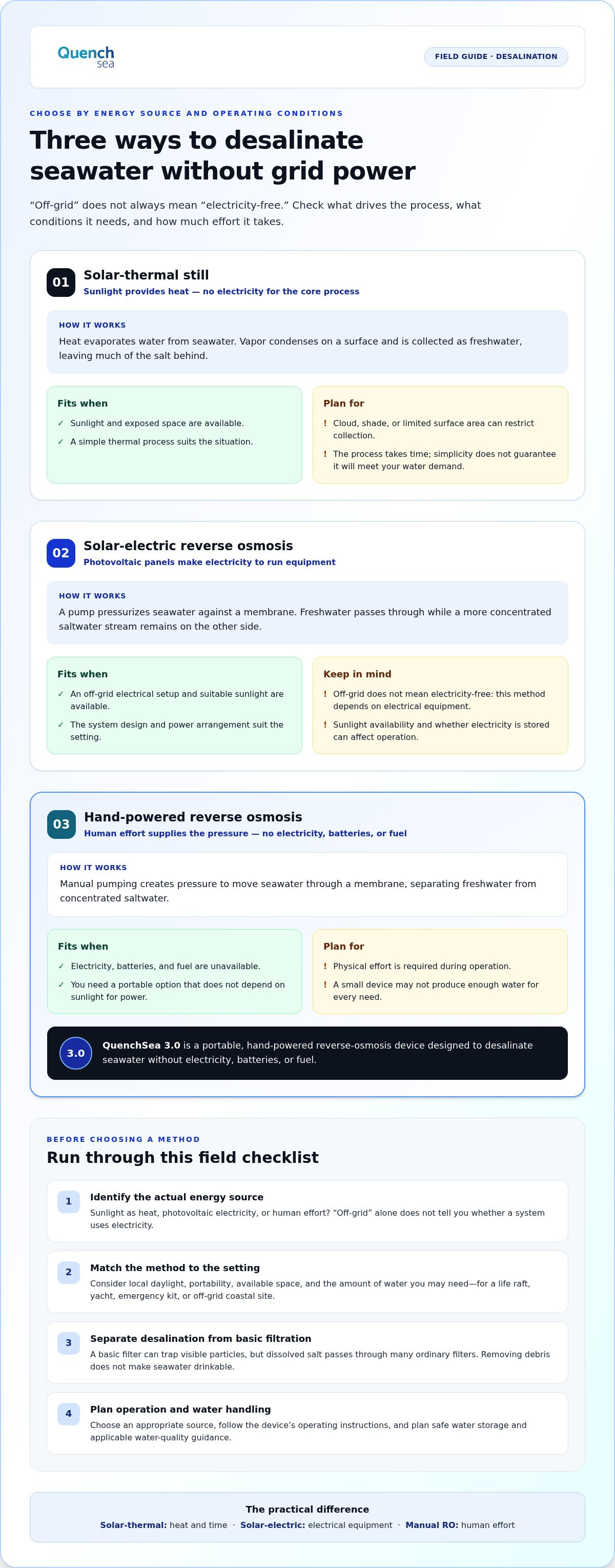
Each method separates salt from seawater, but the process and energy input differ. A solar still uses heat to evaporate water and collect condensation. Solar-powered reverse osmosis uses photovoltaic electricity to run equipment that pressurizes seawater. Manual reverse osmosis relies on human effort to create that pressure. These differences affect where a system can operate, how portable it is, and what it demands from the user.
A solar still uses sunlight and trades portability and speed for a simple thermal process. Solar-electric reverse osmosis uses photovoltaic power and depends on electrical equipment. Hand-powered reverse osmosis uses operator effort to produce pressure without electricity.
Solar stills and solar-thermal desalination
A solar still captures sunlight as heat. The heat evaporates water from seawater, leaving much of the salt behind. Vapor then condenses on a surface and is collected as freshwater. The process is straightforward, but it depends on sunlight, weather, and enough exposed surface to collect the water. Cloud, shade, or limited space can restrict its usefulness. A still may be simple to set up, but that doesn’t mean it will meet a particular water demand.
Research systems may use specialized materials or designs to change how they absorb heat, cool surfaces, or handle leftover salt. Reported results apply to the conditions and configuration tested. They shouldn’t be treated as guaranteed performance for every solar still or as proof that a system is ready for field use.
Solar-electric systems and hand-powered reverse osmosis
Photovoltaic panels convert sunlight into electricity, which can drive pumps and other equipment in a reverse-osmosis system. The pump pushes seawater against a membrane. Freshwater passes through, while a more concentrated saltwater stream remains on the other side. This approach can operate without a grid connection, but it still relies on electricity. Sunlight availability, system design, and whether power is stored can all affect operation.
Manual reverse osmosis uses the same broad separation principle, but the energy comes from the operator. Pumping creates pressure that moves water through a membrane and separates freshwater from concentrated saltwater. QuenchSea 3.0 is a portable hand-powered device designed to do this without electricity, batteries, or fuel. It doesn’t depend on sunlight for power, but it does require physical effort during operation.
These options aren’t interchangeable. Solar-electric systems depend on an electrical setup and suitable power input. A solar still needs heat, collection area, and workable conditions. A manual device demands hands-on pumping. Portability also depends on the complete setup, not just the desalination mechanism. Panels and supporting equipment can make a solar-electric system less compact, while a still needs room to collect sunlight and condensate.
For a field kit without grid access, batteries, or fuel, a hand-powered desalination device is one way to use reverse osmosis without an electrical supply. Compare options by starting with the energy you can reliably provide, then weighing space, weather exposure, and operator effort.
Which No-Power Desalination Method Fits Your Situation?
Choose a method by matching it to the energy, space, weather, and effort you can count on. A solar approach can reduce reliance on fuel, but it needs sunlight and a suitable setup. A manual option works without an electrical supply, but the operator must provide the effort. For seawater desalination without power, the best fit depends on the conditions it needs to handle, not just its label.
- Solar still: Uses direct sunlight as heat. It needs an exposed area and workable weather, and production depends on operating conditions. Its simple process may suit a fixed, sunny location better than a compact emergency kit.
- Solar-electric desalination: Uses photovoltaic panels to generate electricity for desalination equipment. It can operate off-grid, but depends on sunlight and the equipment’s power requirements. Panels and supporting components affect portability and setup needs.
- Hand-powered reverse osmosis: Uses operator effort to create pressure. It doesn’t need grid power, batteries, or fuel, but requires hands-on operation. A portable device such as QuenchSea 3.0 may suit marine or emergency use where those energy sources aren’t available.
These are operating distinctions, not production guarantees. Actual water output depends on the specific system and its operating conditions. Consider what the method requires over time, not only whether it can start operating in your setting.
Choosing for a boat, life raft, or coastal emergency
For a boat or emergency kit, prioritize compactness, independent operation, and a process the user can carry out under pressure. A solar setup needs usable sunlight and space for its components. A still also needs an appropriate collection area. A manual device avoids dependence on sunlight, batteries, and fuel, but requires someone to operate it. Include water supply in broader life-raft preparedness, alongside storage and other essential supplies.
Be realistic about available room and who may need to operate the equipment. A method with a clear, repeatable process is easier to plan around than one whose operation or energy supply doesn’t match conditions on board.
Choosing for an off-grid site or community
For a remote site, start with demand and continuity: how much water is needed, how often, and what infrastructure can support the method? Sustained sunlight and an appropriate installation area may make a solar approach worth considering, with retailers such as MacSell Solar Outlet providing the specialized hardware needed to power stationary off-grid systems. A personal manual device serves a different role from a system intended to supply a community. It depends on an operator and shouldn’t be treated as a substitute for infrastructure designed around ongoing group demand.
Research from MIT and the University of Rochester illustrates that solar desalination includes developing approaches as well as established concepts. Research findings describe particular systems and test conditions, not universal performance. Use them as context, then assess your site’s needs, space, energy source, and operating conditions.
How to Plan for Safe Seawater Desalination in the Field
Desalination addresses salt, but it doesn’t automatically make every water source safe. A seawater intake near fuel spills, industrial discharge, or other chemical pollution may contain hazards that a desalination device isn’t designed to remove. Treat source selection, correct operation, and clean storage as parts of one plan.
Desalination removes salt; it doesn’t guarantee universal purification or removal of every chemical and contaminant. Follow the specific device instructions and relevant water-quality guidance for the intended use. Don’t assume clear-looking water is safe, or use untreated seawater as a substitute for a verified drinking-water source.
Use this sequence before relying on a field setup:
- Assess the source. Look for visible contamination and consider the location. Avoid water that may be affected by fuel, chemicals, or other pollution. Don’t assume a desalination device will address those hazards.
- Check the conditions. Consider weather, available sunlight or human effort, space, and the amount of water needed. These factors can affect whether a method is practical and how consistently it can operate.
- Select and operate the method. Match the device to the source and conditions, then follow its specific instructions. Don’t improvise operating steps or assume different methods have the same limits.
- Collect and store carefully. Use clean containers intended for drinking water, keep treated water separate from untreated seawater, and follow guidance for safe storage.
Assess the water source and operating conditions
Start with the water you can access, not the device you already own. A clean-looking stretch of coast can still be affected by pollution that isn’t visible. If you suspect fuel or chemical contamination, choose another source rather than assuming desalination will make it safe. Then consider whether sunlight, working space, and operator effort will be available throughout use. In an emergency, keep verified drinking water available when possible instead of treating untreated seawater as a safe fallback.
Build redundancy into emergency water planning
Make desalination one layer of preparedness, not the entire plan. Store drinking water in clean, suitable containers and consider a backup approach that fits the setting. On a boat, account for storage space, weather, and who can operate the equipment. Broader marine planning should also consider emergency drinking water at sea, rather than relying on a single device or water source.
For seawater desalination without power, practice the process before an emergency if the device instructions allow it. Familiarity helps you understand the steps, effort, and storage routine in advance. Keep the instructions accessible, and base expectations on the specific device and actual operating conditions, not a general claim about desalination.
If hand-powered desalination fits your field plan, explore the QuenchSea 3.0 desalination device, a portable reverse-osmosis option that operates without electricity, batteries, or fuel.
QuenchSea 3.0: Hand-Powered Seawater Desalination Without Electricity
QuenchSea 3.0 is a portable, hand-powered reverse-osmosis device designed to convert seawater into drinking water. It requires no electricity, batteries, or fuel. Instead, the operator supplies the effort that drives the process. That makes it different from solar-electric desalination, which may work off-grid but still uses electricity.
The device is designed for marine safety, life rafts, yachts, emergency preparedness, disaster relief, defence, and off-grid coastal use. In these settings, electrical infrastructure or a dependable source of stored power may not be available. Manual operation offers another way to power reverse osmosis, though it still requires a person to operate the device.
What manual reverse osmosis offers in a power outage
Reverse osmosis uses pressure to move water through a membrane, separating freshwater from concentrated saltwater. In a hand-powered system, pumping supplies that pressure. QuenchSea 3.0 uses this approach without relying on a grid connection, photovoltaic panels, batteries, or fuel. It can suit situations where those energy sources are unavailable, such as a life raft or remote coastal setting.
Manual operation is a trade-off, not a promise of effortless supply. Follow the device instructions and account for the hands-on work involved. Actual water production depends on the system and operating conditions, so don’t assume a portable unit alone will cover everyone’s full water needs. Treat it as one element of a broader plan, alongside stored drinking water and appropriate containers.
Before selecting a desalination method, consider where you’ll use it, who may need to operate it, and how it fits your water plan. For a boat, think about marine readiness and the possibility that power sources or conditions could change. For an off-grid coastal location, consider the intended use and whether manual operation fits the need. Clear expectations matter as much as the energy source.
Where to learn more and plan your next step
For a product-focused evaluation, compare the device’s features with the demands of your setting. Review its operating instructions and consider how you’ll store treated water and maintain a backup supply. A hand-powered reverse-osmosis device can fit a preparedness plan that needs an option independent of electricity, batteries, and fuel. It doesn’t replace the need to match water requirements to the method’s practical limits.
If you’re assessing seawater desalination without power for marine or emergency use, consider whether manual operation suits your circumstances. Explore the QuenchSea 3.0 desalination device as one option for a power-independent water plan.
Make Your Water Plan Ready for Real Conditions
Make your choice part of a practical plan. Think through where you’ll use it, who will operate it, how you’ll store drinking water, and what you’ll rely on if conditions change. A seawater desalination without power option is most useful when it fits real constraints, not just an ideal scenario.
If your plan includes marine safety, emergency preparedness, disaster relief, or off-grid coastal use, consider whether hand-powered reverse osmosis belongs in your preparedness setup. QuenchSea 3.0 is designed to desalinate seawater without electricity, batteries, or fuel. Consider how it fits your setting and broader water plan before you need it.
Explore QuenchSea 3.0 and take a practical next step toward a more prepared water plan.
Frequently Asked Questions
Can a portable desalination device remove fuel or oil from seawater?
Don’t assume it can. A desalination device is designed for a specific treatment process, and that doesn’t guarantee removal of fuel, oil, or other chemical pollutants. If the water has a sheen, an unusual smell, or is near a known spill, don’t use it as a drinking-water source. Choose water from a safer source and follow local emergency guidance if contamination is suspected.
Does reverse osmosis remove bacteria and viruses from seawater?
A reverse-osmosis membrane can act as a barrier to some microorganisms, but you shouldn’t assume every device removes or inactivates all bacteria and viruses. Performance depends on the system, membrane condition, and correct operation. Follow the device instructions and relevant drinking-water guidance, especially if the water will be used during an outbreak or where contamination is suspected. Don’t treat membrane filtration as a substitute for validated disinfection when guidance calls for it.
Can you use a seawater desalination device with freshwater?
Only if the device instructions say it can process freshwater. A desalination system is designed around seawater and its salt content; freshwater may behave differently and could affect operation or the result. Don’t run a device with a different source just because it looks clean or seems less demanding. Follow the manual’s instructions for approved feedwater and setup. If freshwater is already safe to drink, use it directly rather than processing it unnecessarily.
How should you store water produced by a desalination device?
Collect treated water in a clean, food-safe container with a secure lid. Keep it separate from seawater and any containers used for untreated water, and avoid touching the inside of the container or cap. Label the container if there’s a chance it could be confused with untreated water. Follow the device instructions and local water-storage guidance for cleaning, storage conditions, and how long to keep the water.
Can a hand-powered desalination device replace stored emergency water?
No. Treat it as a backup capability, not a replacement for stored drinking water. The device requires time, effort, suitable seawater, and correct operation, and circumstances may prevent its use. Rough conditions or an injury, for example, could make manual operation difficult. Build a water plan around your likely needs, keep a stored reserve where practical, and include a backup option suited to the setting.
What should you do if desalination equipment stops working during an emergency?
Stop operating it and follow the device’s troubleshooting instructions. Don’t force a jammed component or drink water if the system’s operation or output is uncertain. Switch to stored drinking water or another safe, verified source while you assess the situation. If you can’t restore operation using the approved steps, preserve your remaining supplies and follow emergency instructions from the relevant marine or local response authority.