

When an electrical blackout strikes offshore, your ditch bag shouldn't demand punishing physical labor or an astronomical equipment budget just to keep you alive. For decades, voyagers treated legacy military hand pumps as the only dependable standard. Today, securing a high-performing Katadyn Survivor 35 alternative is no longer just a cost-saving measure; it's a vital upgrade in physical stamina and gear readiness.
You already know that non-electric reverse osmosis is mandatory when onboard power systems drop offline. Yet nobody wants to pump against brutal membrane resistance for hours just to harvest a single liter of freshwater while battling dehydration. You need marine-grade durability that won't seize or foul after months sealed inside a survival locker. In this breakdown, you'll discover the most reliable, cost-effective manual reverse osmosis alternatives to the Katadyn Survivor 35 engineered for offshore safety kits. We compare verified hourly flow rates, mechanical leverage, and salt-rejection performance so you can protect your crew without draining critical energy reserves.
Key Takeaways
- Balance mechanical output with human exertion by understanding how emergency reverse osmosis overcomes massive osmotic pressure without draining user energy.
- Identify the essential criteria for choosing a modern Katadyn Survivor 35 alternative that delivers marine-grade durability and high hourly flow rates.
- Master ditch bag water staging by combining immediate packaged rations with manual desalinators to meet updated offshore survival guidelines.
- Explore how upgraded mechanical leverage and multi-stage filtration protect hand-powered desalinators from fouling while stored inside life rafts.
Why Offshore Sailors Seek a Katadyn Survivor 35 Alternative
Offshore survival kits require absolute dependability. When an unexpected hull breach, fire, or catastrophic electrical failure forces you into a life raft, passive survival strategies quickly collapse. Bluewater voyagers understand that fresh water dictates operational survival time. Historically, mariners turned to a single mechanical standard to meet this life-or-death demand. Today, practical economics and evolving marine safety practices make finding a dependable Katadyn Survivor 35 alternative an urgent priority for bluewater crews.
The Legacy of the Survivor 35 in Marine Survival
Originally developed as the PUR Survivor for military aviators and naval life rafts, this hand-pumped system transformed survival protocols. It proved that a compact, manual watermaker could replace inefficient, failure-prone solar stills in open ocean swells. By converting high-pressure reverse osmosis into a human-powered package, it set the benchmark for maritime ditch kits. Decades of market dominance, however, led to stagnation. Pumping ergonomics remained largely frozen in time, forcing dehydrated survivors to endure punishing, inefficient arm strokes to produce barely enough water to sustain life.
Common Pain Points with Legacy Emergency Desalinators
Decades of field experience have exposed clear operational vulnerabilities in legacy manual units:
- Prohibitive ongoing upkeep: Membrane preservation and replacement seal kits carry steep recurring costs, discouraging crews from running regular functional drills before ocean passages.
- Supply chain friction: Sourcing authentic proprietary components in remote cruising hubs or isolated island chains presents massive logistical headaches.
- Overly complex field maintenance: Intricate internal valve stacks require specialized disassembly tools. Rebuilding a jammed valve inside a violent, pitching raft risks losing tiny spring components overboard.
- High acquisition barriers: Severe retail markups force many sailors to take reckless gambles on expired rations or uninspected second-hand pumps.
The Shifting Landscape of Emergency Ocean Desalination
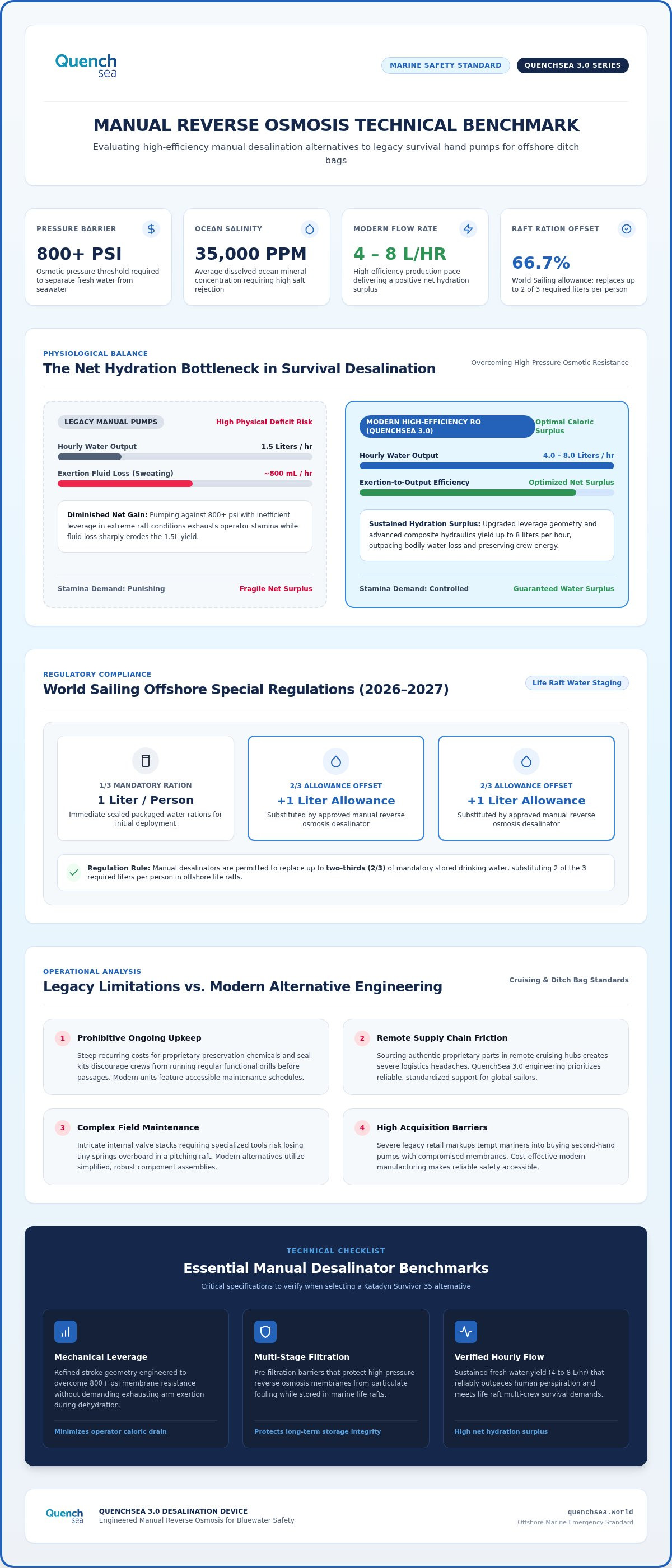
Vessel safety doctrines no longer accept these compromises. The 2026-2027 World Sailing Offshore Special Regulations actively reflect this technical evolution. Under these updated standards, race organizers and safety officials now permit manual desalinators to substitute for up to two-thirds of the mandatory stored drinking water in life rafts, allowing a reliable manual device to replace two of the three required liters per person. Modern composite engineering and refined leverage geometry make non-electric reverse osmosis vastly more accessible and physically efficient. Sailors reviewing our life raft water supply guide know that an effective Katadyn Survivor 35 alternative must deliver marine-grade durability, straightforward maintenance, and sustained hourly volume without exhausting the operator.
Technical Benchmarks for Manual Reverse Osmosis Desalinators
Generating potable water from raw seawater demands extreme mechanical force. Operating a high-pressure manual membrane requires overcoming osmotic pressures exceeding 800 pounds per square inch (psi). When evaluating any Katadyn Survivor 35 alternative, you cannot treat output figures as simple lab numbers. You must assess the rigorous physics of human-powered membrane separation under extreme offshore conditions.
Freshwater Production Rate and Caloric Expenditure
A survival watermaker must generate a substantial net hydration surplus. The scientific mechanics behind the desalination process dictate that forcing water through a semi-permeable membrane demands high, continuous physical energy. Pumping against 800+ psi in a sweltering life raft causes sweating, burning critical body water and calories. If a sluggish pump yields just 1.5 liters per hour but causes you to sweat out 800 milliliters in the process, your real net gain shrinks drastically. High-efficiency survival watermakers solve this physiological bottleneck by producing between 4 and 8 liters per hour, ensuring your actual water yield easily outpaces fluid loss from exertion.
Salt Rejection and Membrane Performance Standards
Typical open-ocean salinity averages roughly 35,000 parts per million (ppm) of dissolved minerals. Potable emergency drinking water must register well below safe biological thresholds, requiring a membrane salt rejection efficiency of at least 98%. Ingestion of hypertonic saltwater leads to rapid cellular dehydration, kidney failure, and hallucinations. Review the physiological realities in our dangers of drinking seawater analysis to understand why uncompromised filtration integrity remains non-negotiable in survival kits.
Ergonomics and Mechanical Leverage in Rough Seas
Physical exhaustion represents the primary failure point in manual ocean desalination. Compact, inline hand-pumps force the operator to rely solely on isolated forearm and bicep contractions. In heavy chop, keeping balance while driving an unassisted piston induces severe cramping within twenty minutes. Modern designs prioritize full-body leverage:
- Extended lever arms: Mechanical advantage channels upper body mass down into the stroke rather than relying on grip strength.
- Integrated foot brackets: Anchoring the chassis against the raft floor prevents slipping across wet surfaces.
- Multi-stage pre-filtration: Capturing silt and algae before they strike the reverse osmosis layer reduces operational drag.
If you need dependable survival engineering built to maximize output while preserving physical stamina, explore the field-tested systems at quenchsea.world to upgrade your offshore vessel redundancy.
Evaluating Katadyn Survivor 35 Alternatives in 2026
Choosing an offshore ditch kit requires assessing real survival conditions rather than ideal laboratory tests. When looking for a practical Katadyn Survivor 35 alternative, mariners must measure equipment against three non-negotiables: hourly freshwater volume, packable footprint, and operational autonomy under total vessel failure. Survival gear must function without external electricity or delicate electronic components.
Passive Solar Stills vs Manual Reverse Osmosis
Passive solar distillation traps evaporate seawater inside clear inflatable chambers. While passive units eliminate physical labor, their practical survival yield is negligible. A typical solar still produces under 500 milliliters per day in direct, scorching sunlight. Under overcast skies, during squalls, or inside choppy swells, output drops near zero. Severe wave action capsizes inflatable stills, letting raw ocean brine contaminate purified reserves. Manual reverse osmosis operates day or night in driving rain or rough swells, delivering reliable hourly yields regardless of surface solar conditions.
Electric 12V Watermakers vs Hand-Powered Backups
Modern cruising vessels depend heavily on DC-powered desalinators for domestic freshwater production. In severe maritime emergencies, electrical infrastructure fails early. Hull breaches drown battery banks; cabin fires melt engine wire runs; lightning strikes wipe out delicate digital control boards. Relying on an electric watermaker for abandonment protocols invites catastrophe. Bluewater crews practicing rigorous offshore safety and survival protocols isolate emergency drinking water from the yacht's power grid. To explore dedicated mechanical vessel plumbing, read our manual water maker for boat guide.
Compact Emergency Hand Pumps vs High-Yield Leverage Units
Selecting a hand-powered Katadyn Survivor 35 alternative involves weighing portability against production volume:
- Ultra-compact emergency pumps: These handheld units minimize pack volume, but output rarely exceeds 1 to 2 liters per hour. Surviving on them requires near-continuous arm exercise.
- Leverage-driven mechanical systems: These units utilize extended swing-arms or foot-braced assemblies. They generate 4 to 8 liters per hour by engaging larger muscle groups.
- Filtration integration: Modern leverage systems feature multi-tier pre-filtration screens, keeping ocean silt and organic matter from clogging core reverse osmosis layers.
A capable manual alternative must produce enough freshwater to sustain multiple adults without demanding nonstop physical exertion. High mechanical advantage turns human effort into reliable survival output.
Configuring Your Vessel Ditch Bag and Survival Water Plan
Packing an abandon-ship bag requires calculating finite space against survival biology. Water constitutes the heaviest, most critical asset inside any life raft. Stashing loose water bottles burns valuable cubic inches and introduces heavy deadweight. Preparing an effective abandonment protocol means pairing limited physical reserves with a proven Katadyn Survivor 35 alternative to establish continuous freshwater generation at sea.
Calculating Water Requirements for Life Raft Survival
Human baseline physiology demands an absolute minimum of 500 milliliters of fresh water daily per person to avoid severe renal failure. Stored foil sachets provide essential, immediate hydration during initial shock, seasickness, and raft deployment. Beyond the first forty-eight hours, static rations run dry. Incorporating a manual desalinator eliminates that hard survival deadline, converting an acute hydration emergency into an open-ended survival timeline while awaiting rescue.
Preventing Membrane Biofouling in Long-Term Storage
Emergency gear spends months or years sealed inside damp lockers. Stored reverse osmosis membranes face severe biological degradation if abandoned without care. Protect pump hardware using disciplined storage protocols:
- Freshwater flush: Always purge seawater entirely from the pump chamber using distilled or fresh water after any sea trials.
- Membrane preservation: Fill fluid cavities with approved biocide storage solutions to stop bacteria and mold growth on the film layer.
- Impact housing: Enclose the device within a padded, sealed dry bag to safeguard fittings against drop damage during sudden vessel departures.
- Bi-annual seal checks: Inspect O-rings and cycle silicone lubricant twice a year so internal drive seals don't dry out or bind.
Rigging Intake Lines in Storm and Heavy Swell Conditions
Surface water surrounding an abandoned vessel often contains floating engine diesel, hydraulic fluid, and turbulent foam. Sucking petroleum products into your intake hose ruins a reverse osmosis membrane instantly. Clip lead fishing weights or stainless steel sinkers two feet above your intake strainer to pull the suction line beneath contaminated surface slicks. Wrap the primary intake with a coarse foam pre-filter to catch floating jellyfish tentacles, sargassum weed, and sediment. For practical hardware staging techniques, reference our comprehensive survival desalination device guide.
Do not wait for a distress call to discover gaps in your abandon-ship preparations. Pack a reliable Katadyn Survivor 35 alternative before untying lines, and secure your vessel's redundant freshwater supply directly at quenchsea.world.
QuenchSea 3.0 Desalination Device: The Engineered Manual Alternative
High-stakes survival gear must balance robust mechanical power with straightforward handling. Hydro Wind Energy tackled this challenge by developing the QuenchSea 3.0 Desalination Device, an advanced manual system that operates entirely without electrical power, batteries, or fuel. By pairing modern materials with high-output leverage mechanics, this system provides offshore sailors, ocean rowers, and search-and-rescue teams with a highly capable, cost-accessible Katadyn Survivor 35 alternative.
Mechanical Leverage vs Traditional Pumping Resistance
Old-school inline hand pumps force you to push directly against dense osmotic resistance using only arm strength. That design burns precious energy when stamina matters most. The QuenchSea 3.0 Desalination Device replaces that exhausting motion with an engineered lever handle. By using a broader mechanical sweep, it lets you drive downward body weight straight into the pressure chamber. A stable footplate anchors the base against rolling life raft floors. You get smooth, continuous stroke cycles that yield 5 to 8 liters per hour without inducing brutal forearm cramps.
Triple-Stage Filtration System Architecture
Unfiltered surface water rapidly destroys sensitive reverse osmosis elements. Raw ocean chop carries abrasive sand, silty sediment, and microscopic algae blooms that choke delicate membrane channels. The QuenchSea 3.0 Desalination Device neutralizes that threat through a disciplined triple-stage sequence:
- Ultrafiltration pre-treatment: Traps coarse sand, macro-plastics, and organic sea debris directly at the fluid intake line.
- Microfiltration barrier: Blocks fine suspended particulates and sediment before they reach the high-pressure hydraulics.
- Reverse osmosis membrane: Rejects over 98% of dissolved sea salts, driving hypertonic brine out the discharge port and producing safe drinking water.
Equipping Your Vessel with the QuenchSea 3.0 Desalination Device
Every ounce matters when you pack an abandon-ship locker. Built with lightweight, high-tensile marine polymers, the device cuts down ditch bag weight while resisting harsh saltwater corrosion. Field serviceability lets operators swap filters cleanly without specialized workshop tools. Review complete system schematics in our QuenchSea 3.0 Desalination Device guide. When you're ready to secure an autonomous freshwater lifeline for your crew, order the QuenchSea 3.0 Desalination Device to ensure dependable survival preparedness.
Secure Your Ocean Hydration Lifeline
Offshore survival isn't the time to negotiate with equipment fatigue or outdated mechanical systems. Securing an autonomous, human-powered freshwater supply turns an unpredictable maritime crisis into a managed waiting period. By moving beyond legacy hand pumps, selecting a modern Katadyn Survivor 35 alternative ensures you maximize water production without exhausting the physical reserves of an already stressed crew.
Engineered by Hydro Wind Energy, the QuenchSea 3.0 Desalination Device delivers complete multi-stage filtration without ever relying on batteries, fuel, or delicate electrical systems. Its high-efficiency leverage mechanism transfers downward body force directly into hydraulic pressure, keeping your ditch bag primed for extreme ocean survival. Equip your life raft with the QuenchSea 3.0 Desalination Device today and ensure your vessel carries unconditional water security across every offshore passage.
Frequently Asked Questions
Can a manual desalinator produce enough water to keep an entire crew alive?
Yes, provided the device delivers adequate flow rates to exceed baseline survival requirements. A person stranded in an open life raft needs at least 500 milliliters of fresh water daily to prevent dehydration. Units yielding between 4 and 8 liters per hour supply enough drinking water for multiple adults within a couple of daily pumping sessions. Rotating operational shifts among uninjured crew members ensures consistent water production without causing physical collapse.
Is the Katadyn Survivor 35 still being manufactured and supported today?
The Katadyn Survivor 35 remains in active production and distribution through select commercial marine suppliers. Replacement membranes, seal packs, and valve components are still sold, though sourcing these parts in remote cruising ports often introduces substantial delivery delays. Because acquisition and maintenance costs remain exceptionally high, many mariners now choose a modern Katadyn Survivor 35 alternative to equip their ditch bags with field-serviceable, accessible hardware.
How much physical effort does it take to pump a manual emergency watermaker?
Pumping against high-pressure reverse osmosis requires noticeable physical force because internal pressures must exceed 800 psi. Legacy inline designs isolate this work directly to your forearms, causing rapid muscle fatigue within twenty minutes. Modern leverage-based systems solve this problem by incorporating long lever handles and footplates. This mechanical layout allows you to engage your core and body weight, dramatically lowering perceived exertion during extended cycles.
What happens if debris or silt enters a manual reverse osmosis membrane?
Abrasive silt, plankton, and sand will permanently score and clog delicate reverse osmosis channels within hours. Once particulate matter fouls the polymer film, internal operational pressure spikes while pure water yield plummets. Multi-stage filtration prevents this failure. Quality survival units place ultrafiltration and microfiltration stages upstream of the reverse osmosis element. These sacrificial pre-filters catch sediment and organic debris before raw seawater strikes the primary desalination membrane.
Can manual desalinators filter brackish or contaminated freshwater streams?
Manual reverse osmosis devices can process brackish coastal waters, tidal inlets, and freshwater streams contaminated with biological pathogens. However, you must keep them clear of petroleum products, heavy industrial chemicals, or thick mud. Sucking oily fuel residue from a sinking vessel into the intake line permanently ruins the thin-film composite membrane. Always submerge intake strainers well below surface slicks to protect internal components.
How do you preserve an emergency desalinator membrane when stored in a ditch bag?
Preserving a stored membrane requires a complete freshwater flush followed by an approved chemical biocide treatment. Never allow raw seawater to sit stagnant inside the pressure cylinder, as organic decay creates foul bacterial mats that rot delicate filter pores. After flushing, seal the unit with protective preservative solution, lubricate all drive seals, and store your Katadyn Survivor 35 alternative inside a padded dry bag away from engine room heat.