

The best island survival saltwater filter may not be the first tool you need. If rain, springs, or other freshwater sources are available, collecting and treating that water may be more practical than desalinating seawater. Ordinary portable filters remove particles and some contaminants, but not dissolved salt, so they can’t make seawater safe to drink.
That distinction matters when water is limited and each method requires different time, effort, and equipment. The decision is whether to collect freshwater, filter or otherwise treat it, distill water, or use manual reverse osmosis when the ocean is your only dependable source.
This guide compares those options so you can match a water source to a suitable treatment method and build a backup plan that doesn’t depend on electricity or fuel. You’ll learn what standard filters can and can’t do, how passive distillation differs from hand-powered desalination, and what to consider before relying on a device such as the QuenchSea 3.0. Start by identifying your source, then choose treatment your conditions and resources can support.
Key Takeaways
- Map possible water sources first, then assess what each source needs before collecting or treating it.
- An island survival saltwater filter must desalinate seawater. Match treatment to the water source, not just its appearance.
- Compare rainwater collection, freshwater treatment, distillation, and manual reverse osmosis by effort, portability, and dependence on outside energy.
- Check a device’s verified output against your group’s needs and the conditions you expect to face.
- Plan for storage and maintenance so your backup water method remains practical when you need it.
Island Survival Saltwater Filter: Start by Identifying Your Water Source
Clear water can still contain hazards, and seawater needs desalination before it can serve as drinking water. Before choosing an island survival saltwater filter, map the sources you can access. Rain, springs, streams, and other freshwater sources may reduce the need to process seawater, but appearance alone can’t tell you whether any source is safe.
Which island water sources should you assess first?
Start with rainwater and accessible freshwater. For rain collection, use a clean catchment surface and food-safe containers. Protect stored water from dirt and recontamination. For springs and streams, consider the surrounding land and possible contamination upstream. Clear, flowing water can still carry microorganisms or dissolved contaminants, so plan appropriate treatment rather than relying on how it looks.
Distinguish seawater from brackish water, which contains less salt than seawater but is still salty. Don’t assume a device designed for seawater will work with every brackish source, or vice versa. Check the instructions for the water conditions you expect.
What does a saltwater filter actually need to do?
Desalination reduces dissolved salts to produce freshwater. In reverse osmosis, pressure moves water through a membrane that rejects much of the salt. Distillation separates water vapor from the salts left behind. These are different processes, outlined in this overview of the desalination process.
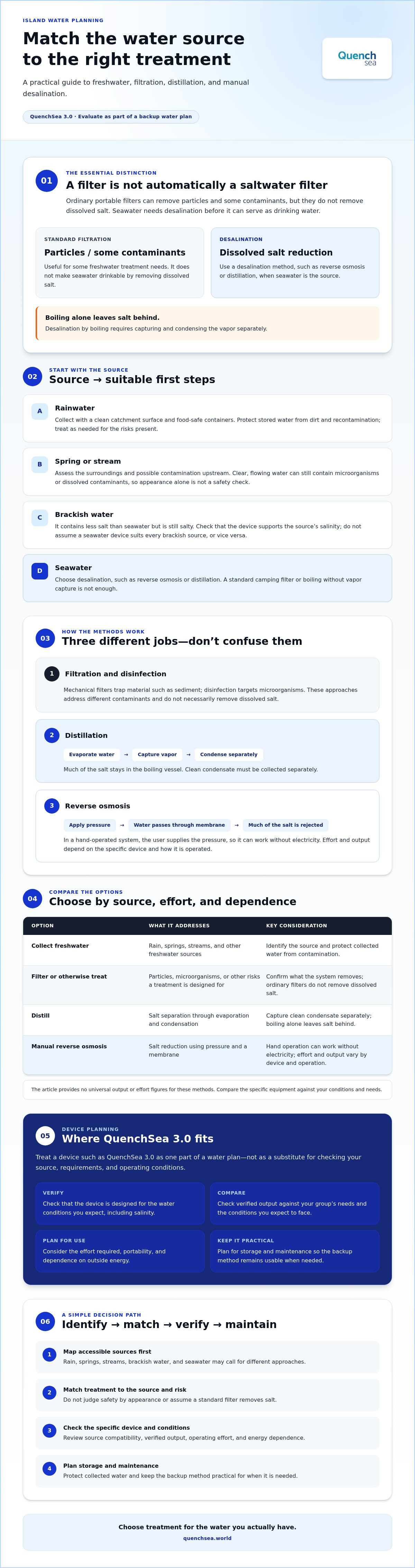
Filters designed mainly for sediment or microorganisms target different contaminants. They may help treat freshwater, but generally don’t remove dissolved salt. Ordinary camping filters do not make seawater drinkable. Before relying on a filter or treatment system, confirm what it is designed to remove.
Use this source-to-method check when planning:
- Rain: Collect with clean equipment and store in protected containers; treat as needed for the risks present.
- Spring or stream: Assess the surroundings and choose treatment appropriate to likely contaminants.
- Brackish water: Verify that the device supports the source’s salinity before use.
- Seawater: Choose a desalination method, such as reverse osmosis or distillation, rather than a standard camping filter.
This order keeps the decision practical: identify the source, then match treatment to its risks and the equipment available.
How Island Saltwater Filters Work: Filtration, Distillation, and Reverse Osmosis
Desalination reduces dissolved salts in seawater to produce freshwater. It addresses a different problem from routine portable filtration. A sediment filter strains particles, while microbial treatment targets organisms. Neither necessarily removes the dissolved minerals that make seawater unsafe to drink. An island survival saltwater filter must use a desalination method suited to the source.
Can an ordinary survival filter remove salt from seawater?
Usually, no. Common mechanical filters trap material based on particle size, while disinfection methods target pathogens. Salt ions are dissolved in water, so removing grit or treating microbes doesn’t remove the salt. The U.S. Environmental Protection Agency’s emergency water disinfection guidance can help with microbial risks, but disinfection is not desalination.
Boiling alone also leaves salt behind. Boiling can help desalinate water only if you capture the vapor and condense it separately, leaving much of the salt in the boiling vessel. That’s distillation, and it requires a way to collect clean condensate. If seawater is your source, choose a desalination process rather than assuming a standard filter or boiling pot is enough.
What is manual reverse osmosis?
Reverse osmosis uses pressure to push water through a semipermeable membrane. The membrane allows water through while rejecting much of the salt. In a system designed for hand operation, the user supplies the pressure, so the device can work without electricity. The effort required and the amount produced depend on the specific device and how it’s operated.
For survival, reverse osmosis is pressure-driven separation that pushes water through a membrane while leaving much of the salt behind. Distillation separates water through evaporation and condensation; reverse osmosis uses a membrane instead. Neither method should be treated as a universal fix for every possible contaminant. Follow the device’s instructions and check its output and water-quality claims for the source and conditions you expect.
Manual reverse osmosis may suit a plan where seawater is available and power is limited. For example, QuenchSea 3.0 is a hand-powered desalination option that operates without electricity, batteries, or fuel. Review its manual desalination device details and operating instructions before deciding whether it fits your needs.
Compare Island Survival Water Options by Source, Effort, and Reliability
Choose a method that fits the water you can actually access. Rain collection depends on rainfall and clean storage. Freshwater treatment depends on finding a source and matching treatment to its risks. Distillation and reverse osmosis can process seawater, but both require equipment and effort. This comparison shows general trade-offs, not guaranteed performance. Conditions and device design matter.
| Option | Best suited source | External energy | Effort and portability | Key limitation |
|---|---|---|---|---|
| Rainwater collection | Rain captured from a clean surface | Usually none for collection | Requires collection and protected storage; portability depends on the setup | Supply depends on rainfall, catchment area, and storage capacity |
| Freshwater treatment | Springs, streams, or other freshwater sources | Depends on the treatment method | Often portable treatment is possible; effort varies by method and source | Choose a treatment that addresses the likely contaminants |
| Distillation | Seawater or other water suitable for distillation | Needs heat, unless the specific system uses another energy source | Requires a setup to collect and condense vapor; portability varies | Production depends on the equipment and available heat |
| Manual reverse osmosis | Seawater, if the device supports that source | No external power for a hand-powered design | Portable designs are available; the user supplies operating effort | Check output, source suitability, instructions, and maintenance needs |
Freshwater treatment and desalination solve different problems. The CDC’s advice on making water safe can help readers assess emergency treatment for biological hazards. It doesn’t replace desalination when the source is seawater.
When should you collect freshwater instead of desalinating seawater?
Choose accessible freshwater first when you can assess the source and have an appropriate treatment method. Rain can be useful, but a brief shower, an unclean catchment surface, or limited storage may make it unreliable. Springs and streams also need treatment suited to their risks. Don’t assume water is safe because it looks clear.
When does a manual seawater desalination device make sense?
Manual desalination can be a practical backup when seawater is the dependable source and electricity or fuel isn’t available. Unlike a method dependent on heat or favorable weather, a hand-powered device relies on the user’s effort. Compare its verified output with your needs and check the instructions for your source and conditions. For more details, consult the guide titled “QuenchSea 3.0 Desalination Device.”
An island survival saltwater filter plan should also account for contamination beyond salt. Desalination doesn’t automatically confirm that every possible contaminant has been addressed. Check what the specific device is designed to remove and whether additional treatment is needed for the source.
How to Choose and Prepare an Island Survival Saltwater Filter
Choose equipment around your water plan, not the other way around. An island survival saltwater filter only helps if it suits the source, produces enough water for the people relying on it, and can be operated and maintained as directed. Use this sequence to check the fit before an emergency.
What should you check before choosing a desalination device?
- 1. Identify the source. Map rainwater, springs, streams, and other possible freshwater sources first. Treat seawater as a separate source that requires desalination.
- 2. Estimate capacity needs. Count the people who may depend on the device and compare their needs with its verified output. Account for the conditions in which you expect to operate it.
- 3. Check the operating method. Confirm that the device is designed for seawater and your intended emergency use. Review its verified output, physical effort, operating steps, and any limits stated by the manufacturer.
- 4. Plan collection and storage. Identify clean collection vessels and separate containers for treated water. Check the manufacturer’s guidance on handling and storage.
- 5. Prepare for maintenance. Understand the required care before relying on the device. Follow manufacturer instructions for maintenance and storage, and confirm which supplies or replacement parts your plan requires.
How do you plan for safe water during an island emergency?
Make a simple map of potential freshwater sources, safe routes to reach them, and places to collect seawater if freshwater becomes unavailable. Rain may be intermittent, and a stream or spring can carry risks that aren’t visible. Choose a suitable treatment method for each source rather than assuming one device will address every hazard.
Keep collection equipment for untreated water separate from containers used for treated water. Label them if needed to reduce the chance of mixing sources after treatment. Seawater is not a substitute for drinking water; read more about why in “Why Is Drinking Sea Water Dangerous?”
Practice with your chosen equipment before an emergency. Read the instructions, assemble the system, and rehearse the steps under realistic conditions. Don’t rely on an assumed output or an unfamiliar process. Check the device’s performance and water-quality claims against its documentation, and follow its stated limitations.
Water plan checklist
- Potential freshwater sources mapped
- Seawater source and device suitability checked
- Clean collection vessels identified
- Treatment method selected for each source
- Treated-water storage containers kept separate
- Backup method and maintenance instructions prepared
For a hand-powered option designed to desalinate seawater without electricity, batteries, or fuel, review the QuenchSea 3.0 desalination device and confirm its instructions and verified output match your plan.
Where QuenchSea 3.0 Fits in an Island Survival Water Plan
QuenchSea 3.0 is a portable, hand-powered reverse-osmosis device designed to desalinate seawater. It operates without electricity, batteries, or fuel. That makes it a potential backup for marine safety, remote coastal use, and island emergency planning when freshwater is scarce or unavailable.
What role can QuenchSea 3.0 play in an island emergency kit?
Think of it as one part of a layered water plan, not a guarantee of unlimited supply. First assess rain, springs, streams, and other possible freshwater sources. If seawater is dependable, a manual desalination device offers another option that doesn’t rely on powered equipment. The user still supplies the effort, and the device’s output must match the number of people and conditions you plan for.
A practical island survival saltwater filter plan accounts for more than the device. You’ll need a suitable source, a way to collect seawater, clean containers for treated water, and a backup if the device can’t be operated or maintained as directed. Desalination addresses salt, but don’t assume it removes every possible contaminant from a source. Follow the manufacturer’s guidance and assess whether additional treatment is needed.
What should you verify before relying on a device?
Review the current manufacturer instructions before packing or using the device. Check its verified output, operating steps, effort requirements, source suitability, and maintenance needs. Understand how to handle produced water and store it in clean, protected containers. Practice before an emergency so you can identify missing equipment and learn the routine while conditions are manageable.
Judge the device against your actual needs rather than assuming a stated output will fit every situation. Consider who may depend on it, how much effort operation requires, and whether you can follow the maintenance instructions with available supplies. Keep assessing freshwater options too. A manual desalination device works best as a planned backup, not a reason to overlook other sources.
If manual reverse osmosis fits your seawater backup plan, explore the QuenchSea 3.0 desalination device and review its current instructions and verified output before relying on it.
Build a Water Plan You Can Rely On
Start with the source, then choose the treatment. Rainwater and freshwater may be practical options when you can collect and assess them safely. Seawater requires desalination: ordinary portable filters aren’t designed to remove dissolved salt. A sound island survival saltwater filter plan also accounts for user effort, verified output, maintenance, and clean storage.
QuenchSea 3.0 is a hand-powered reverse-osmosis device designed for marine safety, emergencies, and off-grid coastal use. It operates without electricity, batteries, or fuel, making it one possible backup when seawater is available. It doesn’t replace checking other water sources or reading the manufacturer’s instructions. Confirm that its verified output and operating requirements fit your situation before relying on it.
Explore the QuenchSea 3.0 desalination device and review its guidance as you prepare your water plan. Map potential sources, select suitable treatment, and practice using your backup equipment before you need it.
Frequently Asked Questions
Can an ordinary water filter make seawater safe to drink?
No. Most ordinary portable filters target particles or microorganisms, not dissolved salt. They don’t desalinate seawater, so filtered seawater remains unsuitable for drinking. Use a desalination method designed for the source, such as reverse osmosis or distillation, and follow its instructions. A suitable island survival saltwater filter must reduce dissolved salts; don’t judge its effectiveness by how clear the water looks.
Does boiling seawater remove the salt?
No. Boiling seawater alone leaves the salt behind as water evaporates, making the remaining liquid more concentrated. To separate freshwater, capture the vapor and condense it in a clean container. That process is distillation. It requires equipment to collect the condensate, and the resulting water needs careful handling and clean storage to avoid recontamination.
Is rainwater safer than island seawater?
Rainwater may be more practical than seawater, but it isn’t automatically safe. Dirt, animal waste, or an unclean roof or collection vessel can contaminate it. Use a clean catchment surface and protected storage, then select treatment appropriate to the risks. Seawater needs desalination to reduce salt. Assess each source separately rather than treating appearance as proof of safety.
How much drinking water can a manual saltwater desalination device produce?
Output depends on the specific device, its condition, operating method, and water source. Check current manufacturer guidance for verified production rates, then compare that output with the number of people and conditions in your plan. Don’t assume a listed rate will match every situation. Also account for user effort, operating instructions, maintenance, and how you’ll collect and store treated water safely.
Does manual reverse osmosis need electricity or fuel?
A hand-powered reverse-osmosis device designed for manual use can operate without electricity, batteries, or fuel. The user supplies the effort needed to create pressure and move water through the membrane. Check the device’s instructions and operating requirements before relying on it. Manual operation removes dependence on external power, but it doesn’t eliminate the need for a suitable source, maintenance, or clean storage.
What should an island survival water kit include?
Plan for sources, treatment, collection, and storage. Include clean collection vessels, treatment suited to possible freshwater sources, and a desalination option if seawater may be your dependable backup. Keep equipment for untreated water separate from clean containers for treated water. Pack any maintenance supplies the device requires, read its instructions, and practice using it before an emergency. Build your backup plan around the sources and equipment you can access.