

Most high-end survival filters are effectively paperweights the moment a storm surge hits your doorstep. While standard units excel at removing bacteria from a mountain stream, they fail instantly when faced with the saline reality of coastal flooding. In a 2026 hurricane scenario, relying solely on a stack of bottled water is a high-risk gamble. You've likely felt the anxiety of watching supermarket shelves go bare or wondering if your electric pump will survive a grid collapse. It's a valid concern because historical data from events like Hurricane Sandy shows that hundreds of water utilities can fail simultaneously, leaving millions without a reliable tap.
We're here to replace that uncertainty with technical confidence. This guide provides a masterclass in hurricane preparedness water purification, focusing on the specific challenges of coastal environments where freshwater sources become brackish or contaminated. You'll learn to build a redundant strategy that separates simple filtration from the rigorous demands of desalination. We'll explore why a mechanical, power-independent solution is the only way to ensure your family’s safety when the infrastructure fails. From understanding reverse osmosis to deploying manual hardware, you're about to gain a survival-grade advantage that doesn't depend on a battery or a FEMA truck.
Key Takeaways
- Identify the "Water Gap" between a storm's impact and the arrival of aid, and why municipal systems fail during grid collapses.
- Learn why standard microfiltration fails in coastal flooding and how to overcome the "Salt Barrier" when freshwater sources turn brackish.
- Master the technical requirements of hurricane preparedness water purification by integrating manual reverse osmosis to secure a redundant supply.
- Build a resilient emergency plan by calculating your family’s daily biological needs and identifying your storage exhaustion date.
- Shift from a scarcity mindset to an "infinite source" strategy by utilizing the ocean as a viable water supply when wells and taps run dry.
The Reality of Water Scarcity During Major Hurricanes
Hurricane impact is immediate. The "Water Gap" begins the moment the storm makes landfall and lasts until humanitarian aid arrives. This window can stretch from 72 hours to several weeks. During this time, you are your own utility provider. Municipal systems fail because they rely on a fragile grid. Power outages kill the pumps. Ground shifting from fallen trees or saturated soil snaps main lines. When a system loses pressure, it doesn't just stop flowing; it begins to suck in surrounding groundwater, which is often saturated with toxins.
In coastal zones, the threat is compounded by the ocean. Storm surges drive seawater inland, infiltrating local aquifers and private wells. Understanding various water purification methods becomes a matter of survival when your primary tap delivers brackish sludge instead of potable water. You must prepare for a scenario where the infrastructure isn't just damaged, but completely compromised by biological and chemical hazards.
Why Stored Water is Your First Point of Failure
Relying on a closet full of plastic jugs is a fragile strategy. FEMA recommends one gallon per person per day, but that is a survival minimum. A family of four needs 56 gallons for a two-week outage. This volume takes up significant floor space and adds hundreds of pounds of static load to your home. If your storage area floods, containers can float away or suffer structural damage from debris. Commercially bottled water also has a shelf life. Over time, the plastic degrades and leaches chemicals into your supply, making long-term stockpiling an inefficient solution for hurricane preparedness water purification.
Contamination Vectors: Beyond Just Bacteria
Floodwater is a chemical cocktail. It picks up motor oil from garages, pesticides from lawns, and heavy metals from industrial sites. When sewage treatment plants lose power, they often discharge raw effluent directly into the flood zone. This creates a high concentration of pathogens like E. coli and Giardia in standing water. Saline intrusion acts as a primary threat to coastal well-water users by rendering freshwater sources undrinkable through high salt concentrations. Standard filters cannot handle this chemical and mineral load. You need a strategy that addresses the complexity of post-storm water, not just the biological basics.
Evaluating Purification Methods: Filters vs. Desalination
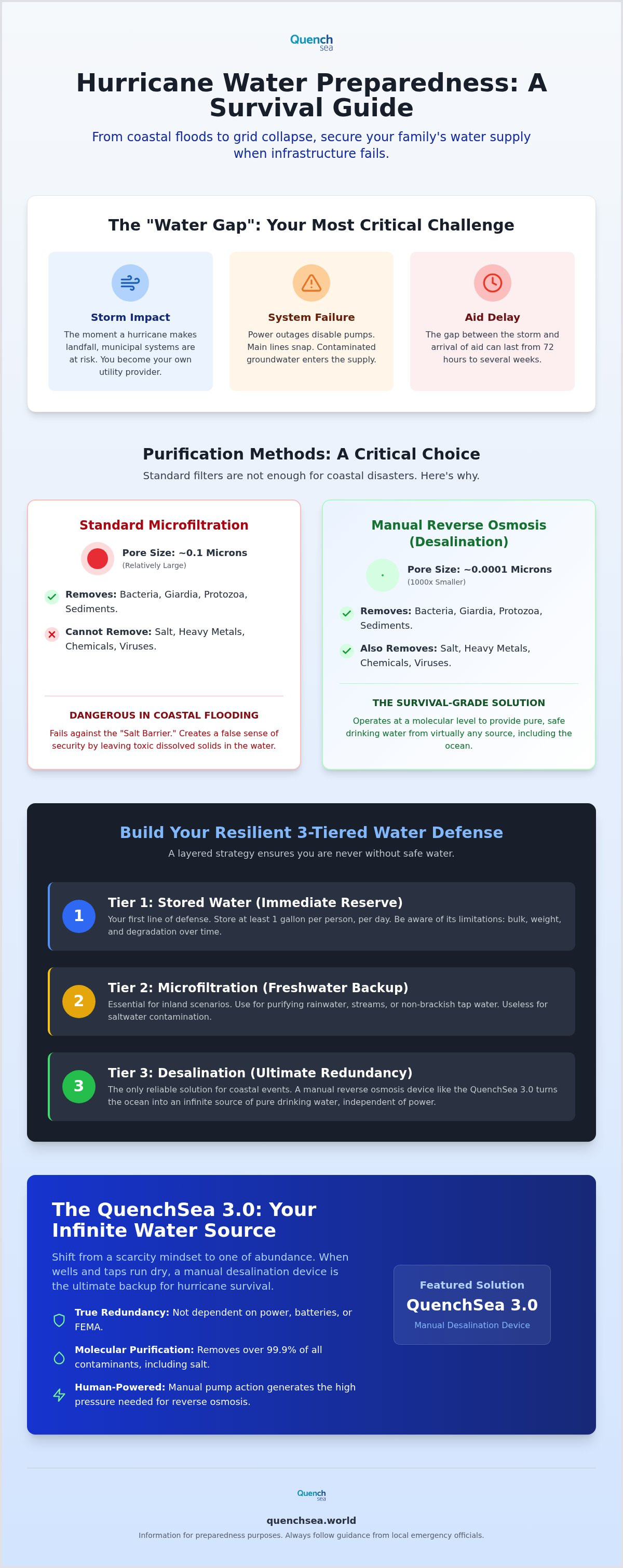
Effective hurricane preparedness water purification requires a tiered defense. Most planners follow a hierarchy of needs: storage, filtration, and desalination. Storage serves as your immediate reserve. Filtration handles biological threats in freshwater. Desalination provides the ultimate redundancy when storm surges turn your environment saline. Understanding the mechanical limits of each method prevents fatal errors during a crisis.
Standard microfiltration typically utilizes hollow fiber membranes with a 0.1-micron pore size. This is a physical barrier. It strains out pathogens like E. coli, Giardia, and Cryptosporidium. However, it cannot stop dissolved solids. This is the "Salt Barrier." Salt molecules are significantly smaller than 0.1 microns. If you run brackish water through a standard survival filter, the output remains toxic. Relying on freshwater tools in a coastal flood zone is a common, dangerous oversight.
Energy requirements also dictate your success. Electric systems are useless during a grid failure. Gravity filters are passive and slow; they often fail to provide enough volume for a family’s hygiene and hydration needs. Manual pump-action systems offer the best balance. They generate the high pressure required for advanced membranes while remaining entirely human-powered.
Standard Survival Filters: What They Can and Cannot Do
Microfilters are excellent for biological decontamination. They neutralize most waterborne diseases found in inland freshwater. Their primary failure point is sediment. Hurricane floodwater is rarely clear. It is a slurry of silt and organic debris. These particles can ruin a standard filter in minutes by clogging the delicate fibers. Using these devices on brackish water is even worse. It provides a false sense of security while leaving high sodium levels that can lead to rapid dehydration in a survival situation.
Manual Reverse Osmosis: The Survival-Grade Solution
Reverse Osmosis (RO) operates at a molecular level. RO membranes have pores roughly 0.0001 microns in size. This is small enough to strip away dissolved salts, heavy metals, and viruses that pass through standard filters. To force water through such a dense barrier, you need significant pressure. Manual RO devices use mechanical leverage to achieve this without electricity. This makes them the highest tier of purification. For those securing a coastal home, integrating a manual desalination device ensures that even if the ocean enters your living room, you have a source of life-sustaining water.
Tactical Water Preparedness for Coastal Regions
Coastal regions face a unique logistical nightmare. While inland residents worry about mud, coastal inhabitants deal with salt. Storm surges don't just flood streets; they fundamentally alter the chemistry of your environment. For effective hurricane preparedness water purification, you must shift your mindset from saving water to creating water. This tactical pivot is essential when your local infrastructure is buried under several feet of saline surge.
When municipal lines snap and private wells are compromised, the ocean becomes your only infinite source. Category 4 and 5 hurricanes often destroy the very power lines required to run home filtration systems or well pumps. If your survival plan depends on a wall outlet or a solar array that might be stripped from your roof, you don't have a plan. You have a liability. You need hardware that functions regardless of grid status or weather conditions. For a deep dive into the technical requirements of these tools, consult this guide on the survival desalination device for emergency hydration.
The Storm Surge Challenge
Salt spray is often overlooked. High-velocity winds carry salt particles miles inland, coating every surface. If you use a rain catchment system, this salt spray will contaminate your initial collection. Coastal cisterns are equally vulnerable. Even if they aren't directly flooded, pressure changes and structural cracks can allow brackish intrusion. Recovering a saline-contaminated well is a long-term engineering project, not a weekend fix. It can take months of flushing to return to potable levels. In the field, identifying water quality is critical. Brackish water is a mix of fresh and salt, often found in estuaries or flooded basements, while pure seawater is the high-salinity baseline. Both will destroy a standard filter.
Redundancy: The Prepper’s Rule of Three
A robust survival strategy relies on layers. One failure shouldn't end your access to hydration. Building a redundant system ensures you aren't left vulnerable when the "Water Gap" expands.
- Primary Layer: Stored bottled water. This is your immediate, zero-effort supply for the first 48 to 72 hours.
- Secondary Layer: Freshwater filters. These are essential for processing rain collection or clear floodwater, provided no salt is present.
- Tertiary Layer: Manual desalination. This is your worst-case insurance. It allows you to process brackish surges or seawater when all other sources are exhausted or contaminated.
This redundant approach ensures your hurricane preparedness water purification strategy remains viable even if the storm lasts longer than expected. By preparing for the most difficult scenario, you ensure total coverage for everything else.
Step-by-Step: Building a Resilient Emergency Water Plan
A resilient plan transforms technical theory into field-ready action. It moves you away from a reactive posture toward a proactive "produce and sustain" mindset. Hurricane preparedness water purification isn't just about owning gear; it's about mastering a sequence of operations that ensures a continuous supply. Follow these five steps to build a system that can withstand a total infrastructure collapse.
Calculating Real-World Consumption
Step 1 requires a hard look at biological reality. Survival hydration is the bare minimum to keep organs functioning, usually around one gallon per person daily. However, sanitation needs often double this requirement. If you're performing physical labor in high heat and humidity, your demand spikes. Heat exhaustion is a lethal threat in a post-storm environment without air conditioning. You must also account for pets. Most animals require significant water relative to their body weight. If family members have medical conditions requiring specialized care, add a 20 percent safety margin to your daily budget.
Step 2 is identifying your exhaustion date. Inventory your stored supply and divide it by your total daily budget. This date is your deadline. You must have your secondary and tertiary purification systems operational before this clock hits zero. Relying on a resupply that may never arrive is a tactical error that leaves your family vulnerable.
Hardware Testing and Drills
Step 3 involves mapping your local "infinite" water sources. Identify the closest ocean access, bay, or brackish river. In a disaster, these are your raw material reservoirs. Step 4 is selecting and testing your hardware. You should never unbox a survival tool for the first time during a storm. Conduct a full drill. Set up the device, draw water from your identified source, and verify the output. This builds muscle memory and ensures all seals are intact before you actually need them.
Basic maintenance is non-negotiable for hand-powered desalination units. After testing with salt water, always flush the system with fresh water to prevent salt crystallization within the membrane. Step 5 involves establishing a rotation and maintenance schedule. Store your RO membranes in a cool, dry place to prevent mold growth or chemical degradation. If you're ready to secure your family's safety with a field-tested solution, order the QuenchSea 3.0 desalination device to ensure your backup supply is ready. A reliable mechanical tool is the difference between waiting for a rescue and sustaining your own life.
QuenchSea 3.0: The Ultimate Backup for Hurricane Survival
The QuenchSea 3.0 is the definitive solution for the "Water Gap" in coastal environments. When the storm surge recedes and leaves behind a landscape of brackish flooding, standard filters become obsolete. This device is a mission-critical component for any serious coastal survival kit. It provides a technical answer to the most pressing question of hurricane preparedness water purification: how do you survive when the freshwater is gone? By utilizing the ocean as your reservoir, you eliminate the fear of running out of bottled supplies.
This hardware represents a tactical shift in emergency response. It functions as a long-term disaster relief water supply that bridges the gap between the storm's impact and the restoration of civil infrastructure. It is built for the reality of the last mile, where aid is slow and conditions are harsh.
Engineering for Extremes
Rugged. Manual. Fail-safe. These are the core pillars of the QuenchSea 3.0 design. It bypasses the vulnerabilities of the modern grid by relying entirely on mechanical leverage. The heart of the unit is a high-performance reverse osmosis membrane specifically engineered to handle the intense osmotic pressure of seawater. Through a simple, hand-powered pumping motion, the device forces contaminated water through a microscopic barrier. This process strips away 98 percent of salts, alongside viruses, bacteria, and microplastics. It converts a hazardous environmental threat into life-sustaining hydration with zero reliance on batteries, fuel, or solar panels.
The Peace of Mind Factor
True preparedness is the absence of anxiety. Knowing you possess a "water maker" changes your survival psychology. You are no longer a victim of supply chain failures or supermarket shortages. The QuenchSea 3.0 offers a level of autonomy that stored water cannot match. If you are forced to evacuate to a coastal shelter or move to higher ground, the unit’s portability ensures your purification capability moves with you. It is a lightweight, utilitarian tool that fits into a standard go-bag or emergency bin.
Do not leave your family’s hydration to chance. When the taps go dry and the surge moves in, your mechanical redundancy will be your most valuable asset. Take the final step in your survival strategy today. Equip your hurricane kit with QuenchSea 3.0 and secure an infinite source of clean water.
Secure Your Infinite Water Source
Coastal hurricanes require more than just stored bottles and basic filters. You've learned that storm surges turn freshwater into a saline hazard, making desalination a tactical necessity rather than an option. By integrating a manual, survival-grade reverse osmosis system into your plan, you eliminate the risk of grid failure and supply chain exhaustion. This level of hurricane preparedness water purification ensures your family remains self-sufficient while others wait for external aid.
The transition from scarcity to abundance depends on the tools you choose today. A portable, hand-powered device provides the mechanical integrity needed for extreme environments without the vulnerability of batteries or fuel. You now have the blueprint to calculate your needs and deploy a redundant strategy that utilizes the ocean as a viable reservoir. Take control of your survival logistics before the next storm makes landfall and the shelves go empty.
Secure your family’s water supply with the QuenchSea 3.0 and ensure you have a rugged, reliable water maker ready for any scenario. You are now prepared to face the storm with technical confidence and absolute autonomy.
Frequently Asked Questions
How much water should I store for a hurricane?
FEMA recommends a minimum of one gallon per person per day. For a family of four, this equates to a three-day supply of 12 gallons. However, a 14-day supply of 56 gallons is the ideal standard for long-term outages. Because storage space is often limited, integrating hurricane preparedness water purification tools allows you to supplement your stockpiles with locally sourced water once your initial containers are empty.
Can I drink seawater if I boil it first?
No, boiling seawater does not make it safe for consumption. While boiling kills pathogens like bacteria and viruses, it does not remove dissolved salts. In fact, boiling evaporates the freshwater, which actually increases the salt concentration in the remaining liquid. Drinking boiled seawater causes rapid cellular dehydration and can lead to kidney failure. You must use a desalination process to physically separate the salt molecules from the water.
What is the difference between a water filter and a desalinator?
A standard water filter uses microfiltration to remove biological contaminants like bacteria and protozoa. Most survival filters have a pore size of 0.1 microns. A desalinator, like the QuenchSea 3.0, uses reverse osmosis membranes with pores as small as 0.0001 microns. This allows the device to strip away dissolved salts and heavy metals that pass through standard filters. Desalination is the only reliable method for processing brackish or saline storm surge water.
Does QuenchSea 3.0 require batteries or electricity?
The QuenchSea 3.0 requires zero electricity, batteries, or fuel to operate. It's a purely mechanical device that relies on manual pressure generated by the user. This design ensures the unit remains functional during total grid collapses or when solar panels are damaged by high winds. By removing the dependency on external power sources, it provides a fail-safe solution for hurricane preparedness water purification in the most extreme coastal environments.
How long does a reverse osmosis membrane last in an emergency?
The longevity of a reverse osmosis membrane depends on the quality of the source water. Under standard emergency conditions, a QuenchSea RO membrane typically processes between 1,000 and 2,000 liters before needing replacement. To maximize this lifespan, you should use pre-filters to remove silt and sediment from floodwater. Replacing pre-filters every three to four weeks during heavy use prevents the delicate RO membrane from clogging prematurely.
Can QuenchSea 3.0 remove bacteria and viruses from floodwater?
Yes, the QuenchSea 3.0 provides comprehensive purification. The reverse osmosis membrane acts as a molecular barrier that blocks pathogens, including bacteria and viruses, which are much larger than the membrane pores. It also filters out microplastics and chemical contaminants often found in urban floodwater. This makes it a superior tool for processing the complex, toxic slurry left behind by hurricane storm surges, offering a level of safety that simple filtration can't provide.
Is it safe to use a manual desalinator on brackish well water?
It's highly effective to use a manual desalinator on brackish well water. When storm surges infiltrate coastal aquifers, the salt concentration rises, making the water undrinkable for standard systems. Reverse osmosis technology is specifically engineered to handle these saline levels. Because brackish water has a lower salt content than pure seawater, the manual effort required to pump the water through the membrane is often reduced, making the purification process faster.
How much physical effort is required to operate a hand-powered water maker?
Operating a hand-powered water maker requires steady, rhythmic physical effort. The QuenchSea 3.0 is designed for a single operator to produce practical volumes of freshwater through manual pumping. While it does require more exertion than a gravity filter, the mechanical leverage is optimized for survival situations. Most users find the effort manageable for producing daily drinking requirements. This manual design is a deliberate trade-off to ensure absolute reliability when the power grid fails.