

Survival at sea isn't a test of willpower; it's a math problem. You cannot ration your way out of a biological deficit. You must produce. Most offshore travelers live with the quiet fear of an empty life raft pack, wondering exactly how much water do you need to survive at sea when rescue is days away. It's a high-stakes calculation where guessing leads to rapid physiological decline. You're right to be concerned about the limits of standard emergency pouches and the confusion surrounding when to start rationing.
This guide provides the precise biological water requirements for ocean survival and explains how to secure a sustainable supply when every drop counts. We will establish clear daily intake targets, ranging from the absolute survival minimum of 120ml to the functional levels required for cognitive clarity. We'll also identify the critical symptoms of dehydration stages and detail a strategy for manual desalination using reverse osmosis. You'll learn how to transform a desperate situation into a managed mission by moving beyond static rations toward mechanical reliability and long-term hydration security.
Key Takeaways
- Identify the biological "Rule of 3s" to understand why water management is the most critical variable for maritime survival.
- Calculate the precise volume of how much water do you need to survive at sea to maintain both basic kidney function and cognitive awareness.
- Recognize the psychological pitfalls of traditional rationing and why withholding water can compromise your decision-making in high-stress environments.
- Account for environmental dehydration triggers like high-wind exposure and seasickness that rapidly deplete your body's fluid reserves.
- Transition from a mindset of scarcity to one of production by utilizing manual desalination technology to generate a reliable freshwater supply.
The Biological Deadline: Why Water is Your First Priority at Sea
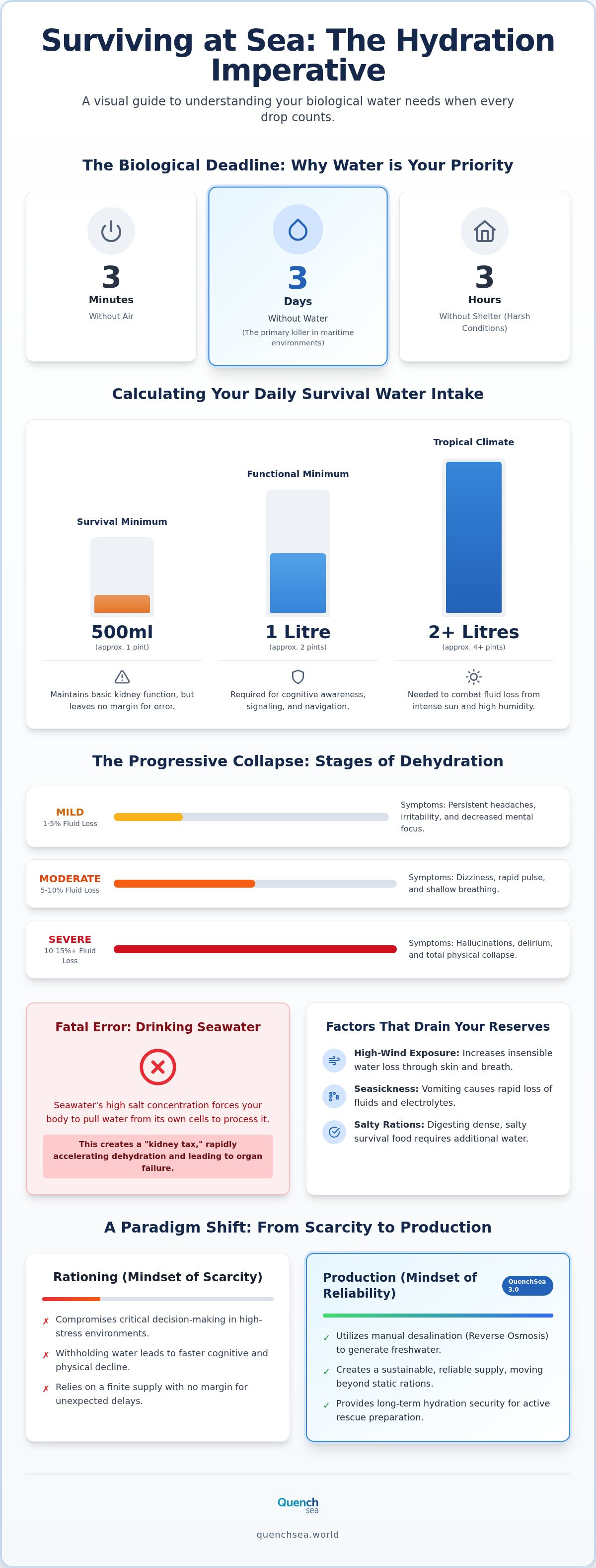
Survival follows a rigid biological hierarchy. Experts refer to this as the "Rule of 3s." You can last three minutes without air and three hours without shelter in harsh conditions. Water is next. You have approximately three days before your systems fail. In warm-water maritime environments, dehydration is the primary killer. It often claims lives faster than starvation or physical injury. Determining exactly how much water do you need to survive at sea is a matter of life and death. Your body depends on water for critical thermoregulation; it is the coolant that prevents heatstroke under a relentless sun. It also facilitates waste removal, filtering toxins through the kidneys. The survival hydration threshold is the specific physiological limit where fluid loss triggers systemic organ failure.
The Stages of Dehydration
Fluid loss is a progressive collapse of the human body's need for water. It begins with mild dehydration, defined as a 1-5% loss of body weight. You'll experience persistent headaches, irritability, and a noticeable decrease in mental focus. These symptoms are dangerous because they cloud judgment when you need it most. Moderate dehydration occurs at a 5-10% loss. This stage brings dizziness, a rapid pulse, and shallow breathing as your heart struggles to pump thickened blood. Severe dehydration, reaching 10-15% loss or more, leads to hallucinations, delirium, and total physical collapse. Understanding exactly how much water do you need to survive at sea allows you to maintain the functional clarity required for rescue.
The Myth of Seawater Consumption
Drinking seawater is a fatal error. It accelerates the dehydration process through intense osmotic pressure. Because the salt concentration in the ocean is significantly higher than in human blood, your body must pull water from its own cells to dilute the salt. This creates what survival experts call a "kidney tax." Your kidneys require more freshwater to process and flush the salt than the seawater itself provides. You're essentially spending your internal reserves to process a toxic intake. Your body's attempt to maintain equilibrium under these conditions is a losing battle that ends in total metabolic shutdown. You can learn more about why is drinking sea water dangerous to understand the cellular mechanics of this failure. In short, every sip of brine shortens your life expectancy.
The Maintenance Minimum: Calculating Your Daily Survival Water Intake
Determining how much water do you need to survive at sea requires a shift from comfort to biological necessity. The absolute minimum for a sedentary adult is 500ml (approximately one pint) per day. This volume is the threshold for maintaining basic kidney function. Without it, the body cannot filter metabolic waste, leading to rapid toxicity. However, surviving is not the same as being functional. To maintain the cognitive awareness required for signaling and navigation, you need a functional minimum of 1 litre per day. Thirst is a lagging indicator. By the time your brain registers the sensation, you've already lost 1-2% of your total body fluid.
Minimum Intake vs. Optimal Intake
Your specific requirement depends on body mass and metabolic rate. A larger individual burns more fluid to maintain homeostasis. You must also account for insensible loss. This is the water that evaporates through your skin and breath, which can exceed 500ml daily in high-wind environments. If you are consuming emergency rations, your water needs increase. Most survival biscuits are dense and salt-heavy; digesting them without additional water forces your body to pull moisture from its own tissues. While 500ml keeps you alive, it leaves no margin for error. Securing a reliable source of freshwater is the only way to move from a state of survival to one of active rescue preparation.
Water Requirements for Different Climates
Climate dictates the speed of your decline. In tropical environments, intense sun and high humidity trigger factors that increase dehydration, pushing the daily requirement toward 2 litres. You lose significant fluids through sweat even if you remain still. Conversely, cold-water survival presents a different challenge. You may not feel the urge to drink, but dry air and the metabolic cost of staying warm still deplete your reserves. Managing how much water do you need to survive at sea becomes even more complex when sea spray and salt crusting on the skin draw moisture out via osmosis. You must treat water as a finite fuel source that requires constant replenishment to prevent mechanical failure of the body.
Rationing vs. Production: The Flaw in Traditional Survival Thinking
Traditional survival manuals often focus on the "sip and save" method. This is a psychological trap. When you focus solely on rationing, you accept a finite timeline. It is a strategy of managed decline. Withholding water leads to fatal errors in judgment because the brain is the first organ to suffer from a fluid deficit. Instead of asking how to make a liter last three days, you must ask how to produce a liter every hour. Production represents extended life; rationing represents delayed death. Establishing a production routine within the first 24 hours is critical. It transforms the survivor from a passive victim of supply into an active operator of a life-critical system. Understanding how much water do you need to survive at sea becomes less about counting pouches and more about managing output.
The Limits of Emergency Water Packs
Emergency supplies are governed by strict international standards. A standard life raft water supply typically contains 1.5 liters per person. This volume is a bridge, not a solution. Carrying months of water is a logistical nightmare; water weighs one kilogram per liter. A raft for six people would require over 100kg of water just to survive three weeks. Beyond weight, storage is vulnerable. Bags can puncture; contamination can ruin a whole batch. Relying on fixed rations forces you to constantly recalculate how much water do you need to survive at sea as your inventory dwindles toward zero.
The Rise of Manual Desalination
Manual reverse osmosis (RO) technology has redefined the survival timeline. A survival desalination device removes 99.9% of salts through mechanical pressure. This shift moves the survival limit from days to weeks or even months. There is an energy cost to production; you must balance physical effort with the water gained. However, modern engineering makes this trade-off highly favorable. Every survival-grade unit must be hand-powered. Batteries fail. Solar panels break or require specific angles. Mechanical reliability is the only guarantee in a high-stress marine environment. By producing fresh water on demand, you eliminate the math of scarcity and maintain the hydration levels necessary for survival.
Factors That Drain Your Reserves: Managing Dehydration Triggers
Calculating how much water do you need to survive at sea is only half of the equation. You must also defend the reserves you already have. Survival is a constant battle against environmental triggers that aggressively strip moisture from your body. Sun exposure is the primary antagonist. In high-wind maritime environments, you will likely experience "sweatless" dehydration. The wind evaporates perspiration off your skin so rapidly that you don't feel wet, yet your body is losing liters of fluid to maintain its core temperature. Seasickness represents an even more immediate threat. Vomiting creates an unrecoverable fluid deficit and rapidly depletes essential electrolytes. Additionally, you must manage your caloric intake. If water is extremely scarce, avoid eating entirely. Digestion is a water-intensive metabolic process that will accelerate your internal decline if you don't have the fluids to support it.
Environmental Management
Reducing your metabolic demand is a survival-grade tactic. You must use every available tool to minimize evaporative loss. Rig canopies immediately to block direct UV radiation and keep your clothing on to protect your skin from the drying effects of salt and wind. Adopt the "cool and still" method by remaining completely motionless during peak sun hours. You can also soak your clothing in seawater to cool your body through external evaporation. This technique reduces the workload on your internal thermoregulation systems. While you must never drink the seawater, you can leverage its thermal properties to preserve your precious freshwater stores.
The Energy-Water Balance
Every physical action has a water price. Manual labor like paddling, bailing, or operating gear can cost you up to one liter of sweat per hour. You must calculate whether the energy spent results in a net gain for your survival timeline. High-efficiency tools are required to ensure that the water you produce or the progress you make exceeds the fluid lost to the effort. Perform high-exertion tasks only during dawn or dusk to minimize heat stress and perspiration. When operating survival equipment, maintain a steady, mechanical rhythm rather than short bursts of high intensity. This prevents your heart rate from spiking and triggering a sweat response that you cannot afford. To ensure your production stays ahead of your physical losses, you need a survival-grade desalination device that maximizes freshwater output with minimal physical cost.
Securing Your Supply: Manual Desalination as a Life-Critical Backup
Survival at sea is no longer limited by the number of pouches in your life raft. The QuenchSea 3.0 represents a fundamental shift in maritime safety. It provides a survival-grade solution for infinite water production. By utilizing manual reverse osmosis, this device removes the guesswork from how much water do you need to survive at sea. It operates without batteries or fuel. It relies entirely on mechanical leverage. This ensures that as long as you have the strength to pump, you have the water to live. You are no longer a passive consumer of a dwindling resource; you are an active producer of life-sustaining fluid.
Integrating a manual water maker for boat safety kits transforms the "Rule of 3s" strategy. Instead of a hard three-day deadline, you gain an open-ended survival timeline. The device becomes the primary bridge between the onset of an emergency and eventual rescue. It eliminates the high-stakes trade-off between immediate hydration and long-term rationing. In a high-stress environment, mechanical reliability is the only metric that matters. The QuenchSea 3.0 delivers that reliability by stripping away the electronics that fail in salt-saturated air.
QuenchSea 3.0: Engineering for Extremes
The QuenchSea 3.0 uses advanced RO membranes to strip 99.9% of salts, bacteria, and viruses from raw seawater. It is engineered for the harshest marine environments. The housing is rugged and corrosion-resistant, designed to survive the impact and exposure common in life raft deployments. In a crisis, complexity is a liability. This device uses a simple mechanical interface that is intuitive even under extreme fatigue. It requires zero technical training to operate. You simply connect the intake, apply manual pressure, and collect fresh drinking water. This simplicity ensures that the question of how much water do you need to survive at sea is always answered with a functional, sustainable supply.
Preparedness as Peace of Mind
Having the right ocean survival gear facilitates a critical mental transition. You move from a "victim" mindset to a "survivor" mindset. Gear readiness provides the psychological stability needed to make rational decisions when rescue is not immediate. You are no longer waiting for help; you are actively managing your biological needs. The QuenchSea 3.0 is a standard component of modern maritime preparation. It ensures your safety kit is a tool for empowerment rather than just a collection of bandages and flares. Secure your survival water supply with QuenchSea 3.0 today.
Master Your Maritime Survival Timeline
Survival at sea is a calculated operation. You've learned that while 500ml is the absolute floor for kidney function, maintaining the cognitive clarity required for rescue demands a higher functional target. Relying solely on static rations creates a finite timeline that eventually reaches zero. By shifting your strategy toward active production, you transition from a victim of circumstance to a master of your environment. Managing external factors like sun exposure and physical exertion is vital to preserving every drop you generate. Understanding how much water do you need to survive at sea allows you to plan with engineering precision rather than fear.
Reliability is the only metric that matters in a crisis. Equip your vessel with the QuenchSea 3.0 for ultimate water security. This device utilizes hand-powered reverse osmosis to provide a sustainable freshwater supply with no electricity required. It's a rugged, survival-grade tool trusted by marine professionals worldwide to bridge the gap between emergency and rescue. When you control your water supply, you control your future on the open ocean. You have the knowledge and the equipment to overcome the harshest conditions. Stay prepared and stay safe.
Frequently Asked Questions
How many days can a human survive at sea without water?
A human can typically survive three to five days without water, though this timeline fluctuates based on environmental temperature and physical exertion. Once fluid loss reaching 15% to 20% of total body weight occurs, death is imminent. Delirium often sets in by day five or six if some hydration isn't maintained. You must prioritize water production immediately to avoid reaching these critical physiological limits where organ failure becomes irreversible and rescue becomes impossible.
Can I drink my own urine to survive at sea?
You should never drink urine to survive. It's a concentrated solution of metabolic waste and salts that your body has already filtered out. Consuming it forces your kidneys to process those toxins again, requiring more freshwater than the urine provides. This cycle accelerates dehydration and triggers rapid kidney failure. Relying on urine is a desperate measure that significantly shortens your survival window rather than extending it. Avoid this trap entirely.
Is it possible to survive by drinking small amounts of seawater?
It's not possible to survive by drinking seawater, even in small quantities. The high salt concentration creates osmotic pressure that pulls water from your cells to dilute the brine. This process leads to the "kidney tax," where your body loses more fluid than it gains. Studies show that drinking seawater is the second leading cause of death in long-term sea survival scenarios. Avoid it entirely to preserve your precious internal reserves.
How much water does a standard life raft emergency pack contain?
A standard SOLAS A PACK life raft contains 1.5 liters of fresh water for each person the raft is permitted to carry. It's usually packaged in 500ml units or smaller 50ml portions to prevent contamination and facilitate rationing. While this volume meets international safety standards, it's only a short-term bridge. Understanding how much water do you need to survive at sea highlights why this static supply is insufficient for extended periods.
How does a manual desalination device like QuenchSea work?
The QuenchSea 3.0 uses manual reverse osmosis technology to convert seawater into safe drinking water. By applying physical pressure through a hand-operated lever, you force seawater through a semi-permeable membrane. This membrane filters out 99.9% of salts, along with bacteria and viruses. It requires no electricity or batteries. This makes it a reliable mechanical solution for extreme marine environments where traditional power sources are unavailable or likely to fail.
What are the first signs of dehydration to look for while stranded?
The first signs of dehydration include persistent headaches, increased irritability, and a noticeable loss of mental focus. You should also monitor the color of your urine; dark, concentrated output indicates your body is struggling to flush toxins with limited fluid. Dry mouth and a rapid pulse often follow these initial symptoms. Identifying these early markers allows you to adjust your hydration strategy before moderate dehydration leads to dizziness or shallow breathing. Don't wait.
How much water should I produce daily with a manual water maker?
You should aim to produce at least one liter of water per person daily to maintain cognitive awareness and basic physical function. While the absolute survival minimum is 500ml, producing a higher volume ensures you stay hydrated enough to manage rescue signals. When calculating how much water do you need to survive at sea, factor in higher production targets for tropical climates. The QuenchSea 3.0 produces 5 to 8 liters per hour.
Does a manual desalination device remove salt completely?
A high-quality manual desalination device like the QuenchSea 3.0 removes 99.9% of salts from seawater. This makes the output safe for human consumption and significantly lower in salinity than standard tap water. In addition to removing salts, the reverse osmosis membrane filters out dissolved solids, bacteria, and viruses. This level of filtration ensures that the water produced isn't just survival-grade, but meets high safety standards for long-term hydration in remote environments.