

Drinking a single cup of seawater to quench your thirst is not a survival tactic. It is a biological death sentence. When you are stranded, the vast blue horizon feels like a cruel irony. You know you need fluids, but your body cannot process the salt. Understanding how dehydration occurs at sea is the first step toward staying alive. Most people realize salt water is dangerous, but few understand the exact speed at which it compromises your internal organs and triggers cellular collapse.
You might feel tempted to follow outdated advice about diluting seawater or sipping small amounts. Don't. Your kidneys require more fresh water to flush out the excess sodium than the seawater itself provides. It is a mathematical net-loss for your survival. This article clarifies the biological mechanics of salt-induced dehydration and how to secure a reliable freshwater source using the QuenchSea 3.0. We examine the science of manual reverse osmosis, debunk lethal survival myths, and identify the mechanical tools necessary to convert the ocean into a life-sustaining resource, producing up to 6 liters of fresh water per hour without electricity or fuel.
Key Takeaways
- Understand the biological "net-loss" mechanism where drinking seawater forces your body to expel more fluid than it consumes to process salt.
- Identify the physiological stages of how dehydration occurs at sea, from initial hypernatremia to critical neurological decline and organ failure.
- Learn why common survival myths, such as diluting seawater or taking small sips, are lethal errors that accelerate cellular collapse.
- Recognize why manual reverse osmosis is the only practical method for desalination in emergency environments where boiling or distillation is impossible.
- Discover how the QuenchSea 3.0 utilizes hand-powered engineering to provide a reliable freshwater source without the need for batteries, fuel, or solar power.
Why Drinking Salt Water is Fatal in Survival Situations
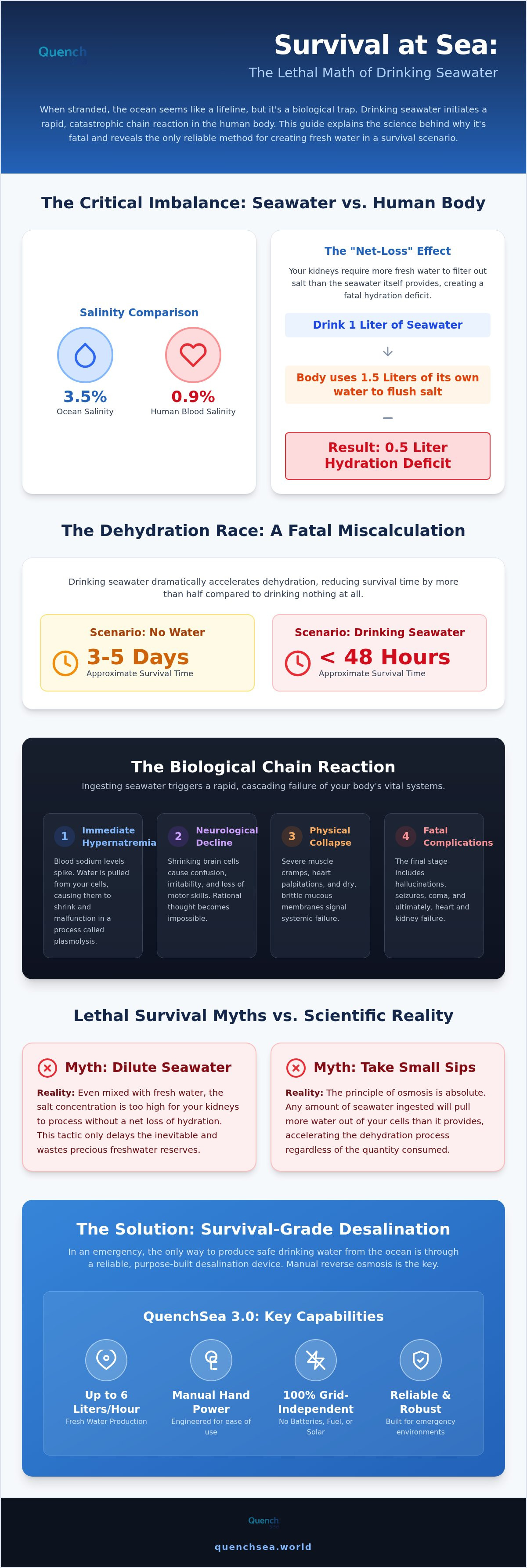
Survival isn't about hope; it's about managing biological resources. The ocean's average salinity is roughly 3.5%, while human blood maintains a precise 0.9%. This massive chemical imbalance is the core of how dehydration occurs at sea. When these two fluids meet in the human digestive system, the result isn't hydration. It's a physiological crisis. Your body isn't built to process high-salinity concentrations, and attempting to do so triggers a rapid decline in cellular integrity.
This creates a "net-loss" scenario. Your body isn't a desalination plant. It can't extract the salt without using its own internal water supply. If you drink a liter of seawater, your kidneys require approximately 1.5 liters of fresh water to flush that salt out. You've just traded a liter of thirst for a half-liter deficit. The chemical reality is documented in the study of Why Drinking Salt Water is Fatal. It's not just "bad" for you; it's a potent dehydration agent that accelerates death.
The Osmotic Pressure Trap
Water follows salt. This is the law of osmosis. When seawater enters your stomach, it pulls water out of your cells through a process called plasmolysis. Your cells shrivel as their life-sustaining fluid is sucked into the digestive system to dilute the incoming brine. This is the mechanical reality of how dehydration occurs at sea. It triggers a feedback loop of intense thirst, leading many to drink more seawater. This cycle ensures cellular collapse happens faster than if you had drank nothing at all.
The Kidney Threshold
Your kidneys are biological filters with fixed mechanical limits. They can only produce urine that is less salty than the ocean. When you force your kidneys to process high salinity, they work at an unsustainable rate. Eventually, they hit a threshold of failure. You'll notice your urine turning dark and thick. This is a sign of extreme toxicity. Once the kidneys can no longer filter the excess sodium, your blood pressure spikes. Your heart must then work harder to pump thickened, salty blood through your system. Without a tool like the QuenchSea 3.0 to provide fresh water, renal failure is inevitable.
The Biological Chain Reaction: How Seawater Shuts Down Your Body
Ingesting seawater initiates a rapid, multi-stage systemic failure. It's not a slow decline. It's a cascading collapse of your body's vital functions. The Biological Chain Reaction begins the moment sodium levels in your bloodstream exceed the capacity of your cells to maintain equilibrium. This process represents the most aggressive form of how dehydration occurs at sea, turning the ocean's water into a biological weapon against your own tissues.
- Stage 1: Immediate Hypernatremia. Blood sodium levels spike instantly. Cells throughout the body begin to shrink as water is pulled into the bloodstream to compensate for the salt.
- Stage 2: Neurological Decline. The brain is highly sensitive to sodium shifts. You'll experience confusion, irritability, and a loss of fine motor skills as brain cells lose volume.
- Stage 3: Physical Collapse. Electrolyte imbalances trigger severe muscle cramps and heart palpitations. Mucous membranes in the mouth and throat turn dry and brittle.
- Stage 4: Fatal Complications. The final descent involves hallucinations, seizures, and a deep coma as the brain and heart fail simultaneously.
Hypernatremia and the Brain
The brain is the first organ to suffer during salt poisoning. As brain cells lose water to the salty blood, they physically shrink, causing intracranial pressure changes and neurological misfires. This often results in "survival madness," where victims lose the ability to think rationally or operate safety equipment. Hypernatremia is the primary physiological killer following seawater ingestion, occurring when blood sodium levels reach toxic concentrations that trigger systemic organ failure. Maintaining a clear head requires fresh water, which is why having a reliable desalination device on hand is a critical survival requirement.
The Timeline of Dehydration
Time is your most valuable asset in a survival scenario. Without any water, a person may survive three to five days depending on the environment. However, drinking seawater can reduce that window to less than 48 hours. Excessive heat, high humidity, and physical exertion accelerate this timeline by increasing sweat rates and metabolic demand. Once you reach the point of no return in organ failure, even medical rescue may not save you. This rapid progression defines how dehydration occurs at sea when salt water is used as a faulty substitute for hydration. Mechanical intervention is the only way to reset this clock and ensure your survival window remains open.
Survival Myths vs. Reality: Why Diluting Seawater Fails
Desperation often breeds dangerous innovation. In a survival scenario, the psychological urge to "do something" can lead to lethal decision-making. Many shipwreck survivors have fallen for the "dilution myth," believing that mixing salt water with their remaining fresh supply will stretch their resources. This logic is flawed. It doesn't solve the problem; it merely disguises the poison. Understanding why is drinking sea water dangerous is essential to avoiding these common survival fallacies.
The small sips fallacy is equally pervasive. Some believe that consuming tiny amounts of seawater allows the body to "adjust" to the salinity. Biology doesn't work that way. Even small amounts of salt disrupt osmoregulation, forcing the kidneys to work harder than necessary. This metabolic stress consumes energy and internal water, accelerating the very process you're trying to prevent. Similarly, drinking your own urine is a tactical error. In a dehydrated state, urine is a highly concentrated solution of waste products and sodium. Re-ingesting it only compounds the toxic load on your renal system.
The Danger of 1:3 Mixing Ratios
A common myth suggests a 1:3 ratio of seawater to fresh water is safe. It isn't. Even at this dilution, the resulting mixture remains hypertonic relative to human blood. Your kidneys still face a net-loss situation. Over a 48 to 72 hour period, the cumulative effect of this salt intake builds up in the bloodstream. This slow-motion poisoning is a primary driver of how dehydration occurs at sea. You're effectively trading a short-term feeling of fullness for long-term organ failure. There is no "safe" amount of salt water when your survival depends on maintaining a precise electrolyte balance.
Rationing Fresh Water Correctly
Tactical hydration is about maintaining a water-positive status. A common mistake is "saving" the last of the fresh water while drinking diluted seawater to compensate. Never do this. Use your fresh water to keep your brain and kidneys functional for as long as possible. Understanding how dehydration occurs at sea allows you to prioritize the correct hydration protocols. Once you enter a state of severe dehydration, your ability to operate equipment or make rational decisions vanishes. If you have a QuenchSea 3.0, use it immediately to supplement your supply. Don't wait for your reserves to hit zero. By the time you feel the extreme effects of thirst, your body is already in a state of emergency repair.
Emergency Desalination: The Only Path to Long-Term Survival
Advising someone not to drink seawater is only half the battle. In a real-world emergency, you must replace that fatal habit with a mechanical solution. Traditional methods like boiling or distillation are functionally impossible on a life raft. Boiling requires a significant fuel source and a stable platform, neither of which exists in a survival scenario. Solar stills are often too slow, producing only milliliters of water while the user continues to lose liters through sweat and respiration. This is the core problem of how dehydration occurs at sea: the environment strips you of water faster than passive systems can replace it.
Modern survival theory has shifted from passive rationing to active production. Relying on a fixed supply of bottled water creates a countdown to organ failure. By contrast, a survival-grade desalination device allows you to maintain a water-positive status indefinitely. Reverse Osmosis (RO) is the global standard for this process. It uses high-pressure membranes to physically separate salt molecules from water, providing a reliable stream of hydration that meets World Health Organization standards.
Manual vs. Electrical Desalination
Reliability is the only metric that matters in the open ocean. Electrical desalination units depend on batteries, solar panels, or fuel-driven generators. Salt spray, cloud cover, and mechanical vibration frequently cause these systems to fail when they are needed most. Manual desalination removes these points of failure. Hand-powered devices rely on human mechanical pressure, ensuring that as long as you can move your arm, you can produce water. Survival gear must be rugged, corrosion-resistant, and simple enough to operate under extreme stress.
Preparing Your Survival Kit
A manual water maker is no longer a luxury; it is a fundamental safety requirement for offshore travelers. Integrating a survival desalination device into your emergency kit fundamentally changes your survival timeline. Instead of calculating how many days you have left, you focus on maintaining the equipment that keeps you alive. Manual RO is the most efficient way to desalinate water without fuel. It provides the high-pressure filtration needed to stop the biological chain reaction of how dehydration occurs at sea. Don't leave your hydration to chance. Equip your vessel with the QuenchSea 3.0 to ensure you have a permanent freshwater source, producing 4 to 6 liters per hour regardless of your distance from land.
QuenchSea 3.0: Survival-Grade Desalination Without Electricity
Understanding how dehydration occurs at sea is vital, but knowledge alone doesn't produce water. In a survival situation, you need a mechanical advantage. The QuenchSea 3.0 is engineered to provide that advantage. It's a manual, hand-powered reverse osmosis device that turns the ocean into a viable resource. By removing the reliance on external power sources, it ensures that your hydration isn't tied to battery life or weather conditions. It's a rugged, mission-driven tool for those who prioritize reliability in extreme environments.
How the QuenchSea 3.0 Works
The device operates on a straightforward but highly efficient mechanical principle. It utilizes manual pressure to overcome the natural osmotic pressure of seawater. The process follows a logical sequence:
- Intake: Seawater is drawn into the system through a pre-filter.
- Compression: Hand-power generates the hydraulic pressure required for reverse osmosis.
- Filtration: The water is forced through a high-performance semi-permeable membrane.
- Output: The system produces 4 to 6 liters of safe drinking water per hour.
This membrane technology achieves a 98% salt rejection rate. It filters out dissolved solids, pathogens, and microplastics. The resulting water contains less than 1,000 milligrams of total dissolved solids (TDS) per liter, meeting WHO standards for safety. In high-stress scenarios, simplicity is a feature. The QuenchSea 3.0 is designed for ease of operation, allowing survivors to produce water even when physical strength is compromised by fatigue. It's built for the reality of the raft, not the comfort of the shore.
Why It Belongs in Your Marine Safety Kit
Every vessel should carry a manual desalination unit as a primary survival tool. Electric water makers are prone to failure in maritime emergencies due to corrosion or electrical shorts. The QuenchSea 3.0 acts as a fail-safe backup that requires no fuel or solar panels. Its rugged design is built for the harsh realities of life rafts and yachts. Portability is central to its utility; it's light enough for coastal bug-outs yet robust enough for offshore endurance.
Being a water producer rather than a water rationer fundamentally changes your psychological state. It replaces the fear of a dwindling supply with the confidence of a sustainable source. Review our life raft water supply guide to see how this device fits into a broader survival strategy. This tool is the definitive answer to the biological threat of how dehydration occurs at sea, providing the mechanical reliability needed to sustain life until rescue arrives.
Mastering the Marine Survival Environment
Survival is a calculated management of biological resources. Relying on myths like diluting seawater or rationing a finite supply leads to a predictable and lethal cellular collapse. We've established that drinking salt water is a biological net-loss, forcing your kidneys to deplete your internal reserves to process excess sodium. This cycle represents the core of how dehydration occurs at sea, turning the ocean's vastness into a primary threat. The only objective path to long-term survival is active, mechanical desalination.
The QuenchSea 3.0 provides this essential safety net. It utilizes hand-powered reverse osmosis technology to convert seawater into safe drinking water without the need for batteries, fuel, or solar power. This device is engineered specifically for marine survival and disaster relief, ensuring that you remain a producer of water rather than a rationer of a dwindling supply. Preparation is the mechanical difference between a crisis and a manageable situation. Equip your life raft with the QuenchSea 3.0 manual desalinator and take control of your hydration. Stay prepared and stay hydrated to ensure you have the tools to overcome the challenges of the open ocean.
Frequently Asked Questions
How long can I survive if I drink salt water?
Drinking salt water drastically shortens your survival window, often reducing it to less than 48 hours. While a person without any water might survive three to five days, the high sodium content in seawater forces your kidneys to use up existing bodily fluids for filtration. This accelerated process is a primary example of how dehydration occurs at sea. It triggers rapid organ failure and neurological collapse far sooner than total abstinence would.
Can you boil salt water to make it drinkable?
Boiling salt water alone does not make it drinkable. It actually increases the salinity by evaporating the fresh water and leaving a more concentrated brine behind. To make seawater safe, you must perform distillation, which involves capturing the steam and condensing it into a separate container. This process is extremely difficult to manage in a life raft without specialized equipment or a significant, stable heat source for evaporation.
What are the first signs of salt water poisoning?
The initial symptoms include extreme thirst, a dry mouth, and a rapid pulse. As sodium levels rise in the blood, you'll experience irritability and mental confusion. These neurological shifts occur because the high salt concentration pulls water out of brain cells. If you don't secure a fresh water source, these signs quickly progress to muscle cramps, heart palpitations, and a total loss of physical coordination or cognitive function.
Does mixing salt water with fresh water make it safe?
Mixing salt water with fresh water is a lethal survival myth. Even a diluted mixture remains hypertonic, meaning it contains more salt than your blood can safely process. Your kidneys will still require more fresh water to flush out the added sodium than the mixture provides. This strategy creates a biological net-loss, exhausting your remaining hydration reserves and accelerating the speed at which systemic organ failure and cellular collapse begin.
Is there any way to drink seawater in an emergency?
There is no safe way to ingest seawater directly in its natural state. Your body lacks the biological mechanism to process such high salt concentrations without sacrificing internal fluids. The only viable path to hydration is through desalination. Using a mechanical tool to remove the salt at a molecular level is the only way to transform the ocean into a life-sustaining resource during a maritime emergency or disaster scenario.
What is the most effective survival desalination method?
Manual reverse osmosis is the most effective method for offshore survival. Unlike distillation, which requires heat and calm conditions, reverse osmosis uses mechanical pressure to force seawater through a semi-permeable membrane. This process removes 98% of salts and contaminants. It's the industry standard because it produces high volumes of fresh water quickly, providing a reliable solution to the problem of how dehydration occurs at sea.
How does a manual desalination device like QuenchSea 3.0 work?
The QuenchSea 3.0 utilizes a hand-powered hydraulic system to drive seawater through a high-pressure reverse osmosis membrane. This mechanical action separates fresh water molecules from salt and impurities without requiring batteries or fuel. The device is engineered for simplicity and durability in high-stress environments. It produces 4 to 6 liters of drinkable water per hour, ensuring a sustainable supply for life raft occupants or offshore sailors in distress.
Can I survive by eating raw fish for hydration?
Eating raw fish for hydration is generally counterproductive in a survival scenario. Fish flesh is high in protein, and the human body requires significant amounts of fresh water to metabolize protein and flush out the resulting urea. If you are already dehydrated, eating fish will actually increase your water deficit. Unless you have an abundant freshwater source, it's safer to avoid solid food entirely to preserve your existing bodily fluids.