

If an electromagnetic pulse (EMP) fries every circuit board in your vicinity, will your high-tech water maker become a five-thousand-dollar anchor? Most coastal preppers rely on sophisticated, electric desalination systems that are vulnerable to the very disasters they're meant to survive. It's a dangerous point of failure. You already know that when the grid goes dark, an EMP proof water filter for seawater is the only way to ensure your survival. In extreme environments, electronics aren't just luxuries; they're liabilities.
This guide proves why a truly fail-safe system must be entirely mechanical. You'll learn how to secure a 100% non-electric hydration plan using rugged, manual reverse osmosis technology. We'll break down the "Survival ROI" of manual labor versus water yield, specifically looking at how devices like the QuenchSea 3.0 produce 6 to 8 liters per hour without a single battery or solar panel. We also provide a tactical checklist to ensure your desalination gear is portable enough for a bug-out bag. It's time to stop hoping the power stays on and start planning for when it doesn't.
Key Takeaways
- Identify why electronic water makers represent a single point of failure during an EMP or grid-down event.
- Leverage manual reverse osmosis technology to create a 100% non-electric hydration plan for coastal survival.
- Use our tactical checklist to verify your EMP proof water filter for seawater is truly mechanical and portable.
- Extend the life of your equipment by implementing field-tested pre-filtration and intake sourcing strategies.
- Deploy the QuenchSea 3.0 to achieve a high-yield output of 6 to 8 liters per hour without fuel or batteries.
The EMP Threat to Coastal Hydration: Why Electronics are a Liability
An Electromagnetic Pulse (EMP) is a high-intensity burst of electromagnetic radiation. It acts like a localized lightning strike to every microchip within its radius. For the coastal prepper, this event transforms high-tech desalination systems into useless hardware. Modern marine water makers rely on delicate sensors, automated valves, and complex circuit boards. If the grid fails or a pulse hits, these components die instantly. You're left with a heavy machine that cannot produce a single drop of freshwater.
Electric desalination systems represent a "single point of failure." They require a functioning power source, intact wiring, and software logic to operate. In contrast, a mechanical system relies on physics and muscle. This distinction is the difference between life and death in a disaster. The rule of 3 survival dictates that water is your immediate priority after securing shelter. Without a functional EMP proof water filter for seawater, your survival clock starts ticking the moment the pumps stop. You need a solution that ignores the grid entirely.
The Fragility of Modern Marine Water Makers
Modern yachts and survival bunkers often feature automated desalination units. These systems are "active" designs. They use high-pressure electric pumps and digital monitoring to maintain water quality. This complexity is a liability. Circuit boards are susceptible to corrosion, moisture, and electromagnetic interference. Solar panels are frequently cited as a backup, but they're fragile. Hail, debris, or heavy atmospheric ash can render them useless. Hydration Vulnerability is the critical risk created when your access to freshwater depends on non-manual, electronic systems that cannot be repaired in the field.
Biological Urgency: The Cost of Drinking Seawater
The temptation to drink untreated seawater is a death sentence. You must understand why is drinking sea water dangerous before you're forced to make a desperate choice. Seawater has a salinity level far higher than human blood. When you ingest it, your kidneys must use more water to flush out the excess salt than the amount you actually consumed. This leads to rapid dehydration, delirium, and eventual organ failure. It doesn't quench thirst; it accelerates death.
Searching for freshwater inland is often a low-probability move. Coastal aquifers are frequently brackish or tainted by storm surges. The only tactical certainty is the ocean in front of you. To harness it, you need Manual Reverse Osmosis. This technology uses mechanical pressure to force water through a membrane, stripping away salt without needing a single watt of power. It's the only way to secure a long-term, grid-independent water supply. Investing in an EMP proof water filter for seawater ensures that your hydration plan remains intact even when the electronics fail.
Manual Reverse Osmosis: The Inherently EMP-Proof Technology
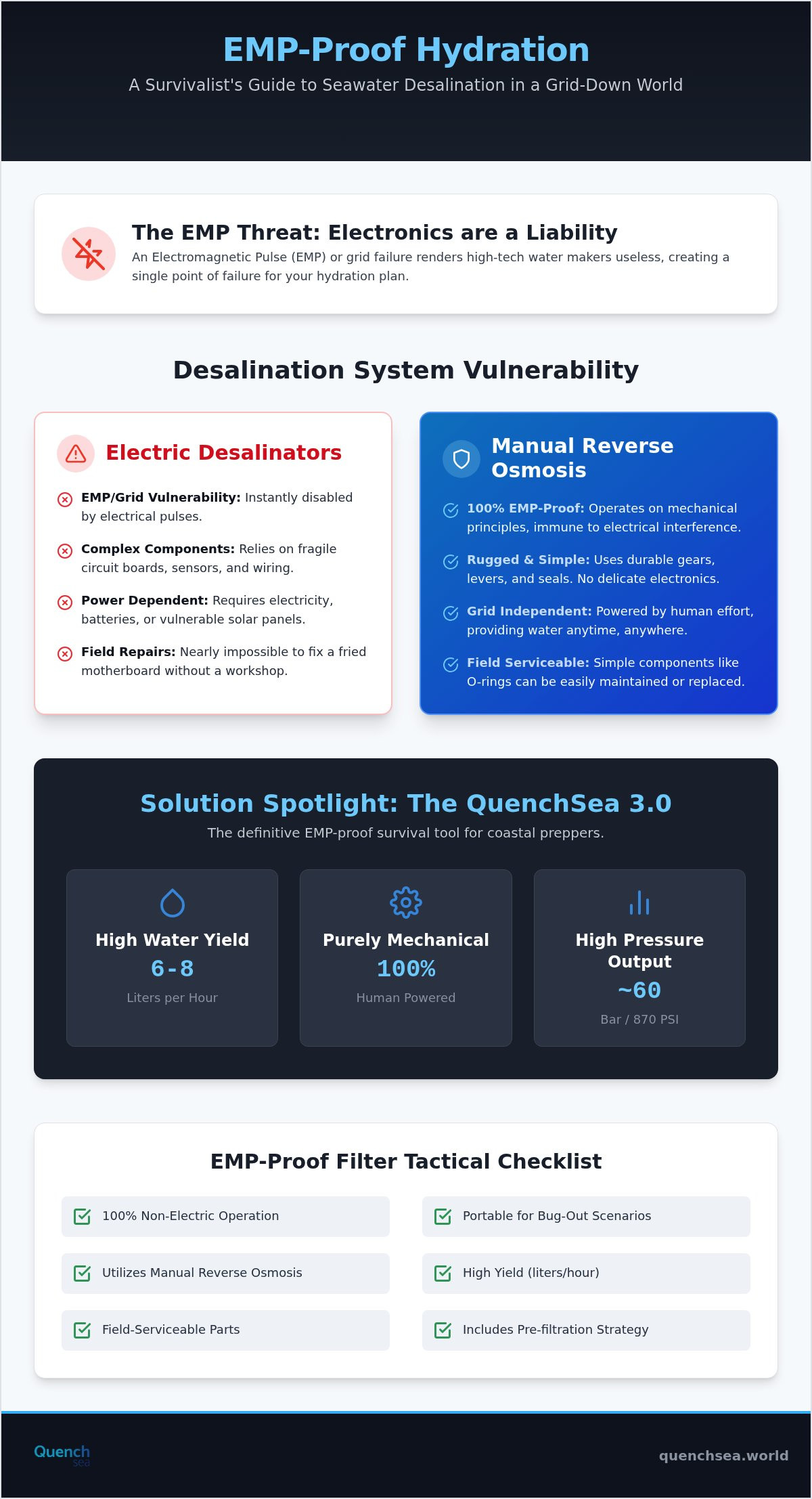
Manual Reverse Osmosis (RO) isn't just a backup; it's a structural defense against grid failure. To desalinate seawater, you must overcome osmotic pressure. This requires a force of approximately 50 to 60 bar (725 to 870 psi). While industrial systems use high-wattage electric pumps, a manual EMP proof water filter for seawater uses mechanical advantage. By utilizing a hand-lever or crank, you convert human muscle power into the hydraulic pressure needed to push saltwater through a semi-permeable membrane. This process is governed by physics, not electronics.
Mechanical systems are 100% immune to electromagnetic interference. There are no transistors to burn out and no capacitors to pop. Gears, seals, and levers remain operational regardless of atmospheric conditions or electrical pulses. This reliability makes manual RO superior to solar stills. Solar stills rely on evaporation, which is slow and weather-dependent. A manual RO device provides high-yield results immediately. You don't wait for the sun; you pump and drink.
How Mechanical Pressure Replaces Electrical Pumps
Electrical pumps are efficient until they aren't. In a "last-mile" survival scenario, repairability is everything. Manual systems use simple O-rings and mechanical valves. These are easier to maintain and troubleshoot than a fried motherboard. The engineering of a hand-lever system maximizes your effort, allowing a single person to generate the necessary pressure without exhaustion. This "instant-on" capability is vital. When you need water, you start the stroke. There is no warm-up period or charging cycle.
Membrane Integrity and TDS Removal
The heart of the system is the semi-permeable membrane. It acts as a physical barrier. It doesn't "die" when the power goes out. This membrane blocks up to 98% of salts and virtually all bacteria and viruses. Total Dissolved Solids (TDS) reduction is critical for long-term health. High TDS levels in drinking water lead to kidney stress and dehydration. By using a manual RO system, you secure an off grid coastal water solution that maintains water quality standards even in total isolation.
- Mechanical RO: 6 to 8 liters per hour, works 24/7, zero electronics.
- Solar Stills: 1 to 2 liters per day, requires clear skies, fragile glass or plastic components.
For those building a truly resilient kit, exploring portable manual desalination tools is the next logical step in hardware-focused preparedness.
The 2026 Checklist for EMP-Proof Seawater Filters
Selecting the right hardware is a technical decision with life-altering consequences. An EMP proof water filter for seawater must survive more than just a pulse; it must withstand the relentless degradation of the coastal environment. Use this checklist to audit your gear before the grid goes dark. If a device fails even one of these criteria, it's a liability, not a survival tool.
- Zero Electronics: This is non-negotiable. If a device features a digital TDS meter, an automated pressure sensor, or an integrated battery, it's vulnerable. True survival gear relies on analog gauges or pure mechanical feedback.
- Manual Output Rate: Efficiency is survival. A system that produces less than 2 liters per hour is insufficient for high-exertion scenarios. High-performance units reach 6 to 8 liters per hour, providing a significant safety margin for families or groups.
- Corrosion Resistance: Salt air is a slow-motion disaster for equipment. Demand 316-grade stainless steel and UV-stabilized polymers. If the housing is prone to rust or sun-bleaching, it'll fail when you need it most.
- Integrated Pre-filtration: Shoreline water is rarely clear. It's filled with silt, micro-plastics, and organic debris. Without a robust pre-filter to catch these particles, your expensive RO membrane will clog within minutes.
- Portability: Survival isn't static. Your filter must fit in a standard bug-out bag. If it's too heavy to carry over a mile of soft sand or rough coastal terrain, it's a burden you can't afford.
Evaluating the 'Survival ROI' of Manual Labor
Every action in a survival scenario has a metabolic cost. Net Hydration is defined as the total water yield minus the metabolic sweat loss incurred during the pumping process. If a device requires 500ml of sweat to produce 600ml of water, the ROI is dangerously low. Ergonomic handles and optimized leverage aren't comfort features; they're biological necessities. They reduce fatigue and ensure you don't burn more calories than you can afford to lose while securing your next drink.
Durability in Extreme Coastal Environments
Coastal survival involves extreme UV exposure and physical impact. Your gear needs impact-resistant housing that can survive a drop onto jagged rocks or the floor of a life raft. Don't settle for brittle plastics. Finally, prioritize field-serviceability. You should be able to clean the pre-filters or swap the membrane without a specialized toolkit. In a grid-down world, your ability to maintain your own equipment is your greatest asset.
Tactical Deployment: Producing Water in a Grid-Down World
Deploying an EMP proof water filter for seawater requires more than just muscle. It demands a tactical approach to sourcing and maintenance. Your first objective is finding clean intake water. Avoid the surf zone where breaking waves churn up sand, silt, and micro-plastics. These particles act like sandpaper on your internal seals. Seek out calmer water or use a weighted intake hose to pull from deeper, clearer layers. If you're on a beach, dig a "beach well" in the sand a few feet from the waterline. Let the sand act as a natural primary filter before the water even reaches your device.
Pre-filtration is your second line of defense. Even with a high-quality device, wrapping your intake in a fine-weave cloth or using a dedicated sediment filter extends the lifespan of the core components. Once the system is primed, establish a steady pumping cadence. Don't use short, erratic bursts. A consistent rhythm maintains optimal pressure across the membrane, maximizing the water yield per calorie burned. This steady pressure ensures you aren't fighting the mechanical resistance of the pump itself.
Extending Membrane Life in the Field
The most critical maintenance step is the emergency seawater to drinking water hack: the freshwater flush. After every use, pump a small amount of freshwater back through the system. This prevents salt crystallization, which can tear the delicate RO membrane as it dries. If you notice increased resistance or a sudden drop in output, your membrane is likely fouling. Address this immediately by cleaning the pre-filters. Never let salt water sit stagnant in the pump for more than 24 hours.
Rationing vs. Production Strategy
In a survival scenario, weight is your enemy. Storing large quantities of water is difficult and creates a target for theft or contamination. A better strategy is "on-demand" production. Desalinate what you need for the next few hours and keep your kit light. Integrate this into your daily routine. Spend 20 minutes each morning producing your baseline hydration. Always monitor the first 250ml of any session. Check for clarity and taste to ensure the seals haven't been compromised during transport. To secure your own tactical hydration kit, order the QuenchSea 3.0 today.
QuenchSea 3.0: The Definitive EMP-Proof Survival Tool
The QuenchSea 3.0 represents the pinnacle of emergency engineering. It is not just a tool; it is a lifeline. As a purely mechanical EMP proof water filter for seawater, it bypasses every vulnerability inherent in modern electronics. If a pulse disables the power grid, your survival depends on equipment that functions via physics, not software. This device converts human effort into life-sustaining freshwater with zero reliance on fuel, batteries, or solar panels. It is the ultimate survival desalination device for anyone living within reach of the coast.
Ruggedized for maritime environments, the QuenchSea 3.0 is built to endure. It optimizes the "Rule of 3" for coastal survivors by providing a reliable source of hydration when bottled supplies vanish or become contaminated. Its design focuses on simplicity and mechanical integrity. You pump. The system filters. You survive. In a world where the grid is no longer a certainty, this device provides a tactical advantage that electric systems cannot match.
Engineering Specs for Extreme Reliability
The internal architecture features high-performance RO membranes. These achieve a 98% salt rejection rate, ensuring the output remains well below the threshold for safe long-term consumption. The device is compact and lightweight, designed specifically to fit into a tactical go-bag or a life raft emergency locker. This portability is critical for those who must move quickly during a disaster. The hardware has been tested in marine safety and humanitarian relief sectors, proving its durability in the world's harshest conditions. It utilizes industrial-grade polymers and corrosion-resistant components to ensure it remains functional after years of storage in salt-air environments.
The Future of Coastal Self-Sufficiency
Relying on electric water makers is a calculated risk that fails in a grid-down scenario. Every coastal emergency kit requires a manual backup to ensure continuous hydration. The QuenchSea 3.0 provides the peace of mind that comes from a tool that just works. It eliminates the "single point of failure" inherent in complex, sensor-driven systems. You control your water supply. You aren't waiting for a rescue that may never come. True preparedness means stripping away the unnecessary and focusing on what is dependable. When the lights go out, your ability to produce freshwater remains your most valuable asset.
Secure your water independence with the QuenchSea 3.0 and ensure your survival kit is truly EMP-proof.
Secure Your Coastal Survival Strategy
True preparedness is about removing variables. When the grid fails, a complex water maker becomes a heavy liability. You need a system that relies on mechanical force. Manual reverse osmosis is the only way to ensure your hydration doesn't depend on a functioning circuit board or a clear sky. By utilizing a 100% mechanical EMP proof water filter for seawater, you eliminate the single point of failure that compromises most modern survival kits. Physics doesn't fail. Electronics do.
The QuenchSea 3.0 is engineered for this exact scenario. It's 100% manual. No batteries or grid are required. Its survival-grade rugged construction is trusted by marine professionals and NGOs worldwide. It provides a reliable, high-yield output of 6 to 8 liters per hour. This isn't just gear; it's a strategic asset for long-term resilience. Equip your survival kit with the EMP-proof QuenchSea 3.0. You can't control the grid, but you can control your access to freshwater. Take command of your hydration today.
Frequently Asked Questions
Will an EMP damage a manual desalination device?
An EMP will not damage a manual desalination device because it contains zero electronic components. Since there are no circuit boards, sensors, or batteries to fry, the mechanical advantage remains intact. This makes a manual EMP proof water filter for seawater a critical asset for grid-down scenarios where electrical pumps would fail instantly. It relies on physics, not microchips.
Can you drink seawater if you boil it first?
No, you cannot drink seawater simply by boiling it. Boiling kills biological pathogens like bacteria and viruses, but it does not remove salt. In fact, boiling seawater causes evaporation, which actually increases the salinity concentration of the remaining liquid. Drinking boiled seawater will accelerate dehydration and lead to organ failure just as quickly as raw seawater. Only reverse osmosis or distillation can remove the salt.
How much water can the QuenchSea 3.0 produce in an hour?
The QuenchSea 3.0 is capable of producing 6 to 8 liters of freshwater per hour. This output is achieved through a steady, manual pumping cadence that forces seawater through a high-performance reverse osmosis membrane. This rate provides a significant safety margin for a small group or family. It ensures that hydration needs are met without requiring excessive physical exhaustion from the operator.
Do I need to add minerals back to the water after desalination?
For immediate survival, you don't need to add minerals back to the water. The primary goal is hydration and salt removal. However, if you're relying on desalinated water for several weeks or months, you should consider remineralization. Adding a pinch of sea salt or using mineral drops helps replace essential electrolytes that are stripped away during the reverse osmosis process to maintain long-term health.
How long does a desalination membrane last if it's not used?
A desalination membrane can last for several years if it's stored in its original, vacuum-sealed packaging. Once the membrane is used and exposed to saltwater, it must be maintained with regular freshwater flushes. This prevents salt crystallization and biological growth from ruining the material. Proper storage in a cool, dry place ensures the membrane remains a reliable component of your EMP proof water filter for seawater.
Is it hard to pump a manual RO filter for a long time?
Pumping a manual RO filter requires physical exertion, but it's designed to be manageable through mechanical advantage. The QuenchSea 3.0 uses a lever-arm design to reduce the force needed to reach the 50+ bar of pressure required for desalination. Most users find that a steady, rhythmic pace allows for continuous operation. It's about maintaining a cadence rather than using raw strength.
Does a portable RO system remove bacteria and viruses too?
Yes, a portable reverse osmosis system removes virtually all bacteria, viruses, and cysts. The pores in an RO membrane are significantly smaller than the size of these pathogens. This provides a physical barrier that ensures the output water is biologically safe. Even if the intake source is contaminated with microorganisms or organic debris, the RO process strips them out along with the salt.
Can I use a survival desalinator on brackish or river water?
You can use a survival desalinator on brackish or river water, though it's specifically engineered for the high salinity of the ocean. While it will easily clean freshwater sources, you must use robust pre-filtration to protect the membrane. Mud, silt, or heavy organic loads in river water can clog the RO membrane quickly. Using it on brackish water is actually easier on the device than full-strength seawater.