

What if a raft’s purifier produces water, but you can’t verify it before anyone drinks? The coast guard life raft water purification question isn’t just how to turn seawater into freshwater. It’s how to build a dependable water plan, understand the limits of backup equipment, and test the output. Packaged reserves should anchor the plan; desalination can provide a backup when conditions allow.
This guide explains how to assess emergency water options and why commercial certification shouldn’t be confused with Coast Guard or life-raft approval. You’ll also learn how a manual reverse-osmosis desalinator works and what its output can realistically provide. QuenchSea 3.0 is hand-lever powered and produces 6-8 L/hr under suitable conditions, though colder or saltier water may reduce output. These RO membranes only work with QuenchSea version 3.0.
Test every batch with a TDS meter or supplied TDS pen. Do not assume filtered water is safe based on appearance alone - test a small amount first, and only drink when TDS reading is below 1 000 ppm. If the water tastes salty or unusual, do not drink it.
Key Takeaways
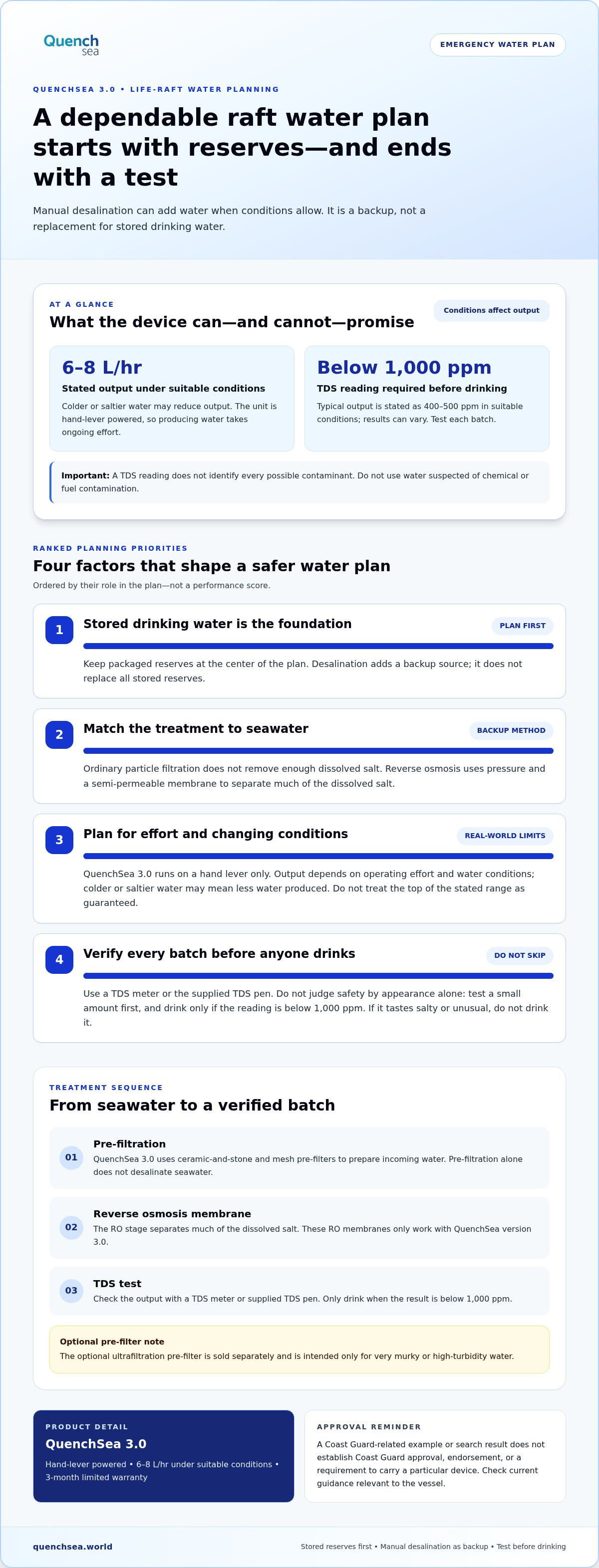
- A coast guard life raft water purification plan should treat stored drinking water as the foundation and manual desalination as a backup, not a replacement for all reserves.
- Reverse osmosis separates much of the dissolved salt from seawater; ordinary filtration alone doesn’t desalinate it.
- QuenchSea 3.0 is hand-lever powered and produces 6-8 L/hr under suitable conditions, with lower output possible in colder or saltier water. It includes a 3-month limited warranty.
- Test output with a TDS meter or supplied TDS pen, and drink only when the reading is below 1,000 ppm. Do not assume filtered water is safe based on appearance alone - test a small amount first, and only drink when TDS reading is below 1 000 ppm. If the water tastes salty or unusual, do not drink it.
- These RO membranes only work with QuenchSea version 3.0. The optional ultrafiltration pre-filter is sold separately and intended only for very murky or high-turbidity water.
What Coast Guard life-raft water purification means in an emergency
In a raft emergency, water treatment depends on the source. Seawater contains dissolved salts, so it must be desalinated before drinking. A filter that catches visible particles alone does not remove enough dissolved salt to make seawater drinkable.
The phrase coast guard life raft water purification can lead to information about very different situations. A large, energy-supported station system can process water at a scale and with infrastructure a compact raft cannot provide. Portable raft-emergency equipment must fit limited space, rely on supplies and effort available onboard, and produce water that users can test. Search-result placement or a Coast Guard-related example does not establish Coast Guard approval, endorsement, or a requirement to carry a particular device.
Why a Coast Guard station example is not a life-raft blueprint
A 2005 Office of Naval Research report describes a high-volume purification system supporting a remote Coast Guard station after storm surges contaminated its lake supply. The station’s setting, infrastructure, and need to maintain water through an Alaska winter differ sharply from a raft’s constraints. Treat the report as historical context, not current Coast Guard policy or a raft-equipment specification. It cannot establish what equipment a vessel must carry.
On a raft, space is restricted, users supply the operating effort, and every stored item competes for room. A station-scale system may depend on substantial infrastructure; a portable purifier is designed for a different task and has its own output limits. The broader field of portable water purification includes multiple approaches, but each must be matched to the water source and emergency conditions.
What a life-raft water plan should clarify
Organize the plan around three practical questions: what drinking water is stored, how it will be protected and handled, and what backup production method is available if reserves run low. Desalination adds a way to produce water, but it does not replace stored reserves, operating effort, or output testing.
There isn’t one universal equipment rule to infer from a search result or historical report. Requirements can depend on the vessel and its operating context. Use current guidance from the relevant authority for your vessel when establishing carriage requirements. For a broader look at reserve planning and supply considerations, see this life raft water supply guide.
Verification is part of purification, not an optional extra. Test desalinated output with a TDS meter or supplied TDS pen, and drink only when the reading is below 1,000 ppm. If the water tastes salty or unusual, do not drink it.
How emergency seawater purification works, and where reverse osmosis fits
Seawater needs desalination, not just ordinary filtration. A mesh or particle filter can catch debris, but dissolved salt passes through many simple filters. Reverse osmosis (RO) addresses that different problem: pressure pushes seawater against a semi-permeable membrane, which allows water to pass while separating much of its dissolved salt. The U.S. Geological Survey explains this and other desalination methods.
Removing much of the salt is a treatment step; it is not proof that the output is safe to drink. Test the water with a TDS meter or supplied TDS pen, and only drink when the reading is below 1,000 ppm. A TDS reading does not identify every possible contaminant, so do not use water suspected of chemical or fuel contamination.
Pre-filtration and reverse osmosis have different jobs
QuenchSea 3.0 uses triple pre-filtration before its industrial RO membrane. Its ceramic-and-stone and mesh pre-filters help prepare incoming water for the membrane. These stages are not a substitute for desalination: pre-filtration alone doesn’t remove enough dissolved salt to make seawater drinkable. The optional ultrafiltration pre-filter is sold separately and intended only for very murky or high-turbidity water.
Keep each part matched to its purpose. Pre-filters treat incoming water before it reaches the RO stage; the membrane performs the salt-separation step. These RO membranes only work with QuenchSea version 3.0. Test the output rather than judging safety by clarity or taste. The device is designed to stay below 1,000 ppm TDS; typical output is 400-500 ppm in suitable conditions, but results can vary. Only drink water when the TDS reading is below 1,000 ppm.
Manual operation brings output and effort limits
QuenchSea 3.0 is powered by a hand lever only. Producing water requires ongoing effort, so consider both the expected supply and the people available to operate it. Its stated output is 6-8 L/hr under suitable conditions, and may be lower with colder or saltier water. Don’t plan around the top of the range as a guaranteed rate.
That’s the practical difference between a powered station-scale plant and a portable manual unit: the raft device depends on hand operation and conditions at the water source. The coast guard life raft water purification question is therefore about more than membrane performance. It also means understanding the effort required and testing each batch. For more detail on the process and operating principles, see this manual reverse osmosis explainer.
For a raft backup plan built around manual RO, explore the QuenchSea 3.0 manual desalinator as one component of a broader water strategy.
Compare life-raft water options without relying on one source
A dependable raft water plan uses layers, not a single device or supply. Stored drinking water is available without production effort, while a manual desalinator can make additional water if conditions allow and someone operates it. Other onboard supplies may help, but their source, handling, and treatment needs still matter. Don’t assume water is drinkable because it looks clear or came from equipment onboard.
Use this comparison to identify what each option contributes. It isn’t a statement of Coast Guard carriage rules or a universal ration quantity. Requirements depend on the vessel and applicable guidance.
| Option | Availability and effort | Verification need |
|---|---|---|
| Stored drinking water | Ready to use if containers remain intact and accessible; no production effort. | Check packaging and handle it to avoid contamination. |
| Manual desalination | Can produce water from seawater, but depends on suitable conditions and ongoing manual operation. | Test each output batch with a TDS meter or supplied TDS pen; drink only below 1,000 ppm. |
| Other onboard supplies | Availability varies with what is carried and what can be safely collected. | Assess the source and any required treatment; verify before drinking. |
Stored water versus producing water at sea
Stored water offers immediate access, which matters when the crew is cold, tired, or managing other urgent tasks. Production takes time and effort. With QuenchSea 3.0, the hand lever requires ongoing user effort, and its stated output is 6-8 L/hr under suitable conditions. Colder or saltier water may reduce output, so don’t treat the rate as guaranteed or discard stored reserves simply because a desalinator is aboard.
Build the plan around reserves first, then consider production as a backup capability. Account for who can operate the device and how output will be tested. For broader planning context, the emergency drinking water at sea guide discusses how supplies fit into an overall water plan.
Questions to use when comparing a backup desalinator
Compare equipment against real use, not just a headline specification. Check the stated output and conditions that can reduce it, the dimensions against available stowage space, the effort required to operate it, and whether a TDS meter or supplied TDS pen is part of the verification plan. Match the device’s intended source and operating limits to the water and conditions you may encounter.
Keep certification claims precise. QuenchSea 3.0 is Applus certified through independent inspection, certification, and testing. That statement does not establish Coast Guard approval or certification of a life-raft system. Backup production does not remove the need to verify every output batch before drinking. Test with a TDS meter or supplied TDS pen, and drink only below 1,000 ppm.
How to operate and verify desalinated water safely
Use a clear sequence: prepare the device according to its instructions, operate the hand lever, collect the output, test it, then decide whether to drink. Test every batch. A clear appearance or expected operating rate can’t replace a TDS reading.
- Prepare the device. Follow the product instructions for setup and use. Confirm the feed water does not exceed 45 °C (113 °F).
- Operate the lever. Pump by hand as directed. Production requires ongoing user effort.
- Collect the output. Keep the collected water separate so you can test it before drinking.
- Test TDS. Use a TDS meter or supplied TDS pen to check the collected water.
- Decide whether to drink. Drink only if the reading is below 1,000 ppm. If it is 1,000 ppm or higher, don’t drink it; follow the product instructions.
Use a TDS reading as a required decision point
The device is designed to stay below 1,000 ppm TDS. Typical output is 400-500 ppm in suitable conditions, but those figures don’t guarantee the reading for every batch. Take a small sample and test it before anyone drinks. If the reading does not meet the threshold, don’t treat a clearer appearance or a second look as a reason to ignore it. Consult the product instructions for guidance.
For coast guard life raft water purification, verification is part of the procedure, not an optional final check. If several people are sharing the water, communicate which batches have been tested and their readings so nobody mistakes an untested batch for one that passed.
Stop if taste or operating conditions raise concern
Taste is a warning, not a substitute for testing: a normal taste doesn’t prove that a batch meets the TDS threshold. Colder or saltier feed water may lower output, so allow for reduced production rather than assuming the device will deliver at its stated rate in every condition. Never use feed water above 45 °C (113 °F).
Keep the decision simple. Only drink output when the TDS reading is below 1,000 ppm. A higher reading means don’t drink that batch; follow the product instructions. Don’t improvise steps for a suspected device fault, chemical contamination, or an uncertain water source. Those situations need guidance beyond a TDS reading alone.
Prepare before an emergency by reviewing the operating and testing steps for the QuenchSea 3.0 manual desalinator, and keep the TDS check in your water plan.
QuenchSea 3.0 as a hand-powered life-raft water backup
QuenchSea 3.0 is a portable manual reverse-osmosis desalinator designed for marine safety and emergency use. It produces drinking-water output from seawater, but should sit within a layered raft plan alongside stored water and a way to verify each batch. It is not a guarantee of rescue, Coast Guard approval, life-raft certification, or a complete water supply by itself.
The unit weighs 6 kg and uses a hand lever only. Its stated output is 6-8 L/hr under suitable conditions, but colder or saltier feed water may reduce production. The lever requires ongoing user effort, so consider who will operate it and how that work fits the demands of an emergency. The product has a 3-month limited warranty.
What the QuenchSea 3.0 configuration includes
The filtration sequence includes a ceramic-and-stone pre-filter and a mesh pre-filter ahead of the fitted reverse-osmosis membrane. Each stage has a different role: pre-filtration comes before the membrane, which separates much of the dissolved salt. Pre-filtration alone doesn’t make seawater suitable to drink.
These RO membranes only work with QuenchSea version 3.0. The ultrafiltration pre-filter is optional, sold separately, and intended only for very murky or high-turbidity water. It isn’t standard equipment for every source. Follow the product instructions for setup, feed-water limits, and operation rather than improvising in a raft.
Check fit, operating limits, and next steps
Before relying on any backup desalinator, assess four practical factors:
- Stowage: Confirm the unit’s 6 kg weight and physical dimensions fit your available space.
- Manual effort: Plan for hand-lever operation, which requires ongoing user input.
- Feed water: Do not use feed water above 45 °C (113 °F); colder or saltier water may lower output.
- Verification: Keep a TDS meter or supplied TDS pen available and test the output before drinking.
QuenchSea 3.0 is Applus certified through independent inspection, certification, and testing. That certification is distinct from a claim of Coast Guard approval or life-raft-system certification. For coast guard life raft water purification planning, keep the distinction clear: product test credentials don’t replace checking the requirements that apply to your vessel or verifying the water it produces.
QuenchSea 3.0 is available as a unit only for $400, a unit with two spare RO membranes and two ultrafiltration pre-filters for $500, or a unit with those spares plus a TDS pen for $540. The unit-only configuration includes a pre-installed RO membrane, ceramic-and-stone pre-filter, and mesh pre-filter. Choose a configuration based on whether you want spare filters and a TDS pen included with your device.
For a closer look at specifications and product considerations, explore the QuenchSea 3.0 buyer's guide as you build a broader water plan.
Make your water plan usable before you need it
The strongest coast guard life raft water purification plan is one the crew can follow under pressure. Before your next trip, turn the guidance into a short onboard routine: know where stored water and testing tools are kept, decide who will operate backup equipment, and review the current authority guidance that applies to your vessel. Make sure the crew knows that every output batch needs a TDS test and that water should only be drunk when the reading is below 1,000 ppm.
QuenchSea’s 1:1 donation pledge supports its goal of delivering 100 million devices by 2035. For your own setup, focus on practical readiness: understand the equipment, follow its instructions, and make water testing part of the process rather than an afterthought.
Explore the QuenchSea 3.0 manual desalination device and consider whether it fits your emergency water plan. Preparedness starts with clear decisions made before an emergency. Give your crew a water routine they can use.
Frequently Asked Questions
Does the Coast Guard require a desalination device in every life raft?
Don’t assume every life raft must carry a desalination device. Requirements can depend on the vessel and the rules that apply to its operation, so use current Coast Guard guidance or the relevant authority’s instructions for your vessel. A search result, product description, or historical example isn’t enough to establish a requirement. For coast guard life raft water purification planning, treat a portable desalinator as a potential backup, not a substitute for confirming applicable carriage requirements.
Can a portable seawater purifier remove fuel or chemical contamination?
Don’t rely on a portable seawater desalinator to make fuel- or chemically contaminated water safe. Reverse osmosis removes much of the dissolved salt, but a TDS reading does not identify every contaminant or establish chemical safety. Avoid using water you suspect is contaminated, and don’t drink it based on appearance or a passing TDS result.
How should I store a manual desalinator with life-raft equipment?
Store it according to its product instructions and the equipment plan for your vessel. Before stowing it, make sure the device and its components are accounted for, and keep the instructions and TDS meter or supplied TDS pen accessible to the crew. Choose a location where the unit can be retrieved without unpacking unrelated emergency gear. Review the arrangement during routine safety checks, especially after equipment is moved or replaced.
Can rough seas affect the use of a hand-operated water maker?
Yes. Vessel movement may make handling the device, operating its lever, and collecting output more difficult. Don’t let water production interfere with immediate safety actions or secure footing. Plan who will operate the unit and where it can be used as safely as conditions allow, then follow its instructions. If conditions make operation unsafe, prioritize crew safety and use available stored drinking water while conditions are reassessed.
Is an Applus-certified purifier the same as a Coast Guard-approved life-raft system?
No. Applus certification refers to independent inspection, certification, and testing. It doesn’t by itself establish Coast Guard approval, endorsement, or certification of a complete life-raft system. Keep those claims separate when assessing equipment. If approval or carriage status matters for your vessel, rely on current authority guidance rather than assuming one certification covers a different regulatory or system requirement.
What happens if seawater is colder or saltier than usual?
Colder or saltier feed water may lower QuenchSea 3.0’s output, so production can be slower than expected. Allow for that possibility when planning who will operate the device and how you’ll manage stored supplies. Test output with a TDS meter or supplied TDS pen, and only drink when the reading is below 1,000 ppm.
Can QuenchSea 3.0 produce drinking water without batteries or fuel?
Yes. QuenchSea 3.0 is powered by its hand lever and doesn’t need batteries, fuel, solar panels, or external electricity. The lever still requires ongoing user effort, so it isn’t an automatic water source. Test every output batch with a TDS meter or supplied TDS pen, and only drink when the reading is below 1,000 ppm. Treat it as one part of an emergency water plan, not the entire plan.