

What if the best emergency watermaker is the one your crew can carry, operate, and rely on after leaving the boat? Choosing a catamaran ditch bag water desalinator means balancing water production against limited space, crew effort, and the other gear needed to signal for rescue and stay safe. A device that looks capable on a product page may not suit your evacuation plan.
Power independence alone isn’t enough. Your crew also needs to understand how a manual desalinator works, what its stated output depends on, and how to use it under pressure. QuenchSea 3.0 is a hand-powered reverse-osmosis option that operates without electricity, batteries, or fuel. It should support a broader water plan, not replace stored supplies or safe rationing.
This guide explains how to assess specifications, packed size, operating demands, and stowage before choosing a device. You’ll also learn how to plan around stored reserves and water production, and how to inspect and practice with your backup before an emergency.
Key Takeaways
- Build your ditch-bag water plan around evacuation needs, rather than assuming onboard tanks and equipment will remain available.
- Compare stored water, manual reverse osmosis, and other emergency options by power needs, crew effort, space, maintenance, and verified output.
- Use a practical checklist to match a catamaran ditch bag water desalinator to your crew, capacity limits, and readiness plan.
- Assess QuenchSea 3.0 as a hand-powered, power-independent option, and check current product documentation for specifications and operating guidance.
- Prepare the crew to inspect and operate the device while keeping stored water and safe rationing in the plan.
Why a Catamaran Ditch Bag Needs a Deliberate Water Plan
A desalinator is a backup water-production tool, not a complete ditch-bag water plan. A catamaran ditch bag water desalinator can help the crew make freshwater from seawater, but it can’t replace an initial reserve of safe drinking water, a clear rationing plan, or the other equipment needed to survive and signal for help.
Abandoning ship changes what the crew can rely on. The catamaran’s water tanks, batteries, electric watermaker, and other fixed equipment may no longer be accessible. The ditch bag needs to hold selected essentials in a form the crew can grab quickly. Space is limited, so every item competes with communications, signaling, first aid, and other survival gear. Plan around the crew and evacuation strategy, not the assumption that the bag can hold everything.
What changes when a catamaran crew abandons ship?
Once the crew leaves the vessel, they depend on what they carried and what they can use safely. Plan for the actual people aboard: a manual device may require sustained effort and clear instructions, so consider whether inexperienced or vulnerable crew members can help operate it. Keep the plan simple enough to follow under stress. If capacity forces trade-offs, decide in advance which items take priority.
Why a seawater desalinator is only one part of the plan
Carry safe drinking water for immediate use. A desalinator takes time and effort to produce more. Its output depends on the device, operating conditions, and the person using it, so don’t treat a stated rate as a guaranteed supply in every emergency. A desalinator produces freshwater through a desalination process; it isn’t a reason to skip stored reserves or practice.
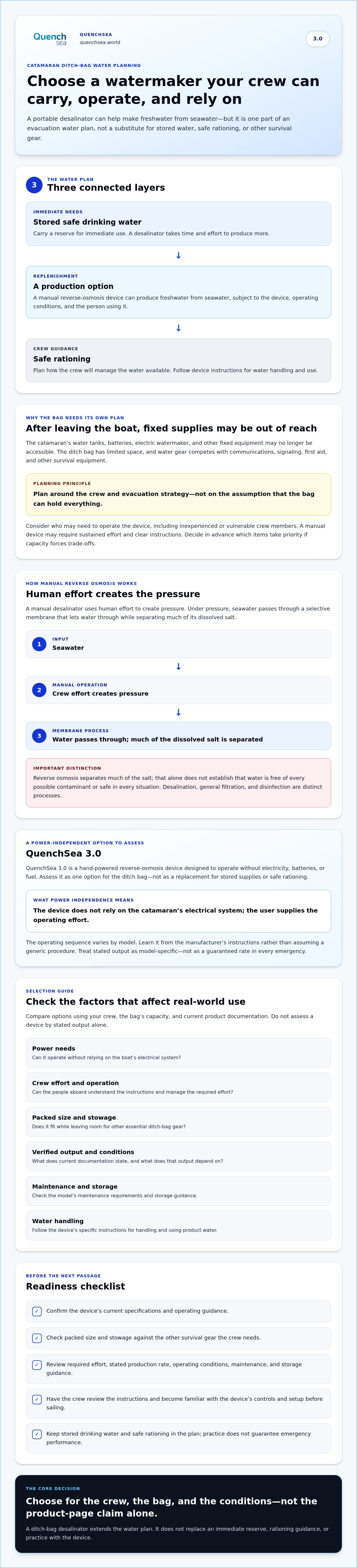
Think in three connected layers: stored water for immediate needs, a production option for replenishment, and rationing guidance to help the crew manage what’s available. Follow the device instructions for water handling, operation, and maintenance. For broader planning around emergency reserves, see this life raft water supply guide.
A ditch-bag desalinator is a portable device for producing freshwater from seawater when normal onboard supplies may be out of reach. Its role is to extend the crew’s water plan, not carry the whole burden. Before choosing one, check how it fits the bag, who can operate it, and what else the crew needs to bring.
How a Manual Catamaran Water Desalinator Makes Freshwater
A manual desalinator uses human effort to create the pressure needed for reverse osmosis. Under pressure, seawater passes through a selective membrane that lets water through while separating much of its dissolved salt. The U.S. Geological Survey explains how systems convert sea water into drinking water, including through desalination technologies used in marine settings.
Power independence matters during an evacuation because a hand-powered desalinator can operate without relying on the catamaran’s electrical system. QuenchSea 3.0 is a hand-powered reverse-osmosis device designed to operate without electricity, batteries, or fuel. That makes it one option to assess for a catamaran ditch bag water desalinator, alongside the effort required and the specifications your crew can verify.
What reverse osmosis does, and what it doesn’t establish
Reverse osmosis separates much of the salt from seawater; it doesn’t establish that water is free of every possible contaminant or safe in every situation. Desalination, general filtration, and disinfection are distinct processes, not interchangeable terms. Check the specific device’s instructions for water handling and use, and follow its guidance before drinking the product water.
What manual operation means for the crew
“Manual” means the user supplies the effort instead of drawing power from the boat. The operating sequence varies by model, so learn it from the manufacturer’s instructions rather than relying on a generic pumping procedure. Before choosing, verify the model’s required effort, production rate, operating conditions, maintenance, and storage guidance against current documentation.
Practice before sailing. Have the crew review the instructions and become familiar with the device’s controls and setup. This can reveal questions about who can operate it and whether the process is manageable for your crew, but practice can’t guarantee performance in an emergency. Treat advertised output as model-specific, not as a universal rate or a promise of what the crew will produce in all conditions.
For model-specific information, consult QuenchSea 3.0’s portable desalination buyer’s guide, then confirm operating and care details in current product documentation. Use those verified details to decide whether its power source and operating demands fit your crew’s plan.
Compare Ditch-Bag Desalinator Options Using the Right Criteria
Start with the crew’s emergency use case, not a headline output claim. Check how each option gets power, how much effort it requires, whether it fits the bag, who can use it, and what upkeep it needs. For a catamaran ditch bag water desalinator, confirm model-specific figures in current manufacturer documentation. Output claims are comparable only when their units and test conditions match.
| Option | Power and effort | Space, crew, and upkeep | Output to verify |
|---|---|---|---|
| Stored drinking water | No operating power or production effort. | Packaged reserves take bag space and have a finite supply. Check container condition and storage guidance. | Amount carried. There is no ongoing production. |
| Manual reverse osmosis, such as QuenchSea 3.0 | Uses human effort, not onboard electricity, batteries, or fuel. | Check actual packed dimensions, weight, operating demands, crew capability, and maintenance instructions. | Use the manufacturer’s stated rate and the conditions under which it applies. |
| Electric watermaker | Requires a compatible power source, such as electricity or batteries. Confirm what the specific unit needs. | Assess whether it can travel with the crew and be operated after evacuation. Verify maintenance and operating limits. | Compare the documented rate only under its stated power and operating conditions. |
| Other emergency devices | Power and user effort vary by method. | Check whether the device is designed for seawater, who can use it, and its care requirements. | Verify what water source it treats and its documented output or treatment capacity. |
Manual reverse osmosis versus electric watermakers
Neither approach is universally better. An electric system may suit routine onboard use, while a manual unit can remain operable without the vessel’s power supply. Ask a practical question: could the crew access and operate this device if the catamaran’s batteries and fixed systems were unavailable? Verify weight, output, pressure requirements, and operating limits for each model rather than assuming similar devices perform alike.
Stored water, desalinators, and other emergency options
Stored water provides an immediate reserve but runs out; production devices require time, effort, or power. Other emergency treatments may work differently from reverse osmosis and may not desalinate seawater. Read the intended-use instructions before treating them as substitutes. For wider marine-device comparisons, see the guide to manual boat water makers.
Keep the comparison grounded in your crew, bag capacity, and manufacturer instructions. No category removes the need to plan reserves and rationing. Record the source and test conditions for product figures rather than treating them as directly comparable by default.
Use This Catamaran Ditch-Bag Checklist Before You Buy
A suitable device must work for your crew and fit the bag without displacing higher-priority safety equipment. Use this checklist to compare catamaran ditch bag water desalinator options against your actual evacuation plan, not just a product description.
- Define your crew’s needs. Consider how many people may need water, who can operate the device, and whether anyone has limited strength or little experience with emergency equipment. Use those details to shape your water plan, but don’t assume one output requirement applies to every crew.
- Test the bag’s actual capacity. Check the device’s packed dimensions and weight in current manufacturer documentation. Then assess its fit alongside stored water, communications, signaling, first aid, and other essential gear. Confirm that it stays accessible and can be removed without unpacking the whole bag.
- Understand the operation. Read the manufacturer’s procedure and identify what the crew must do, what conditions the device requires, and how much effort operation involves. Check that the instructions can be stored or accessed with the equipment and that crew members can find and understand them.
- Verify specifications and care. Confirm the stated output and the conditions under which it applies. Check the documented weight, dimensions, maintenance, storage, and packaging guidance. Don’t rely on an unqualified product listing or compare output figures from different test conditions as if they were equivalent.
- Confirm readiness. Follow the manufacturer’s inspection and maintenance instructions. Make sure the crew knows where the device is stored, and review the ditch bag periodically, including after use, inspection, or any change to its contents.
Before adding a device, know whether it fits, who can operate it, what its verified output depends on, and how to keep it ready. These checks can expose practical problems before a passage, when there’s time to adjust the packing plan or choose another option.
To assess a manual desalination option against this checklist, review the QuenchSea 3.0 desalination device and confirm its current specifications and operating guidance in product documentation.
Is QuenchSea 3.0 a Fit for Your Catamaran Ditch Bag?
QuenchSea 3.0 is a portable, hand-powered reverse-osmosis device designed to convert seawater into drinking water. It operates without electricity, batteries, or fuel and is designed for marine safety and emergency preparedness. These features make it an option to assess when choosing a catamaran ditch bag water desalinator, particularly if you want a water-production device that doesn’t depend on the vessel’s electrical system.
Where the confirmed QuenchSea 3.0 features may fit
Hand-powered operation can be relevant if the crew must leave fixed equipment and onboard power behind. But power independence alone doesn’t determine whether a device suits your bag. The crew still needs to be able to operate it, and the unit must fit alongside other prioritized gear. Treat it as one possible part of the water plan, not as a replacement for stored drinking water, rationing guidance, or broader emergency preparation.
Don’t infer exact output, weight, packed dimensions, certifications, or performance in particular conditions from the device category or specifications for another product. Check current QuenchSea 3.0 documentation for those details. Follow the product’s instructions for use and water handling; desalination shouldn’t be treated as proof that water from every source is safe.
Make the final decision with a practical fit check
Before stowing the device, compare its documented dimensions and weight with the actual ditch bag and the equipment your crew needs to carry. Review the stated output and the conditions behind it. Then read the operation, inspection, storage, and maintenance instructions. Consider whether each crew member can locate the device and consult its guidance under pressure. If a critical specification or instruction is unclear, resolve that before relying on the device as emergency equipment.
A sound decision comes down to fit and readiness: does the documented device suit your crew, available bag space, and evacuation plan, and can the crew follow its instructions? Even a suitable desalinator works best as one part of a plan that includes stored water and crew familiarity. Check current product information before making your choice.
Review the QuenchSea 3.0 desalination device and verify its current specifications and operating guidance for your catamaran ditch bag.
Set Up a Water Backup Your Crew Can Use
The right catamaran ditch bag water desalinator is one that fits your evacuation plan, available bag space, and the people who may need to operate it. Compare verified specifications and operating demands, then check the device’s instructions before stowing it.
Keep the water plan layered. Carry stored drinking water for immediate use, understand how any production device works, and agree on how the crew will manage supplies. A desalinator can extend that plan, but it doesn’t replace reserves, familiarization, or broader emergency preparation.
QuenchSea 3.0 is a hand-powered reverse-osmosis device designed for marine safety and emergency preparedness. It operates without electricity, batteries, or fuel. Check its current product documentation for specifications, fit, and care guidance before deciding whether it suits your crew.
Review the QuenchSea 3.0 desalination device and take the next step toward a water backup your crew understands. Prepared decisions make a stronger plan.
Frequently Asked Questions
What is a catamaran ditch-bag water desalinator?
A catamaran ditch-bag water desalinator is a portable device intended to produce freshwater from seawater during an emergency at sea. Manual reverse-osmosis models use human effort to create pressure instead of relying on onboard electricity. Treat the device as one part of your water plan, not a replacement for carried drinking water, crew familiarization, or the vessel’s wider safety plan. Check its instructions and output conditions before packing it.
Is a manual desalinator suitable for a catamaran ditch bag?
It can be suitable if its verified dimensions, weight, operating demands, and intended use match your crew and available bag space. Manual operation avoids dependence on onboard electrical power, but it still requires effort and correct use. Check whether crew members can operate it and keep it accessible alongside other essential safety gear. The right choice depends on your evacuation plan and crew, not simply on owning a catamaran.
How much drinking water can a portable desalinator produce?
Production varies by model and operating conditions, so use current manufacturer specifications and note the conditions behind each stated rate. Don’t assume a daily figure from one product listing applies to another device or to an emergency situation. Compare verified output with your crew’s plan, but keep stored drinking water in the plan too. Follow the manufacturer’s water-handling instructions and relevant emergency guidance.
Can a hand-powered water desalinator work without electricity?
Yes. A hand-powered reverse-osmosis desalinator uses manual effort to create pressure, so it doesn’t need electricity for that process. Requirements vary by model, so check the specific device’s instructions, maintenance guidance, and stated operating limits. Power independence can help if onboard systems are unavailable, but it doesn’t remove the need to understand how to use the device or plan around realistic output.
What should I pack with a ditch-bag desalinator?
Follow the manufacturer’s packing and storage instructions, and stow the unit where the crew can reach it without displacing other essential safety equipment. Carry an appropriate initial reserve of drinking water, and make sure crew members know where the device instructions are kept. The exact kit depends on your vessel, crew, and evacuation plan. Review the whole ditch bag regularly; one device isn’t a complete emergency-water plan.
Does a seawater desalinator remove every contaminant?
No. Don’t assume desalination removes every possible contaminant or makes every water source safe. Reverse osmosis separates much of the salt from seawater, but the device’s capabilities and water-use guidance depend on the specific model. Read and follow the manufacturer’s instructions, including any stated limitations. Desalination, general filtration, and disinfection aren’t interchangeable, so base decisions on verified product guidance and appropriate emergency-water advice.
How do I choose between a manual and electric boat water maker?
Compare power source, operating effort, verified output, dimensions, maintenance, and intended use. An electric water maker needs a suitable power supply; a manual model needs someone who can operate it. Neither option suits every vessel or emergency. For a ditch bag, prioritize a device that fits your evacuation plan, remains accessible, and can be used by your crew. Verify specifications and operating guidance in current manufacturer documentation.